Learn → Skills & Development
Skills & Development: What Toddlers Learn Through Play

Toy listings are full of skill words — fine motor, sensory, problem-solving, cognitive — used so freely that they've stopped meaning much. This guide takes each one in turn: what it actually refers to, why it matters between one and five, and the kinds of play that tend to support it. The aim is to make those words useful again, not to turn your living room into a classroom.
Key takeaways
- Skills develop through ordinary repeated play, not through structured instruction — a child stacking the same tower forty times is doing the work.
- Most toys support several skills at once; the ones listed on a package are a selection, not a limit.
- Repetition is not boredom. A child returning to the same activity is consolidating something.
- Skills build on each other in sequence — grasping precedes threading, sorting precedes counting — so a poor match is often a sequencing problem, not an ability one.
- The strongest thing an adult can do is leave a concentrating child alone.
How play builds skills
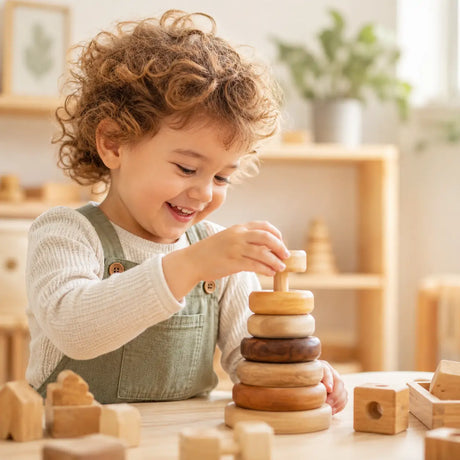
Young children learn by doing a thing repeatedly and slightly differently each time. A toddler dropping a block into a cup isn't playing a game with a win condition; they're running an experiment on grip, release, aim, and gravity, and they'll run it two hundred more times before they're satisfied.
Two things follow from that. First, repetition is the mechanism, not a sign of a boring toy. Second, the most valuable thing usually happening during good play is concentration itself — the capacity to stay with something. That capacity transfers to everything later, and it's easily broken by a well-meaning adult offering help or praise mid-task.
We'd also say plainly: no toy causes an outcome. Play supports development, the same way good food supports growth. Any brand promising more than that is overreaching.
Looking for the toys? Our Skills at Play guide maps JuniSprouts collections to each of these skill areas — physical, cognitive, and social & emotional.
The skills, one at a time
Fine motor

Control of the small muscles of the hands and fingers — grasping, pinching, releasing, threading, turning. This is the skill most directly connected to later self-care and handwriting, and it develops through pincer-grip practice more than anything else. Look for threading, posting, pegs, knobs, tongs, and lacing.
Read more: Fine Motor Skills in Toddlers.
Gross motor
Whole-body control: balance, coordination, core strength, crossing the midline. Easy to overlook indoors, but it underpins sitting still and hand control later — a child with an unsteady core has less to spare for their fingers. Balance boards, push toys, and anything requiring carrying something heavy across a room.
Read more: Stacking and Balancing: The Physics Toddlers Learn by Hand.
Problem-solving
Holding a goal in mind and trying routes to it. Visible from around eighteen months, when a child starts rotating a shape rather than pushing harder. Self-correcting toys — where the child can see whether it worked — do this best, because the feedback comes from the material rather than from you.
Read more: What Counts as a STEM Toy for a Toddler?
Sorting and classification
Recognising that objects share properties and can be grouped by them. It looks trivial and it isn't — classification underlies mathematics, reading, and most of how we organise information. Toddlers often sort spontaneously long before anyone asks them to. Colour and shape sorters, nesting sets, matching pairs.
Read more: Why Toddlers Love to Sort — And What It Teaches.
Early math
Before numerals: quantity, one-to-one correspondence, patterns, size ordering, more and less. A child who can recite "one two three" is doing something different from a child who can hand you exactly three blocks — the second is the skill that matters. Counting sets, pattern materials, graduated sizes.
Read more: Early Math Before Numbers.
Language
Vocabulary, structure, and the back-and-forth of conversation. Play supports it mostly by giving you and your child something specific to talk about together. Naming, describing, and narrating during shared play does more than any toy marketed as a language toy. Animal figures, pretend play sets, picture-rich materials.
Read more: Pretend Play and Language Development.
Sensory processing
Taking in and organising information from touch, sound, movement, and proprioception. For some children this is regulating — heavy work and textured materials help them settle. Natural materials matter here more than anywhere else, because wood, metal, and cloth each feel and sound different in a way moulded plastic doesn't.
Read more: Sensory Play: What It Is and Why It Calms Some Children.
Focus and concentration
Not a fixed trait — a capacity that grows with practice and shrinks with interruption. It's supported far more by the environment than by any toy: fewer options out, uninterrupted stretches of time, and an adult willing to say nothing while a child works. Toy rotation is the highest-leverage intervention here.
Read more: How to Help a Toddler Build Focus.
Imaginative and social play

Roles, storylines, negotiation, and taking another perspective. Appears around two and becomes elaborate by three or four. This is where children rehearse the social world — including the parts that worry them, which is why the doctor set gets a workout after a doctor's visit.
Read more: Open-Ended vs. Single-Purpose Toys.
Skill and the play that supports it

| Skill | What the play looks like | Typical toys |
|---|---|---|
| Fine motor | Pinching, threading, posting, turning | Lacing sets, pegs, busy boards |
| Gross motor | Balancing, carrying, climbing, pushing | Balance boards, push toys |
| Problem-solving | Trying, adjusting, trying again | Puzzles, shape sorters, construction |
| Sorting | Grouping by colour, shape, or size | Sorters, nesting sets, matching pairs |
| Early math | Counting out, ordering, patterning | Counting sets, graduated blocks |
| Language | Naming, describing, narrating together | Animal figures, pretend play sets |
| Sensory | Handling, listening, mouthing, feeling | Wooden materials, simple instruments |
| Focus | Returning to one thing, at length | Any well-matched toy, few options out |
| Imaginative | Roles, storylines, stand-in objects | Play kitchens, figures, open-ended blocks |
Children develop at their own pace and in their own order. If you have questions or concerns about your child's development, your pediatrician is the right person to speak with.
Supporting a skill without drilling a child
The gap between supporting development and testing it is narrow, and children detect the difference immediately. A few things that keep it on the right side:
- Don't quiz. "What colour is this?" turns play into an exam. Naming it yourself in passing — "you found another red one" — does the same work without the pressure.
- Wait before helping. The struggle is where the learning sits. Step in when frustration turns to distress, not before.
- Describe rather than praise. "You got all four in" keeps attention on the work. "Good job!" moves it onto your approval.
- Let them finish. Interrupting a concentrating child costs more than whatever you were going to say.
- Follow the interest. A child deep in sorting will get more from another sorting activity than from the counting set you'd planned to introduce.
Frequently asked questions
What are fine motor skills, exactly?
Control of the small muscles in the hands and fingers — the movements used for pinching, threading, holding a spoon, and eventually writing. They develop through repeated practice with small objects rather than through instruction.
How do I know which skills a toy actually supports?
Watch what the child's hands and attention have to do to use it. If it requires precise pinching, it's fine motor. If it requires grouping, it's classification. Most toys support several; packaging tends to list whichever sounds best.
My child plays with the same thing every day. Is that a problem?
Almost always the opposite. Repetition is how young children consolidate a skill. They'll move on when they're done, and typically that happens quite suddenly.
Do educational toys work better than ordinary ones?
"Educational" isn't a regulated term and doesn't reliably indicate anything. A set of plain blocks supports more skills than most toys marketed as educational. What matters is whether it's well matched to the child and whether they choose to keep using it.
Should I be doing structured activities with my toddler?
Not particularly. Free play with well-chosen materials covers most of this ground. Shared, unhurried, unpressured time — talking during play, letting them lead — matters more than any curriculum.
What is sensory play and does my child need it?
Play that deliberately engages touch, sound, movement, or texture. All children get something from it; some find it noticeably regulating. It doesn't require a special product — water, dry rice, and textured natural materials all qualify.
When should I start counting with my child?
Counting objects together can start whenever it comes up naturally — stairs, grapes, blocks. The useful skill is one-to-one correspondence, matching one number word to one object, which usually settles somewhere around three.
How does screen time affect these skills?
This is genuinely contested and depends heavily on content, context, and age. Rather than repeat a number, we'd point you to your pediatrician or the American Academy of Pediatrics for current guidance.
Go deeper: our Skills & Development guides
- Fine Motor Skills in Toddlers — what they are and how play helps
- Why Toddlers Love to Sort — and what sorting teaches
- Early Math Before Numbers — counting, patterns, and quantity
- Sensory Play — what it is and why it calms some children
- Stacking and Balancing — the physics toddlers learn by hand
- Pretend Play and Language Development
- How to Help a Toddler Build Focus — without forcing it
- What Counts as a STEM Toy for a Toddler?
- Open-Ended vs. Single-Purpose Toys — which grow with your child
Keep reading
- Play by Age — when each of these tends to appear
- Montessori Basics — the environment side of the picture
- Toy Safety & Materials — age ratings, small parts, and finishes
Last reviewed: July 2026