Learn → Play by Age
Play by Age: A Stage-by-Stage Guide from 6 Months to 5 Years

Children change fast in the first five years, and the kind of play that holds their attention changes with them. A toy that was ignored at fourteen months can become the favorite thing in the house at nineteen. This guide walks through what children are typically working on at each stage and what kinds of play tend to support it — so you can choose with a bit more confidence, whether you're buying for your own child or for someone else's.
Ready to shop? Browse our Shop by Age collections to see stage-matched wooden toys for each age.
Key takeaways
- Age labels on toys are set mainly by safety testing, not by developmental fit — a 3+ label usually means small parts, not that a two-year-old couldn't manage it.
- Children move through stages in a broadly similar order but on very different timelines, and a few months either side of any range is completely ordinary.
- The best-matched toy is one that's slightly harder than what a child can already do easily — challenging enough to hold attention, not so hard it gets abandoned.
- Open-ended toys stretch across more stages than single-purpose ones, which makes them better value and better gifts.
- If you're buying a gift and unsure, aiming slightly older is usually safer than aiming younger — provided the safety rating still fits.
Why age ranges on toys are a starting point, not a rule
The age range printed on a toy box is primarily a safety rating, not a developmental recommendation. In the United States, a 3+ label most often means the toy contains small parts that could pose a choking hazard to younger children. It doesn't necessarily mean a two-year-old wouldn't understand it or enjoy it.
This matters in both directions. A toy labeled 18 months+ might be well within a bright fourteen-month-old's abilities but still carry a genuine hazard for them. And a toy labeled 3+ might bore a five-year-old completely. Safety ratings should be followed. Developmental fit is a separate judgment, and it's the one you make yourself, based on the child in front of you.
Our own listings carry both: an age rating we take seriously, and a "Development Skills at Play" section describing what the toy actually supports. We'd rather you read the second one before deciding.
What children are typically working on at each stage

6 to 12 months: grasping, mouthing, and cause-and-effect
Play at this stage is almost entirely sensory and physical. Babies are learning that their hands belong to them and can be aimed, that objects continue to exist when hidden, and that their actions produce results — shake this, it makes a sound; drop this, it falls every single time.
What tends to work: chunky graspable objects, simple rattles, soft rolling shapes, high-contrast patterns, and anything that responds predictably to being handled. Everything at this age goes in the mouth, so material quality and finish matter more than complexity.
What doesn't yet: anything requiring stacking, sorting, or a sequence of steps. Save those.
Music & Sensory Toys · Wooden Toys
Read the full guide: Toys for 6–12 Months: Grasping, Mouthing, and Cause-and-Effect
12 to 18 months: standing, carrying, putting in and taking out
Once children are upright and mobile, play becomes about transport and containment. Filling a basket and emptying it. Carrying something across the room for no obvious reason. Putting an object into a hole and getting it back out — the beginning of what will become sorting.
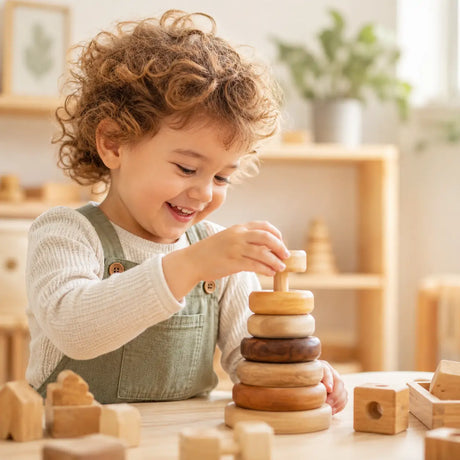
What tends to work: simple posting and dropping toys, large stacking rings, push-along objects, chunky wooden shapes, and containers of any kind. First pretend play sometimes appears here too — holding a toy phone to an ear, brushing a doll's hair.
What's often frustrating: fine detail work, small pegs, anything needing a precise grip. The intent is there before the hands are.
Montessori Toys for 1 Year Olds · Stacking Toys
Read the full guide: Best Toys for 1 Year Olds: A Developmental Guide
18 to 24 months: sorting, matching, and early problem-solving
This is often when a child first sits with something and works at it. Shape sorters start to click. Simple two- and three-piece puzzles become satisfying rather than infuriating. Children begin to notice that objects belong to categories — these are the round ones, these are the red ones.
What tends to work: shape sorters, chunky knob puzzles, simple color and shape sorting sets, nesting cups, and first building blocks. Language is expanding quickly, so toys that give you something to name together earn their keep twice over.
Montessori Toys for 1 Year Olds · Sorting Toys · Fine Motor Toys
Read the full guide: When Is a Toddler Ready for Puzzles?
2 to 3 years: imitation, sequence, and the beginning of pretend
Two-year-olds want to do what they see adults doing. Play becomes imitative and increasingly narrative — cooking a meal, feeding a toy animal, loading a truck and driving it somewhere specific. Sequences of two or three steps become manageable and interesting.
What tends to work: play kitchens and pretend food, doctor and tool sets, animal figures, vehicles, threading and lacing, and building blocks with more pieces than before. Fine motor control has improved enough that smaller manipulation becomes rewarding rather than defeating.
Montessori Toys for 2 Year Olds · Pretend Play · Play Kitchen & Pretend Food
Read the full guide: Best Toys for 2 Year Olds: What They're Working On
3 to 4 years: elaborate pretend, early counting, and building
Pretend play becomes genuinely inventive around three — extended storylines, assigned roles, objects standing in for other objects. At the same time, early mathematical thinking appears: counting objects with one-to-one correspondence, recognizing quantity, noticing and extending patterns.
What tends to work: open-ended building sets, counting and pattern materials, more complex puzzles, magnetic tiles and construction toys, and pretend play sets with more parts and possibilities. Letters and numbers start to hold real interest for many children here.
Montessori Toys for 3 Year Olds · Counting & Math Toys · Letters & Numbers
Read the full guide: Best Toys for 3 Year Olds: Pretend Play Takes Over
4 to 5 years: rules, strategy, and sustained projects
Four- and five-year-olds can hold a goal in mind and work toward it across a longer stretch of time. Simple rule-based games become playable — and losing becomes survivable, most days. Building projects get planned rather than improvised.
What tends to work: memory and matching games, more demanding puzzles, STEM-style construction and simple engineering sets, and balance and coordination challenges. This is also the age where a child will happily return to the same project across several days if you leave it out.
Montessori Toys for 4 Year Olds · STEM-Inspired Toys · Puzzles & Memory Games
Read the full guide: Best Toys for 4 Year Olds: Early Logic and Building
Typical play behaviors by stage

Children vary enormously, and the ranges below overlap on purpose. Treat this as a rough map, not a checklist.
| Stage | Often working on | Play that tends to suit |
|---|---|---|
| 6–12 months | Grasping, mouthing, cause-and-effect, object permanence | Rattles, rolling shapes, simple sensory objects |
| 12–18 months | Walking, carrying, filling and emptying | Posting toys, stacking rings, push-alongs, containers |
| 18–24 months | Sorting, matching, first problem-solving | Shape sorters, knob puzzles, nesting cups, first blocks |
| 2–3 years | Imitation, two- and three-step sequences, early pretend | Play kitchens, animal figures, vehicles, threading |
| 3–4 years | Narrative pretend, counting, patterns, construction | Open-ended blocks, counting sets, complex puzzles |
| 4–5 years | Rules, strategy, planning, sustained projects | Memory games, STEM sets, balance challenges |
Every child develops at their own pace, and differences of several months in either direction are entirely typical. If you have questions or concerns about your child's development, your pediatrician is the right person to speak with.
How to tell if a toy is too easy or too hard
The clearest signal is what happens in the first ten minutes. A toy that's well matched produces a particular kind of quiet concentration — some fumbling, some repetition, and visible satisfaction when it works.
Signs it's too easy: the child completes it correctly on the first try and doesn't come back to it. They use the pieces for something else entirely, which is fine but tells you the intended activity isn't the draw.
Signs it's too hard: repeated failure with rising frustration, pushing it away within a minute or two, or handing it to you to do. Occasional frustration is part of learning. Consistent frustration means put it away and try again in two months — this is almost always the right call, and it works surprisingly often.
A useful principle borrowed from Montessori practice: the ideal challenge is just beyond what a child can already do comfortably. Not far beyond. Just.
Buying a gift? Aim for the stage they're about to enter

If you're buying for a child you don't see every day, you're likely working from an outdated mental picture of what they can do. Children change fast, and gifts often arrive at a birthday — the exact moment they've just moved into a new stage.
Practical guidance for gift buyers:
- Aim slightly older, within the safety rating. A toy a child grows into gets played with for a year. A toy they've outgrown gets played with for a week. But never go under the stated age rating to do it — that rating exists for hazard reasons.
- Prefer open-ended over single-purpose. Blocks, figures, and building sets span several stages. A puzzle with one solution spans a few months.
- Ask what they already have, not what they want. Parents are usually happier to receive a category they're missing than a duplicate of a favorite.
- For a first birthday, aim at 12–18 months, not 12. The gap between a one-year-old on the day and three months later is significant.
First Birthday Gifts · Gifts Under $25
Read the full guides: First Birthday Gift Guide · Buying Ahead: Choosing a Gift for the Stage That's Coming
Frequently asked questions
Is it bad to give a child a toy meant for an older age group?
It depends entirely on why the toy is rated that way. If the rating reflects a choking hazard, small magnets, or long cords, then yes — that rating should be followed regardless of how capable the child is. If the rating reflects complexity alone, a capable younger child may manage it happily. When in doubt, check the product's stated hazard information rather than the number alone.
My toddler ignores most of their toys. What's going on?
Usually one of three things: too many toys available at once, a poor stage match, or simple familiarity. The first is the most common and the easiest to fix. Putting most toys away and rotating a small selection every couple of weeks tends to produce longer, more focused play almost immediately. For more, read Why Your Toddler Ignores the New Toy.
How many toys does a toddler actually need?
Fewer than most homes have. There's no correct number, but children generally play more deeply when fewer options are visible. A small, well-chosen, rotating selection tends to outperform a full shelf.
Should I buy toys that match my child's age or their ability?
Ability, within the safety rating. The age label sets the floor for safety; your judgment sets the fit.
When can a toddler start doing puzzles?
Many children manage chunky knob puzzles with two or three pieces somewhere between 18 and 24 months, and interlocking puzzles closer to three. Both ends of that range vary widely.
Do wooden toys suit every age?
They span most of this range well, but the specific toy matters more than the material. A wooden toy with small removable parts is not appropriate for a child who still mouths everything, regardless of how beautifully it's made.
Is it worth buying toys a child will grow into?
Often yes, if the toy is open-ended and the safety rating fits at the time of gifting. Store it and introduce it when the moment arrives — a toy offered at the right stage gets a much better reception than one that sat around being ignored first.
My child is behind the ranges on this page. Should I worry?
These ranges are broad generalizations and normal variation is wide. A page written by a toy shop is not the place to answer this question. Your pediatrician can assess your child properly and is the right person to ask.
Keep reading
- Skills & Development — what fine motor, sorting, and sensory play actually mean
- Montessori Basics — the approach behind much of the guidance above
- Toy Safety & Materials — how age ratings, small parts, and finishes work
Last reviewed: July 2026