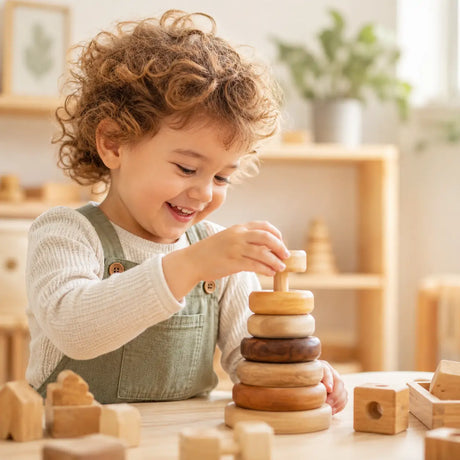
Understanding Montessori toys
What are Montessori toys?
What are Montessori toys?
Montessori toys are simple, purposeful playthings designed to let a child explore at their own pace. They're usually made from natural materials, focus on one clear skill at a time, and don't do the playing for the child — no batteries, no flashing lights. The idea is that the child leads and the toy quietly follows.
What makes a Montessori toy different from a regular toy?
What makes a Montessori toy different from a regular toy?
Mostly it's about who's doing the work. A toy that sings and lights up when a button is pressed keeps a child entertained. A Montessori toy asks the child to figure something out — how the pieces fit, how high the tower goes before it topples. The play is slower, and it tends to hold attention longer.
Why are most Montessori toys made of wood?
Why are most Montessori toys made of wood?
Wood gives a child something honest to hold. It has weight, texture, temperature, and grain — real sensory information that plastic tends to flatten out. It's also durable enough to pass between siblings, and it ages gracefully rather than looking worn. There's no rule against other natural materials; wood simply does the most jobs well. You can browse everything in our wooden toys collection.
Why are Montessori toys usually not brightly colored?
Why are Montessori toys usually not brightly colored?
Softer, more natural colors keep the focus on what the child is doing rather than on the toy itself. When everything competes for attention, nothing holds it. That said, color isn't off-limits — our rainbow toys use color deliberately, as something to sort, order, and name. The aim is intention, not restraint for its own sake.
What does open-ended play actually mean?
What does open-ended play actually mean?
It means the toy doesn't have a single right answer. A set of wooden arches can be a bridge on Monday, a tunnel on Tuesday, and a row of hills by Friday. Open-ended toys tend to last longer in a child's affection, because the child keeps inventing new reasons to pick them up.
What is a self-correcting toy?
What is a self-correcting toy?
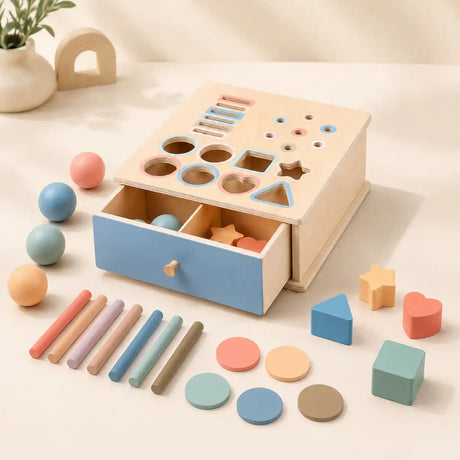
A self-correcting toy lets a child notice their own mistake without an adult stepping in. A shape sorter is the classic example — the triangle simply won't drop through the circle. That small, private moment of realising it isn't the right piece builds problem-solving and confidence more gently than being told the answer. Most of our sorting toys work this way.
Choosing toys for your child
Are Montessori toys worth the price?
Are Montessori toys worth the price?
It depends on how the toy gets used. A well-made wooden toy usually costs more upfront than a plastic equivalent, but it tends to survive several children and stay interesting for years rather than weeks. We'd rather you buy one thoughtful toy than five that end up in a bin — which is also why we don't run a subscription.
How many toys should my child have out at once?
How many toys should my child have out at once?
Fewer than you'd think. Many families find that six to eight toys available at a time, with the rest stored away and rotated every couple of weeks, leads to deeper and calmer play. A toy that's been out of sight for a fortnight often comes back as good as new.
What's the difference between Montessori and Waldorf toys?
What's the difference between Montessori and Waldorf toys?
Montessori toys lean toward real-world skills and self-correcting tasks — sorting, threading, matching, practical life. Waldorf toys lean toward imagination and open form, often deliberately unfinished so the child supplies the story. A Waldorf rainbow stacker is a rainbow, a tunnel, or a boat depending on the day. We carry both, because most children want both. Here's the fuller comparison if you'd like the detail.
Do I need to follow the Montessori method to use these toys?
Do I need to follow the Montessori method to use these toys?
Not at all. These are simply well-designed toys that happen to follow Montessori principles. Plenty of our customers have never read a word about the method — they wanted something beautiful and screen-free that their child would actually play with. Use them however suits your family.
Choosing the right toy (parents' most-asked)
What are the best Montessori toys for a 1-year-old?
What are the best Montessori toys for a 1-year-old?
At this age, simple, hands-on, open-ended toys win — things a new toddler can grip, drop, and stack at their own pace. A single well-made stacker or sorter holds attention far longer than a bin of flashing plastic. Our Wooden 3-in-1 Geometric Stacker combines stacking, shape-matching, and color play, and makes a lovely first Montessori toy.
Is there a no-subscription alternative to toy boxes like Lovevery?
Is there a no-subscription alternative to toy boxes like Lovevery?
Yes. If you'd rather choose one thoughtful piece at a time than commit to a monthly box — and keep only what your child actually plays with — buying individually gives you the same quality without the subscription or the clutter. Our Wooden 4-in-1 Learning Bundle is a multi-skill starter that spans several stages.
How can I do Montessori at home without spending a fortune?
How can I do Montessori at home without spending a fortune?
The heart of Montessori isn't a shopping list — it's real, purposeful activities your child can work at independently. Start with one or two well-chosen pieces and grow your shelf slowly as their interests change. A small sorting set like our Wooden Montessori Rainbow Bead Sorting Set is an affordable place to begin.
Which toys help develop fine motor skills and the pincer grasp?
Which toys help develop fine motor skills and the pincer grasp?
Fine motor strength grows through pinching, threading, and precise placing — the small movements behind holding a crayon later on. Threading and lacing toys give exactly that practice. Our Wooden Food Lacing Set is designed to support hand strength and coordination.
My toddler has too many toys — which few are worth keeping?
My toddler has too many toys — which few are worth keeping?
Fewer, better toys often lead to calmer, deeper play. The keepers are open-ended pieces a child returns to and uses in new ways as they grow. A set like our Wooden Gem Building Blocks Set earns its place — build it, rebuild it, endlessly.
How do I ask family not to buy loud plastic toys — what should they gift instead?
How do I ask family not to buy loud plastic toys — what should they gift instead?
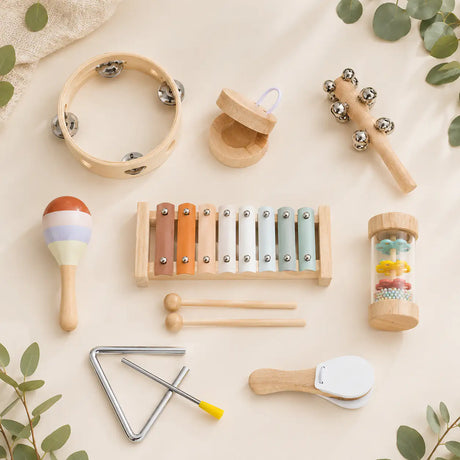
The kindest, most effective approach is to make the good option easy: share a short wishlist before birthdays with one or two toys you'd love. A beautiful, child-powered wooden toy — like our Wooden Musical Instrument Set — makes a gift that looks special and lasts, with no batteries required.
Is pretend play okay in Montessori, and which pretend toys are good?
Is pretend play okay in Montessori, and which pretend toys are good?
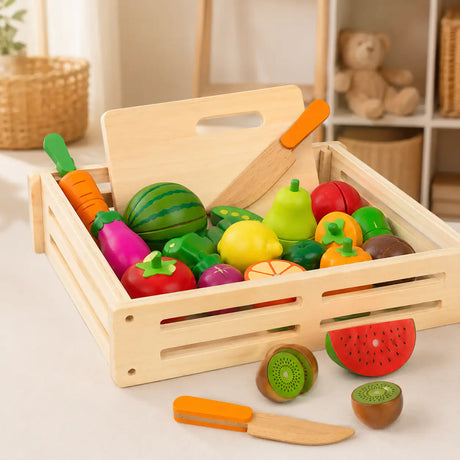
Absolutely. Montessori simply favors grounded, real-life pretend play — slicing fruit, pouring tea, caring for a doll — which supports language and social skills. Practical kitchen-and-food themes are an instant hit. Our Wooden Cutting Fruits & Vegetables Play Set is a long-time favorite.
Is there a wooden alternative to popular play-food sets like the ice cream cart?
Is there a wooden alternative to popular play-food sets like the ice cream cart?
If your toddler loves play food and ‘shopkeeper’ games, a wooden version brings the same endless role-play and holds up beautifully to real use. Our Wooden Ice Cream Cart Pull-Along Toy even doubles as a pull-along for a little gross-motor fun.
Which toys keep a toddler happily busy without screens?
Which toys keep a toddler happily busy without screens?
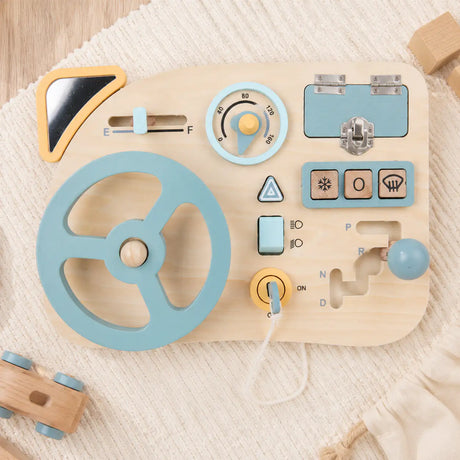
No single toy is a magic fix, but an inviting, open-ended activity within reach helps a child settle into focused, screen-free play. Busy boards give small hands latches, gears, and problems to solve. Our Wooden Montessori Busy Board is made for exactly that — keep it on a low shelf so your child can choose it themselves.
What's a good first-birthday gift for a 1-year-old?
What's a good first-birthday gift for a 1-year-old?
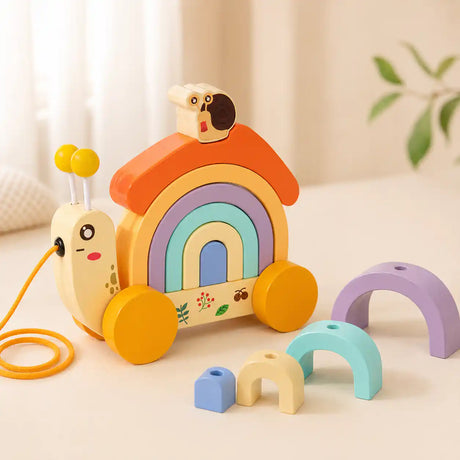
The best first-birthday gifts grow with the child — something to push and pull now, and stack and sort later. Our Wooden Snail Pull-Along Rainbow Stacker is a pull-along and stacker in one, and arrives looking gift-ready.
What's a good toy for a baby just learning to walk?
What's a good toy for a baby just learning to walk?
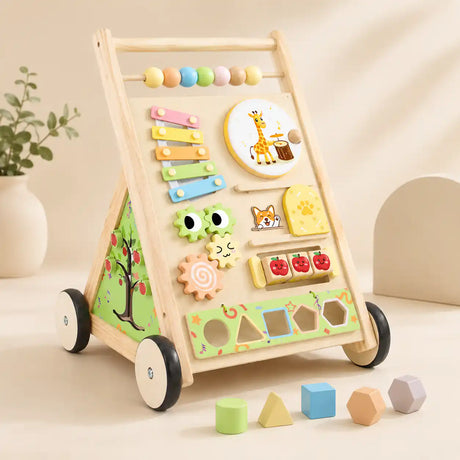
New walkers gain confidence with a sturdy push toy they can lean on and steer. Our Wooden 10-in-1 Activity Walker is stable enough for first steps, with built-in activities so it stays useful once walking is mastered.
What's a good shape sorter, and when is my child ready for one?
What's a good shape sorter, and when is my child ready for one?
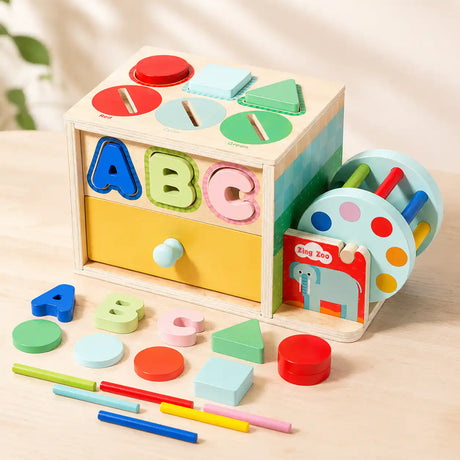
Most toddlers enjoy shape sorters around 12–18 months, once they can grasp and aim a block — and the trial-and-error is the point. Our Wooden Shape Sorter Box supports shape recognition, problem-solving, and hand-eye coordination.
How do I help my toddler learn colors and sorting?
How do I help my toddler learn colors and sorting?
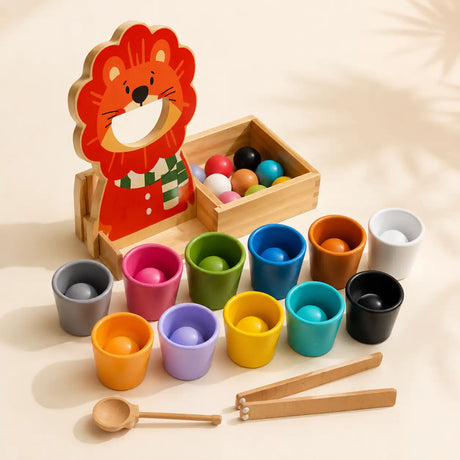
Sorting by color is one of the first ways toddlers organize the world, and it's most fun hands-on. A sorting toy lets a child match and self-correct at their own pace. Try our Wooden Lion Color Sorter, and name the colors together as you play.
How do I introduce counting and numbers?
How do I introduce counting and numbers?
Early number sense grows by touching and moving real objects. A number-stacking toy connects a numeral to its quantity, long before formal math. Our Wooden Stacking Number Blocks make counting playful.
Which toys help my toddler start learning the alphabet?
Which toys help my toddler start learning the alphabet?
Letters land best when they're something to hold. Our Wooden Magnetic Alphabet Fishing Game turns letter recognition into a game of catch — a lovely place to start is the letters in your child's name.
Are rainbow stackers really worth it?
Are rainbow stackers really worth it?
They're a favorite because there's no single right way to use them — arches, tunnels, fences, towers — so they grow with a child for years rather than weeks. Our 12 Piece Wooden Rainbow Stacker is an heirloom-quality, open-ended piece.
Which open-ended toys grow with my child?
Which open-ended toys grow with my child?
The longest-lasting toys have no fixed outcome — loose parts a toddler balances now and builds elaborate scenes with later. Our Wooden Rainbow Semicircles invite stacking, balancing, and imaginative building at every age.
Which toys help with focus and attention span?
Which toys help with focus and attention span?
Single-purpose activities with a clear goal help a child settle in without the distraction of lights and sounds. A memory game invites quiet concentration and a satisfying finish. Our Wooden Carrot Memory Game is a gentle place to begin.
What are good quiet or travel toys for a toddler?
What are good quiet or travel toys for a toddler?
For planes and waiting rooms, the ideal toy is compact, screen-free, and absorbing. Our Montessori Busy Book Set folds up small and packs buttons, matching, and fine motor tasks into one tidy set.
Which toys build hand-eye coordination and problem-solving for a 2–3 year old?
Which toys build hand-eye coordination and problem-solving for a 2–3 year old?
Around two, toddlers love toys that reward a bit of effort — hammering, posting, and cause-and-effect. Our Wooden Hammer & Peg Pounding Bench channels big energy into precise, coordinated movements.
Ordering from JuniSprouts
What age range are JuniSprouts toys best for?
What age range are JuniSprouts toys best for?
Most of our toys are made for children between 1 and 5 years old, though several grow well beyond that. Every product card shows a recommended minimum age, and each product page breaks down what a child is likely to do with the toy at each stage. When in doubt, size up — open-ended toys tend to be grown into rather than out of. You can shop directly by age: 1 year olds, 2 year olds, 3 year olds, or 4 year olds and up.
Are JuniSprouts toys safe for toddlers?
Are JuniSprouts toys safe for toddlers?
We choose toys with early childhood in mind — smooth finishes, sturdy construction, and age-appropriate design. Each listing states its recommended minimum age, and where a set includes smaller pieces we say so clearly. Please review the age guidance and details on each product page. Adult supervision is always recommended during play.
How long does shipping take?
How long does shipping take?
Most orders are processed within 1 business day. Once your order ships you'll receive a tracking number so you can follow it along. Delivery times vary by carrier and location, and can run longer around holidays or during weather delays. Full details are in our shipping policy.
What if I'm not happy with my order?
What if I'm not happy with my order?
Please write to us at support@junisprouts.com and we'll make it right. Whether something arrived damaged, wasn't what you expected, or simply isn't the right fit for your child, we'd rather hear from you than have you keep a toy you don't love. See our refund and returns policy for the specifics.
Still have a question?
While you're here
View all-
 1 year29% off
 -
1 year31% off
-
1 year31% off
-
1 year30% off
-
1-2 year31% off
-
1-2 year30% off
-
1 year30% off
-
1 year30% off
-
2-3 year31% off
-
1 year30% off
-
1 year30% off
-
1-2 year31% off