When a toddler holds a block to their ear and says "hello?", something remarkable is happening. Pretend play — using one thing to stand for another, and acting out little scenes — is one of the biggest engines of language development in the early years. This guide is part of our Skills & Development hub on what children learn through play.
Here's how pretend play and talking grow up together, and the simple props that fuel both.

Key takeaways
- Pretend play and language develop hand in hand — acting out scenes gives children a reason to use and stretch words.
- Using one object to represent another (a block as a phone) is symbolic thinking, the same ability that underlies language itself.
- Pretend play builds vocabulary, storytelling, turn-taking, and empathy.
- Realistic, open-ended props — play food, dolls, animals — invite the richest talk.
- Joining in and narrating, then stepping back, does more than any flashcard.
How does pretend play build language?
Pretend play gives children a reason to talk. To run a pretend café, a child has to name things, give instructions, take an order, and narrate what's happening — all of which pulls new words into use and stitches them into sentences. Because the play is theirs, the language is motivated and meaningful, which is exactly the condition under which vocabulary grows fastest.
A Wooden Toddler Tool Box gives that instinct somewhere to go: as a child "fixes" and "builds," they narrate what they're doing, picking up the names of tools and actions along the way.

There's a deeper link, too. Letting a wooden block "be" a phone is symbolic thinking — understanding that one thing can stand for another. That's the very same mental leap that lets a sound ("dog") stand for a real animal. Children who are busy with rich pretend play are exercising the foundation that language is built on.
Realistic props give the play somewhere to go. A wooden play food set turns snack time into a whole conversation of serving, choosing, and describing.

 Wooden Birthday Cake Pretend Play Set
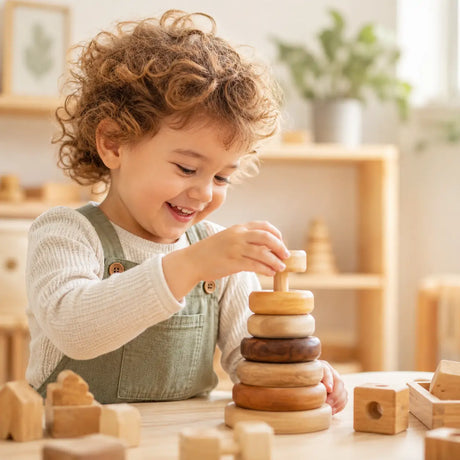
 Wooden Animal Puzzle Stacker
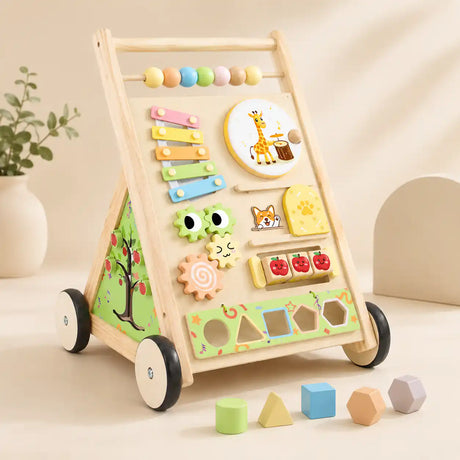
 Montessori Busy Book Set
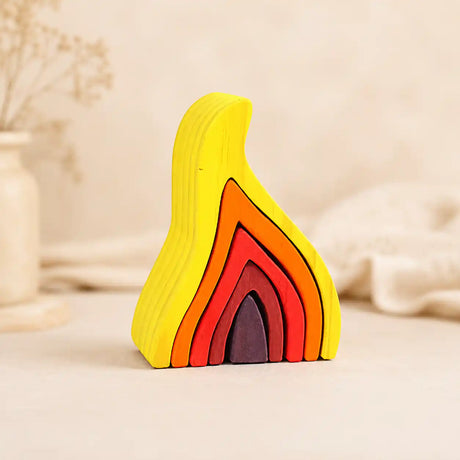
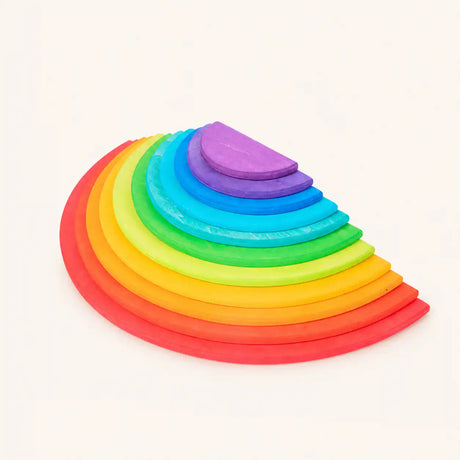
 Wooden Rainbow Arch Stacker
 Wooden Rainbow Car & Peg Doll Set
How does pretend play change as children grow?
| Age | What pretend play looks like | Language it builds |
|---|---|---|
| Around 2 | Feeds a doll, stirs an empty pot | First naming, simple actions |
| Around 3 | Acts out familiar scenes, assigns roles | Sentences, sequencing, describing |
| Around 4 | Invents detailed stories with others | Negotiation, narrative, perspective |

Which toys support pretend play and talk?
The best pretend-play props are realistic enough to suggest a story and open-ended enough to become anything. Small-world figures are a favourite: wooden rainbow peg doll friends become a family, a class, or a set of customers, giving children characters to speak for. Play-kitchen sets invite the everyday scripts children hear at home — cooking, serving, tidying. Explore our play kitchen & pretend food range for more.

 Wooden Feed the Bear Set
 Wooden Food Lacing Set
 Wooden Cutting Fruits & Vegetables Play Set
 Wooden Montessori Harvest Cart
How can I encourage pretend play at home?
You don't need much. Offer a few realistic props, then follow your child's lead rather than directing the story. Narrate your own real tasks out loud ("I'm chopping carrots for soup") to hand your child new material, and join their game briefly before stepping back. Ask open questions — "what happens next?" — instead of quizzing. Keeping a small, rotated set of props on a low shelf helps, too. This child-led approach sits at the heart of Montessori at home, and it flourishes around age three, as our guide to the best toys for 3 year olds describes. For help settling a child into deeper play, see helping a toddler build focus.

Frequently asked questions
-
How does pretend play help language development?
Pretend play gives children a reason to use and stretch words — naming things, giving instructions, and narrating scenes. Because the play is theirs, the language is motivated and meaningful, which is when vocabulary grows fastest. -
What is symbolic play?
Symbolic play is using one object to stand for another, like a block for a phone. It reflects the same mental leap that underlies language, where a sound stands for a real thing, so it's closely tied to talking. -
At what age does pretend play start?
The first pretend play usually appears around age two — feeding a doll or stirring an empty pot — and grows into detailed, story-rich play around ages three and four. Every child develops at their own pace. -
What toys are best for pretend play?
Realistic, open-ended props: play food and kitchen sets, dolls and small-world figures, and simple animals. They suggest a story while leaving room for the child's imagination to lead. -
How can I support my toddler's talking through play?
Follow their pretend play rather than directing it, narrate your own tasks out loud, ask open questions like "what happens next?", and join in briefly before stepping back. Meaningful conversation beats drilling words. -
Does pretend play build social skills?
Yes. Shared pretend play teaches turn-taking, negotiating roles, and seeing another point of view, all of which support empathy and cooperation as children grow.
A note on development: the skills and milestones described here are typical patterns, not targets. Children develop at their own pace, and this guide is not a substitute for medical advice. If you have any concerns about your child's development, please speak with your pediatrician.
Last reviewed: July 2026.
Sources & further reading
- ZERO TO THREE — Stages of Play from 24–36 Months: The World of Imagination
- American Academy of Pediatrics — The Power of Play (Yogman et al., 2018)
- Head Start (U.S. Administration for Children & Families) — It's Make-believable