Stack two blocks and watch them topple, and a toddler is running a tiny physics experiment. Stacking and balancing toys are among the oldest and simplest play materials there are, and they quietly teach some of the deepest lessons — about gravity, weight, and cause and effect. This Toy Spotlight is part of our Skills & Development hub on what children learn through play.
Here's what a toddler is actually learning when they stack and balance, and how the play grows with them.

Key takeaways
- Stacking and balancing teach real-world physics — gravity, weight, and stability — through hands-on trial and error.
- They build fine motor control, spatial reasoning, patience, and the confidence that comes from trying again.
- Knocking a tower down is part of the learning, not a failure — repetition is how the lesson sticks.
- The play scales from simple stacking at one to genuine balance challenges at three and four.
- Open-ended stacking toys get used in more ways, and for more years, than single-task ones.
What do toddlers learn by stacking?
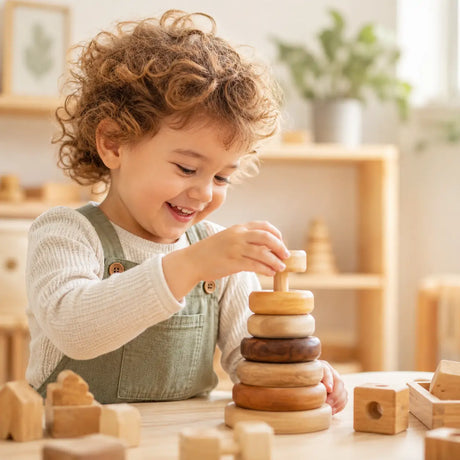
Stacking looks simple, but it's packed with learning. To build a tower, a child has to place each piece with control, judge where it should sit, and let go at the right moment — a real workout for hand-eye coordination and fine motor control. They're also absorbing early physics: that a wide base is steadier than a narrow one, that a heavy piece on top topples the lot, that lining edges up helps. Nobody teaches this; the blocks teach it, over and over.
A Wooden Ocean Wave Stacker is a good example: the curved pieces only balance when a child judges the shape and where the weight sits, turning trial and error into steady, hands-on learning.

And then there's the delicious crash. Knocking the tower down isn't a child undoing their work — it's cause and effect in action, and the reset that lets them do the whole satisfying process again. Repetition is exactly how the lesson lands.
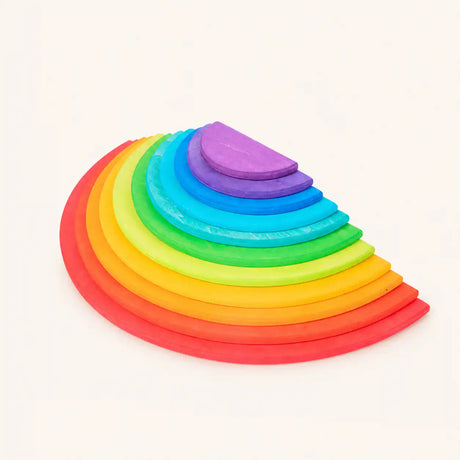
Open-ended stacking sets give the most room to explore. Wooden rainbow semicircles can be stacked, nested, lined up, and built into arches and scenes — a different challenge every time.

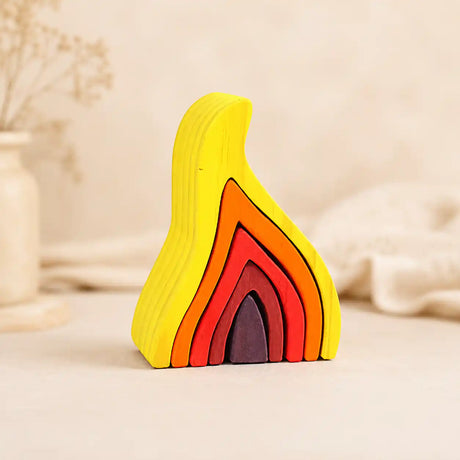
 Wooden Flame Stacking Puzzle
 Wooden Snail Pull-Along Rainbow Stacker
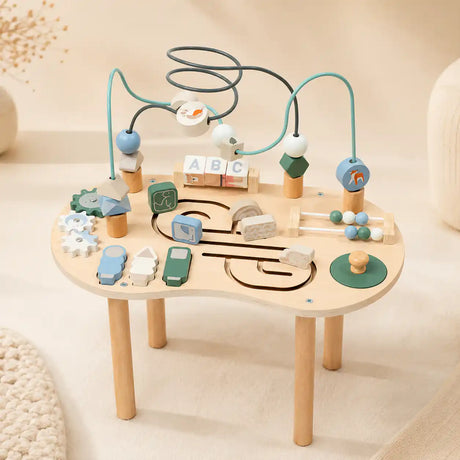
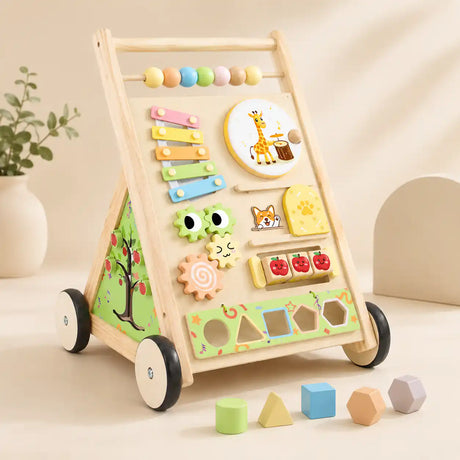
 Wooden Activity Table
 Wooden Rainbow Stacking Discs Set
 Wooden Animal Puzzle Stacker
How does stacking play change with age?
| Age | What it looks like | What it builds |
|---|---|---|
| Around 1 | Places one piece, knocks it down | Grasp and release, cause and effect |
| Around 2 | Builds a small tower, nests cups | Control, size and order |
| Around 3 | Balances trickier shapes, plans a build | Spatial reasoning, patience |
| Around 4 | Constructs and rebalances complex structures | Planning, persistence, problem-solving |

What's the difference between stacking and balancing toys?
Stacking toys are about building up — rings on a peg, blocks into a tower, cups nested inside cups. Balancing toys add a wobble: the base moves, or the pieces have to counterweight each other, so the child has to feel for the tipping point. A wooden balancing cactus stacking toy is a lovely bridge between the two, asking a child to build and keep it steady. Explore more in our balancing toys collection.

Why is knocking it down part of the learning?
It's tempting to see a toppled tower as the "end" of successful play, but for a toddler the crash is often the point. Watching everything fall is a vivid, repeatable demonstration of cause and effect, and rebuilding is where the practice happens. Rather than steering your child toward keeping the tower up, let them run the loop — build, topple, rebuild — as many times as they like. That patience-building cycle is the same persistence our guide to puzzles describes, and it pairs naturally with the hand skills in our fine motor skills guide.

Frequently asked questions
-
What do toddlers learn from stacking toys?
Stacking teaches real-world physics — gravity, weight, and stability — plus fine motor control, spatial reasoning, and patience. Children learn by trial and error as they build, topple, and rebuild. -
Why do toddlers knock down towers?
Knocking a tower down is cause and effect in action, not a failure. The crash is a vivid, repeatable result, and rebuilding is where the real practice happens. It's a healthy part of the learning. -
What is the difference between stacking and balancing toys?
Stacking toys are about building up — rings, blocks, and nesting cups. Balancing toys add a wobble or counterweight, so the child has to feel for the tipping point and keep the structure steady. -
At what age can a toddler stack blocks?
Many children place and topple a single piece around age one, build small towers around two, and manage trickier balance challenges by three and four. Every child develops at their own pace. -
Are wooden stacking toys good for development?
Yes. Open-ended wooden stacking and balancing toys support fine motor skills, spatial reasoning, and persistence, and they're used in many ways across several years. -
How do stacking toys build patience?
The build-topple-rebuild cycle rewards trying again. Repeating a satisfying process and recovering from a collapse quietly grows persistence and focus.
A note on development: the skills and milestones described here are typical patterns, not targets. Children develop at their own pace, and this guide is not a substitute for medical advice. If you have any concerns about your child's development, please speak with your pediatrician.
Last reviewed: July 2026.
Sources & further reading
- NAEYC — Ten Things Children Learn From Block Play
- NAEYC — Developing Your Preschooler's Spatial Thinking
- NAEYC — Block Construction in Toddler Settings