Somewhere around the third birthday, play changes character. The sorting and stacking of the toddler years gives way to stories — a block becomes a phone, a doll becomes a patient, the living room becomes a shop. Choosing the best toys for 3 year olds means feeding that surge of imagination, while still supporting the hands-on skills that keep developing.
This guide covers what three-year-olds are working on and the toys that support it, with real picks throughout. It's part of our Play by Age series, and picks up where our guide to the best toys for 2 year olds leaves off.
Key takeaways
- At three, pretend play takes center stage — children act out real life and invent their own stories.
- The best toys are open-ended props (play food, dolls, animals) plus puzzles and building that add a little more challenge.
- Pretend play is powerful for language development, empathy, and problem-solving, not just fun.
- Three-year-olds can handle multi-step play, so toys with more pieces and possibilities hold their interest.
- Age labels remain a safety guide — keep supervising and store small parts safely.
What are 3 year olds working on developmentally?
Three-year-olds are natural storytellers. Their language has exploded, so they narrate their play, assign roles, and hold short conversations with their toys. This is the golden age of imaginative play, and it does real developmental work: acting out scenes helps children process emotions, practice social roles, and build vocabulary.
At the same time, their thinking is getting more logical. Many three-year-olds can complete more complex puzzles, count small groups, sort by more than one feature, and follow multi-step play. Their hands are capable and precise, ready for detailed pretend props and building. It all adds up to longer, richer play sessions than a year ago.
Three is also a big year for feelings. Pretend play becomes a safe way to work through big emotions — a child might comfort a crying doll, play out a visit to the doctor, or be the one in charge for a change. Watching the themes in your child's play is a lovely window into what's on their mind.

Children reach these stages at their own pace, and the range is wide. Toys can invite storytelling and challenge, but the child sets the tempo. If you have questions about your child's development, your pediatrician is the right person to ask.
What kinds of toys are best for a 3 year old?
The best toys at three give children a world to play with and a bit more to figure out. Here are the categories worth having.
Pretend play sets. Realistic props turn everyday life into a story. A wooden birthday cake pretend play set or a wooden cutting fruits & vegetables set invites slicing, serving, and role-play. Explore more in pretend play and play kitchen & pretend food.


 Wooden Play Food Set
 Wooden Animal Puzzle Stacker
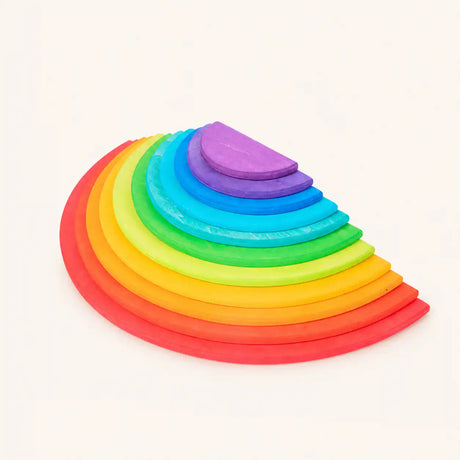
 Wooden Rainbow Arch Stacker
 Wooden Rainbow Car & Peg Doll Set
Small-world figures. Dolls, animals, and little characters are the cast of a three-year-old's stories. Wooden rainbow peg doll friends and a wooden forest tree set combine beautifully for open-ended small-world play.


Puzzles and matching. Three-year-olds are ready for puzzles with more pieces and logic. These build patience and spatial reasoning; see puzzles & memory games for age-right options.
Hands-on activity toys. A Montessori busy book set bundles practical-life skills — buttoning, zipping, matching — into quiet, independent play that three-year-olds find satisfying.

Building with a story. Open-ended blocks and sets now become castles, garages, and forests. The best building toys leave room for a child's imagination to lead.
Books, art, and mark-making. Three-year-olds love stories and are starting to enjoy drawing. Picture books feed the imagination that powers pretend play, while simple art materials build fine motor control and self-expression. The two often blend — a child draws a character, then acts out its story.

Which toy supports which skill?
Matching a gift to what your three-year-old is practicing? This table pairs common toy types with the skills they tend to support.
| Toy type | What the child does | Skills it supports |
|---|---|---|
| Pretend play sets | Cooks, serves, role-plays | Language, empathy, sequencing |
| Small-world figures | Invents stories with characters | Imagination, social understanding |
| Puzzles & matching | Solves more complex puzzles | Logic, spatial reasoning, patience |
| Practical-life activities | Buttons, zips, laces | Fine motor, independence, focus |
| Open-ended building | Builds settings for stories | Planning, creativity, problem-solving |
How can I encourage pretend play at home?
You don't need much. Offer a few realistic, open-ended props, give your child time and space, and resist the urge to direct the story. A small rotation of toys works better than a big pile — it's easier for a three-year-old to dive deep when the shelf isn't overwhelming. Joining in briefly, then stepping back, shows interest without taking over. This child-led approach sits at the heart of Montessori at home.
It also helps to give play a home. A low shelf with a few inviting props — a basket of play food, a family of figures, a cloth that can be a blanket or a river — signals that this is a space for imagination. Rotating what's on offer every week or two keeps the stories fresh. And narrating your own real tasks out loud ("I'm chopping carrots for soup") quietly hands your child new material for their next game.
Playing with others: the start of cooperative play
Around three, children begin shifting from playing alongside other children to playing with them. Shared pretend play — running a pretend shop, building a farm together — is where three-year-olds practice taking turns, negotiating roles, and seeing another point of view. It doesn't always go smoothly, and that's part of the learning. You can help gently: offer toys with enough pieces for two, model simple turn-taking language, and step back when the play is flowing. Open-ended sets like small-world figures and building blocks work beautifully here, because there's room for more than one imagination at the table.
What should I look for in a safe toy for a 3 year old?
Three-year-olds are less likely to mouth toys, but safety still matters. Choose sturdy pieces with child-safe finishes, check the recommended age (which often reflects small-part hazards), and keep an eye on younger siblings who might get hold of smaller pieces. Our toy safety guide breaks down what age labels and small-parts warnings actually mean.
What are the best gift ideas for a 3 year old?
The most-loved gifts at three invite storytelling: a pretend-play set, a cast of little characters, or an open-ended building set. Natural wooden toys take the wear of imaginative play and only get more characterful with time. Browse the full range in Montessori Toys for 3 Year Olds, and when your child is ready for more logic and building, see our guide to the best toys for 4 year olds.
 Wooden Rainbow Stacking Discs Set
 Wooden Rainbow Stacking Tablets
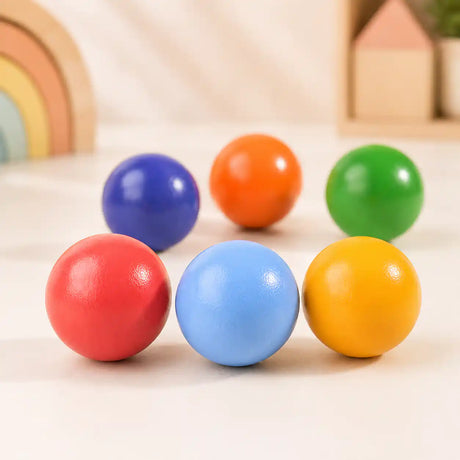
 Wooden Rainbow Balls
Frequently asked questions
-
What are the best toys for a 3 year old?
The best toys for a three-year-old are pretend-play sets, small-world figures, more complex puzzles, and open-ended building toys. These feed the imaginative play and growing logic that define age three. -
Why is pretend play important for 3 year olds?
Pretend play builds language, empathy, and problem-solving. Acting out real-life scenes helps three-year-olds process emotions and practice social roles — it's serious developmental work disguised as fun. -
What skills are 3 year olds developing?
Around age three, many children develop rich imaginative play, stronger language, early logic and counting, and the ability to follow multi-step play. Each child moves at their own pace. -
Are wooden toys good for 3 year olds?
Yes. Open-ended wooden toys support imaginative play especially well because they can become anything, and they're durable enough for years of storytelling. -
How many toys should a 3 year old have out?
A small, rotated selection. Fewer toys on the shelf helps a three-year-old settle into deeper, longer pretend play. -
What is a good gift for a 3 year old?
Open-ended, story-friendly toys — a pretend-play set, peg dolls, or a building set. Our Montessori Toys for 3 Year Olds collection is a great starting point. -
Should a 3 year old have screen-based or electronic toys?
Simple, open-ended toys tend to encourage more creativity and language than electronic ones. They let the child, not the toy, drive the story. -
When are children ready for more complex puzzles?
Around age three, many children can handle puzzles with more pieces and logic. Start simple and add difficulty as their patience and skill grow.
A note on development: the milestones described here are typical patterns, not targets. Children develop at their own pace, and this guide is not a substitute for medical advice. If you have any concerns about your child's development, please speak with your pediatrician.
Last reviewed: July 2026.
Sources & further reading
- CDC — Developmental Milestones (Learn the Signs. Act Early.)
- NAEYC — 10 Things Every Parent Should Know About Play