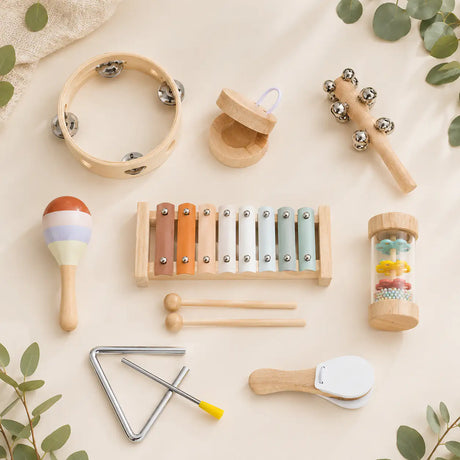
Musical instruments for toddlers are worth having on the shelf because of what a child does with them, not what they hear from them. When a one- or two-year-old strikes a xylophone bar, shakes an egg shaker, or pats a hand drum, they are practising cause and effect, hand-eye coordination, grip strength, and the earliest sense of steady beat — the same timing sense that research links to language processing. A simple wooden percussion set does more for a toddler than a toy that plays songs on its own.
That distinction matters more than most gift guides admit. The research that most clearly favours music in early childhood is about active participation, not background listening. And the second thing worth knowing before you buy is that sound-making toys are one of the few toy categories with a genuine, well-documented safety issue that has nothing to do with choking: volume.
Here is what instruments actually teach, when each type suits a toddler, how loud is too loud, and how to use them at home without turning the living room into a drum circle you cannot switch off.
What musical instruments actually teach a toddler
It helps to separate the musical skills from the developmental ones. Toddlers are not learning to play music in any formal sense. They are using an instrument as a tool that happens to give immediate, satisfying feedback.
- Cause and effect. Shake, and a sound happens. Stop, and it stops. For a child under two, that reliability is the whole appeal, and it is the same reasoning muscle they use on stacking cups and posting boxes.
- Fine motor control. Holding a mallet, aiming it at a narrow bar, and adjusting force is precise work. Grasping shakers strengthens the hand. Threading a wrist bell over a hand is a dressing skill in disguise.
- Gross motor and midline crossing. A xylophone laid flat encourages a child to reach across the centre of the body with one hand — a coordination pattern that underpins later skills like handwriting.
- Auditory discrimination. Loud and soft, fast and slow, high and low, wood and metal and skin. These are early sorting concepts delivered through the ears rather than the eyes.
- Steady beat and timing. The slowest-developing skill, and arguably the most interesting one.
- Turn-taking and joint attention. Copying a rhythm you tap is a social exchange with a musical wrapper.
The American Academy of Pediatrics describes music-based play as a near-universal feature of early childhood and a contributor to school-readiness skills across intellectual, social-emotional, motor, language, and literacy domains. That is a broad claim, but it reflects how many different systems a child uses at once when making sound.

Why playing beats listening
The most useful single study for parents here is a randomised trial from McMaster University. Researchers assigned six-month-old infants to six months of either an active, participatory music class — parents and babies handling instruments, singing, and moving together — or a class where music played in the background while the babies did other things.
The active group came out ahead on more than music. They acquired culture-specific musical knowledge earlier, and they showed stronger development of prelinguistic communicative gestures and social behaviour than the passive group. In other words, the difference was not simply musical: it showed up in how the babies communicated.
This is the practical takeaway. A speaker playing a nursery-rhyme playlist is pleasant, and it has its place. An instrument a child holds and controls is doing something different. If you are choosing between a toy that performs music at your toddler and a plain wooden shaker they operate themselves, the shaker is the one doing the developmental work.
It is also worth being honest about the limits. This is a small, specific body of research. Making music with your child supports communication and connection; it is not a shortcut to advanced development, and no toy guarantees an outcome. Treat it as one good ingredient in an ordinary childhood, not an intervention.
When is a toddler ready for each instrument?
Beat synchronisation — actually matching your movement to an external rhythm — arrives later than most parents expect. A 2024 longitudinal study tracked infants drumming to drumbeats, syllables, and nursery rhymes between five and eleven months. Across that window, infants could not yet reliably synchronise to the beat. What did change was that their spontaneous drumming got faster and markedly more regular with age, and by eleven months a subset began slowing from their natural tempo toward the tempo they were hearing. The flexibility to genuinely match a beat generally develops through the second year and keeps improving well beyond it.
So if your two-year-old bangs enthusiastically and completely off the beat, that is the expected picture, not a problem to correct.
| Age | What they can do | Instruments that suit |
|---|---|---|
| 6–12 months | Grasps, shakes, mouths, and repeats for cause and effect. No beat matching yet. | Chunky one-piece shakers, wooden rattles, a small hand drum to pat. Sealed construction only. |
| 1–2 years | Two-handed play, early tool use with a mallet, loves repetition and volume contrast. | Xylophone with a chunky mallet, tambourine, egg shakers, rhythm sticks with supervision. |
| 2–3 years | Starts copying simple patterns, tempo becomes more flexible, enjoys stop-and-go games. | Full small percussion set, castanets, guiro or scraper, wrist bells for movement play. |
| 3–4 years | Can hold a steady beat for short stretches, follows loud/soft and fast/slow directions. | Tuned xylophone or glockenspiel, simple recorder or whistle, small drum for group play. |
Age grading on the box still governs. Shakers containing loose beads, small bells, and anything with detachable parts carry choking risk for children who still mouth objects, and manufacturer age ratings should be followed rather than judged by eye. Adult supervision is recommended for all instrument play in this age range, particularly with sticks and mallets.
How loud is too loud?
This is the part gift guides skip. Sound-producing toys are regulated for volume, but the standard has a well-known weak point.
Under the ASTM F963 toy safety standard, most toys must not exceed a sound-pressure level of 85 decibels measured at 50 centimetres — roughly 20 inches — from the toy. The Sight & Hearing Association, which has tested toys with University of Minnesota researchers for years, argues that 50 centimetres is an adult arm's length, not a child's. Toddlers hold noisy things right up to their faces. In the association's 2021 round of testing, 19 of 24 toys measured louder than 85 dB.
Distance matters enormously. Clinicians at Hackensack Meridian Health note that a toy measuring 90 decibels at arm's length is effectively about 120 decibels when pressed against the ear. And according to NIOSH, permissible exposure time halves with every three decibels above 85 — so the gap between "a bit loud" and "genuinely risky" is narrower than it sounds. Noise-induced hearing loss is cumulative and does not announce itself.
Three things follow from this for anyone buying a musical toy:
- Acoustic instruments are self-limiting in a way electronic ones are not. A wooden shaker or a small hand drum is only as loud as a toddler's arm can make it. A battery-powered toy with a speaker has a volume set by a manufacturer.
- Test before you gift. Free sound-level meter apps, including the NIOSH Sound Level Meter app, let you check a toy in the shop or at home.
- You can quiet a toy you already own. Take the batteries out, use the lowest volume setting, or put a piece of tape over the speaker.
None of this makes sound-making toys a bad idea. It makes unamplified ones the sensible default for a toddler, which is a large part of why wooden percussion has stayed a fixture in Montessori and early-years settings. If you want the fuller picture on materials, our comparison of wooden versus plastic toys covers the trade-offs honestly.

How to actually play: five simple rhythm activities
Instruments left on a shelf tend to get one enthusiastic minute and then ignored. A little structure — very little — extends the play enormously.
- Copy me. Tap a two-beat pattern. Pause. Let them try. Keep it short and do not correct them. Turn-taking is the point, accuracy is not.
- Loud and soft. Play a whisper-quiet round, then a big round. Toddlers find the contrast genuinely funny, and it builds real volume control — useful for everyone's ears.
- Stop and go. Play together, then freeze. Waiting for the restart is impulse-control practice dressed up as a game.
- Match the song. Sing a familiar nursery rhyme and shake along. Rhymes have strong, predictable stress patterns, which is exactly the rhythmic structure researchers connect to language processing.
- Sound sorting. For a three- or four-year-old, group instruments by how they are played — shaken, struck, scraped — or by material. It turns the basket into a classification activity.
Two practical notes. Keep the set small and rotate it; five instruments available all the time will hold less attention than two swapped out weekly. And if your child seeks out or avoids certain sounds strongly, that is worth noticing — our guide to sensory play and why it calms some children goes into how sound fits into a child's wider sensory picture.
What to look for when choosing
- Real, pleasant tone. A tuned xylophone is worth more than an untuned one. Poorly tuned bars teach a child sound relationships that are simply wrong, and they are unpleasant enough that the toy gets abandoned.
- Sealed, one-piece shakers. No screw caps, no glued seams that can work loose around loose beads.
- Securely fixed bars and bells. Check that xylophone bars are properly fastened and that bells cannot be prised off a tambourine frame.
- A mallet sized for a toddler grip — short, thick handle, rounded head, no sharp point.
- Smooth, well-finished wood with no splinters or rough edges, and finishes described in the product details rather than assumed.
- Age grading that matches your child, followed as written rather than estimated.
- No amplification. If it has a speaker and a volume you cannot control, it belongs to a different category of purchase.
Our music and sensory toys collection is built around this kind of unamplified, hands-on sound play — instruments a child operates rather than switches on.
Frequently asked questions
What age can a baby start playing musical instruments?
Around six months, babies can grasp and shake a simple, sealed rattle or shaker and enjoy the cause and effect. Mallet instruments like a xylophone generally suit from around twelve months, once a child can aim a tool. Follow the manufacturer's age grading on any specific toy, and supervise play.
Do musical toys really help language development?
Research links rhythm and beat-perception skills with language processing, and a randomised trial found that infants in active music classes developed prelinguistic communicative gestures more strongly than infants who only heard music passively. That is a supportive association, not a guarantee — instruments are one helpful ingredient among many, and singing and talking with your child matter at least as much.
Are wooden instruments better than plastic ones for toddlers?
Not automatically, but acoustic wooden instruments have a practical advantage: their volume is limited by the child, not by a speaker. They also tend to produce a warmer, better-tuned tone and stand up to years of enthusiastic use. Construction quality and age suitability matter more than material alone.
My toddler just bangs everything. Is that musical play?
Yes. Repetitive banging is a play schema — a child systematically testing what different surfaces and forces do. It looks chaotic and it is genuine exploration. Beat matching does not typically emerge until the second year and continues developing for years after that.
How can I tell if a musical toy is too loud?
Measure it with a free sound-level meter app, holding the phone where your child would hold the toy rather than at arm's length. Aim well below 85 decibels at close range. If a toy you already own is too loud, remove the batteries, use the lowest setting, or tape over the speaker.
References
- Active music classes in infancy enhance musical, communicative and social development — Developmental Science (2012)
- Becoming musically enculturated: effects of music classes for infants on brain and behavior — Annals of the New York Academy of Sciences (2012)
- Precursors to infant sensorimotor synchronization to speech and non-speech rhythms: A longitudinal study — Developmental Science (2024)
- Synchronizing with the rhythm: Infant neural entrainment to complex musical and speech stimuli — Frontiers in Psychology (2022)
- Rhythm perception, production, and synchronization during the perinatal period — Frontiers in Psychology (2014)
- Infants and Music Media — American Academy of Pediatrics
- Sight & Hearing Association Releases Annual Noisy Toys List — AudiologyOnline (2021)
- Can Loud Toys Cause Hearing Loss? — Hackensack Meridian Health (2024)
- Music and reading activities in early childhood associated with improved language development in preterm infants — Frontiers in Psychology (2024)
A basket of wooden instruments is one of the few things on a toddler shelf that a child can genuinely be in charge of — loud when they choose, quiet when they choose, and different every time. That control is the lesson. Smart play for little growing minds.