A toy is Montessori when it has one clear purpose, is made from natural materials, reflects the real world, and lets a child learn by doing rather than by being entertained. In other words, it's less about a label on the box and more about how the toy behaves in a child's hands. "Montessori" isn't a certification — it's a set of design ideas drawn from the work of Dr. Maria Montessori. This guide is part of our Montessori Basics hub, where we explain the approach in plain language for everyday families.
Below are the five qualities we look for before a toy earns a place on the shelf — and how to use them the next time you're shopping.

Key takeaways
- A Montessori toy usually has one clear purpose rather than lights, sounds, and a dozen functions at once.
- It's made from natural materials like wood, which give real weight and texture that little hands can learn from.
- It's based on reality — real animals, real activities, real proportions — especially for children under three.
- It's often self-correcting, so a child can see and fix a mistake without an adult stepping in.
- "Montessori" is not a legal certification, so judge a toy by these qualities rather than by the word on the box.
What does "Montessori" actually mean on a toy?
"Montessori" describes a philosophy of learning, not a trademark or safety standard. It comes from Dr. Maria Montessori, an Italian physician who observed that young children learn best through hands-on, self-directed activity in a calm, prepared environment. Any company can print the word on a box, which is exactly why it helps to carry your own checklist.
In a Montessori classroom, specially designed "materials" isolate one concept at a time. At home you don't need the full set — you're simply looking for toys that share the same spirit: purposeful, beautiful, and built around what a child is naturally drawn to do at their stage.
The five things that make a toy Montessori
1. It's based on reality, not fantasy
Especially before age three, children are busy making sense of the actual world. Montessori-aligned toys lean into that: realistic animal figures, a wooden set of fruit to slice, a small pitcher that really pours. Fantasy and imagination absolutely have their place as children grow, but a grounding in the real world tends to come first. When in doubt, ask whether the toy reflects something a child could recognize from everyday life.
2. It's made from natural materials
Wood, cotton, wool, and metal give a child honest sensory feedback — real weight, real temperature, real grain. A wooden block is cool, solid, and a little heavy; a plastic one tells the hand almost nothing. Natural materials are also calmer to look at, which supports focus. It's why so much of what we carry lives in our wooden toys collection.

3. It has a single, clear purpose
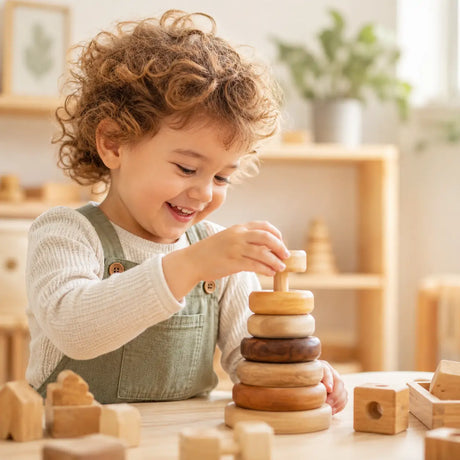
Montessori calls this the "isolation of difficulty" — a toy focuses on one skill or idea so the child can work at it without distraction. A shape sorter is about matching shape to hole. A stacking ring is about size order. There are no flashing lights or background music competing for attention, which means the child, not the toy, is doing the thinking.
4. It's self-correcting
The best early materials let a child notice their own mistakes. If a puzzle piece is the wrong one, it simply won't fit — no adult correction needed. This "control of error" builds quiet confidence and problem-solving, because the child gets to work it out for themselves. A wooden animal puzzle stacker is a lovely first example: each animal has one right place.

5. It's sized and weighted for real little hands
A Montessori toy fits the child, not the other way around. Pieces are graspable, weighty enough to feel substantial, and scaled so a toddler can actually manage them. This is where fine motor development quietly happens — pinching, threading, turning, and placing. A classic wooden pull-along rainbow stacker is a good example of a toy built for small, capable hands, and you'll find many more across our fine motor toys collection.

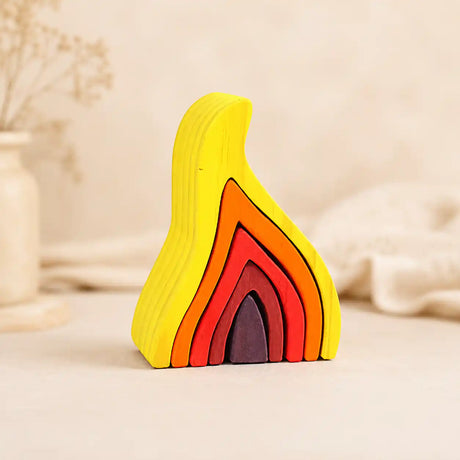
 Wooden Flame Stacking Puzzle
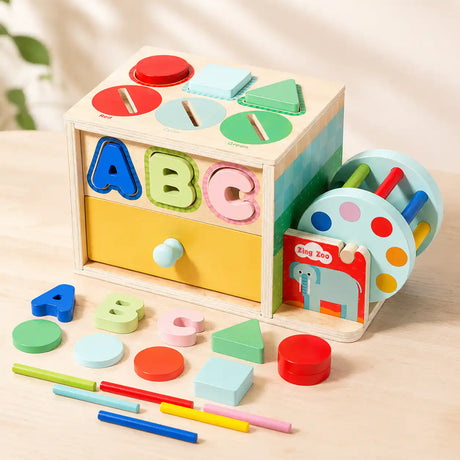
 Wooden 6-in-1 Activity Cube
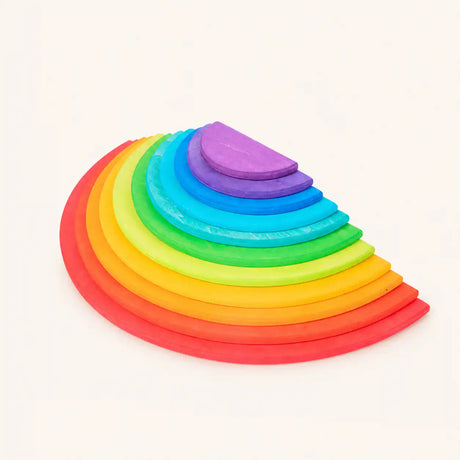
 Wooden Rainbow Semicircles
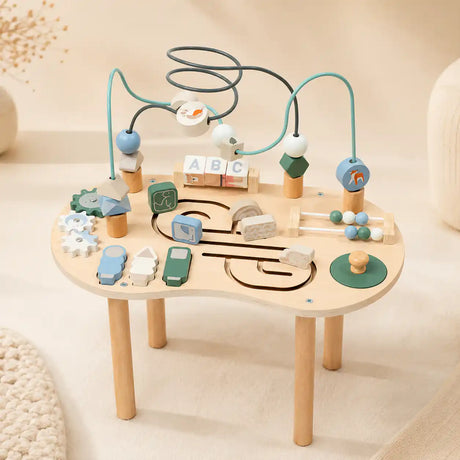
 Wooden Activity Table
Montessori toy vs. conventional toy: a quick comparison
Not every good toy is Montessori, and that's perfectly fine — but the differences are easy to see once they sit side by side.
| Quality | Montessori-aligned toy | Conventional toy |
|---|---|---|
| Purpose | One clear skill or concept | Many functions at once |
| Feedback | Comes from the child's own action | Comes from lights, sounds, batteries |
| Materials | Natural — wood, cotton, metal | Often plastic |
| Who does the work | The child | The toy |
| Error handling | Self-correcting; the child sees the mistake | An adult or the toy signals the mistake |
| Play style | Open-ended, repeatable, calm | Often single-use novelty |
Does a toy have to be wooden to be Montessori?
No. Wood is popular in Montessori spaces because it's natural, durable, and pleasant to handle, but the philosophy is about how a toy works, not what it's made of. A cotton ball-drop, a metal bell, or a woven basket can all be beautifully Montessori. Wood simply happens to tick several boxes at once, which is why it dominates the look. What matters most is that the material is real and gives honest feedback — we dig into this in do Montessori toys have to be wooden? It's also closely tied to the idea of open-ended versus single-purpose toys, which is worth a read if you're building a shelf.
How to use these five criteria when you shop
Next time a toy catches your eye, run it through a quick mental checklist: Does it do one thing well? Is it made of natural materials? Does it reflect the real world? Can my child correct their own mistakes? Does it fit their hands and their stage? Four or five yeses, and you're almost certainly looking at a Montessori-aligned toy — whatever the label says.
If you'd like a curated starting point, our wooden toys collection is organized around exactly these principles, with age guidance on every listing so you can match the toy to the child. For more, visit the Montessori Basics hub, compare styles in Montessori or Waldorf toys, or see why toddlers love to sort.
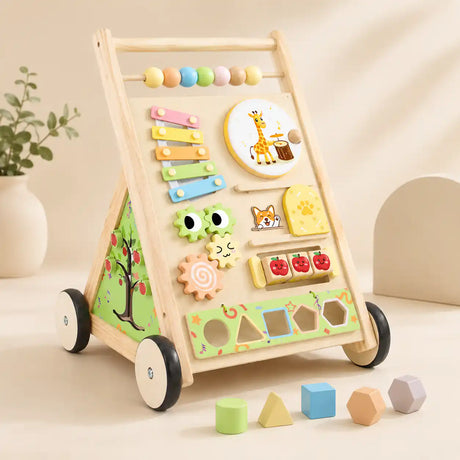
 Wooden 10-in-1 Activity Walker
Frequently asked questions
-
Is "Montessori" a certified or trademarked label on toys?
No. "Montessori" is not a legal certification or trademark for toys, so any product can use the word. That's why it helps to judge a toy by its actual qualities — purpose, materials, realism, and whether it's self-correcting — rather than by the name on the packaging. -
Are Montessori toys better than regular toys?
No single toy determines how a child develops. Montessori-aligned toys are simply designed to support focus, independence, and hands-on problem-solving, which many parents find leads to calmer, deeper play. The best toy is one that fits your child's current stage and interests. -
Do Montessori toys have to avoid all plastic?
Not strictly. The preference for natural materials is about sensory quality and calm, not a hard rule. Many families use mostly wood and cotton with a few well-chosen exceptions. Focus on real, honest materials rather than banning a single one. -
At what age can I start with Montessori toys?
From the earliest months, with the toy matched to the stage — high-contrast objects and grasping toys for babies, then sorting, stacking, and threading as hands get more capable. Always check the age guidance and supervision notes on each listing, and keep small parts away from children who still mouth objects. -
What's the difference between a Montessori toy and an open-ended toy?
They overlap but aren't identical. Open-ended toys like plain wooden blocks can be used many ways, while classic Montessori materials often isolate one specific skill. Both value the child doing the thinking, and many toys are happily both. -
How many Montessori toys does a child actually need?
Fewer than you'd think. Montessori favors a small, rotated selection over a crowded toy box, because too many choices can scatter a child's attention. A handful of well-chosen toys, swapped out occasionally, usually supports deeper play than a shelf packed full.
A note on development and safety: play supports growth, but every child develops at their own pace, and no single toy guarantees a particular outcome. Always follow the age guidance and supervision notes on each product listing, and keep small parts away from children who still put things in their mouths. Adult supervision is recommended during play.
Last reviewed: July 2026.
Sources & further reading
- American Montessori Society — What Is Montessori
- American Academy of Pediatrics — Selecting Appropriate Toys for Young Children in the Digital Era
- NAEYC — 10 Things Every Parent Should Know About Play