The short version: a federal safety standard for water bead toys took effect on March 12, 2026, setting limits on how large the beads may expand, capping the amount of acrylamide they can release, and requiring blunt warning labels. Six months on, toys containing oversized water beads are still being recalled — including two recalls announced on September 3, 2026 covering roughly 15,200 squishy toys. The rule is real and it is being enforced, but it does not retroactively clean out what is already in American homes.
That gap is the part worth understanding as a parent. A rule that applies to toys manufactured after a certain date does nothing about the sensory kit bought last summer, the party-favor squishy that came home in a goodie bag, or the marketplace listing that slipped past inspection. Enforcement catches products at ports and after the fact; it does not knock on your door.
So here is what the water bead rule actually changed, why recalls have continued anyway, what pediatric researchers have found about how these injuries happen, and how to think about sensory play for children under five without the risk.
What the federal water bead rule actually requires
A water bead is a superabsorbent polymer — the U.S. Consumer Product Safety Commission (CPSC) defines it as a variably shaped liquid-absorbent polymer made of materials such as polyacrylamide or polyacrylate, which expands when soaked in liquid. CPSC notes the beads can grow up to 100 times their original size in water. They are sold as sensory toys, craft supplies, decorative filler, and gel-blaster ammunition.
The Commission approved the standard on August 21, 2025 in a 2–0 vote, and it took effect March 12, 2026 as Safety Standard for Toys: Requirements for Water Beads, codified at 16 C.F.R. § 1250.4. It has three parts:
- A size limit. Dehydrated beads in a toy that fit entirely inside the small-parts cylinder must be able to pass through a 5.0 mm diameter funnel or sieve test gauge once fully expanded. In plain terms: a bead is no longer allowed to swell into something big enough to lodge in a small airway or bowel.
- An acrylamide limit. Beads in toys may not release more than 325 micrograms of extractable acrylamide from 100 small beads or one large bead, where a small bead measures under 4.0 mm in every dimension when dry.
- Mandatory warnings. The toy, its packaging, and its container must carry a prescribed warning label. Products sold loose or in bins need an individual hangtag or sticker.
Importantly, this is a children's product rule, which means covered toys must be tested by a CPSC-accepted third-party lab, and the Children's Product Certificate must specifically list 16 C.F.R. § 1250.4. That paperwork requirement is what gives inspectors something concrete to check at the border.
One limit worth knowing: the rule covers water bead toys. Water beads sold as vase filler, garden soil additives, or craft supplies fall outside its scope, and CPSC advises keeping those products out of spaces where children live and play.
Why toys are still being recalled six months later
The clearest recent example came on September 3, 2026, when CPSC announced two separate recalls of squishy dumpling-style toys whose internal water beads expand larger than permitted. OKK Trading recalled about 7,200 Rainbow Mystery Squishy Bun Toys sold through third-party stores nationwide between May and August 2026. The same day, roughly 8,000 GIHNJSI Squeezy Dumplings sold on Amazon were recalled. Neither recall listed any reported injuries.
CPSC also issued a warning — not a recall — about roughly 106 similar squishy bun toys from a third seller, because that seller did not agree to recall the product or offer a remedy. That distinction matters: a warning means the agency is telling you directly, because the company will not.

Buried in the recall notice is the detail that makes this a household problem rather than a filing-cabinet one. CPSC's description of the recalled Rainbow Mystery toy notes there are no markings on the product itself other than a cartoon face. Once the packaging is gone — and with a squeeze toy, it goes fast — a parent has no brand, no model number, and no way to match the toy in the toy bin to the notice on the screen.
The volume behind the enforcement effort is substantial. In an August 5, 2026 consumer safety alert about fake and counterfeit squishy toys, CPSC reported it had identified 55 shipments of violative squishy toys at U.S. ports and worked with Customs and Border Protection to prevent 355,683 units from entering the country. The same alert flagged counterfeit squishies that may fail requirements on water beads, small parts, lead, and phthalates, and reiterated a warning about a social media trend encouraging children to microwave squishy toys, which can burst and cause serious burns.
So the honest picture is not "the rule failed." It is that a standard applying to newly manufactured goods takes time to work through a global supply chain and an online marketplace where sellers turn over constantly.
What happens when a young child swallows a water bead
The mechanism is straightforward and is why the size limit exists. A dry bead is small enough to swallow easily. Once inside the body, it keeps absorbing fluid and expands — and an object that was harmless going down can become large enough to obstruct. CPSC describes the resulting hazards as ingestion, choking, and intestinal obstruction, with severe discomfort, vomiting, dehydration, and a risk of death.
The injury data is consistent about who is most affected. In its 2025 announcement of the standard, CPSC cited an estimated 6,300 water bead-related ingestion injuries treated in U.S. emergency departments between 2017 and 2022, along with at least one reported death of a 10-month-old girl in 2023.
A study from the Center for Injury Research and Policy at Nationwide Children's Hospital, drawing on national injury surveillance data, estimated 8,159 emergency department visits involving water beads among people under 20 from 2007 through 2022. More than half of those cases — 55% — involved children younger than five. Swallowing accounted for 46% of visits, followed by beads placed in the ear (33%), the nose (12%), and eye injuries (9%). Most patients, 92%, were treated and released. But admissions concentrated sharply in the youngest group: children under five made up 90% of admissions, and every one of those admissions involved swallowing.
A separate analysis published in the Journal of Pediatric Gastroenterology and Nutrition reviewed water bead injuries from 2013 to 2023 and found a significant upward trend after 2020, with ingestion accounting for 66% of cases and children under two making up 29% of injuries. Roughly 7% of cases required escalation of care.
Gary Smith, MD, DrPH, senior author of the Nationwide Children's study, put the practical guidance plainly: if children under six, or children with developmental delays, live in or visit your home, keep water beads out of the home — and raise it with childcare directors, preschool teachers, and therapists who may be using them with young children.
That last clause is easy to skip past and worth sitting with. Water beads are popular in early intervention and classroom sensory bins precisely because they feel wonderful. Popularity in a professional setting is not the same as suitability for a two-year-old who still mouths things.
How to check the toys already in your home
The new rule gives you a useful mental filter, but for toys you already own, a physical check is more reliable than a label hunt. CPSC's guidance for spotting counterfeit and noncompliant squishy toys translates well to a general once-over:
- Retire anything torn, punctured, leaking, sticky, or oddly soft. With a contained-bead toy, the outer skin is the only thing standing between the filling and a curious mouth. If it is failing, the toy is done.
- Be suspicious of unmarked toys. No manufacturer name, no age grading, no safety warning, no tracking information — that combination is a genuine red flag, not just sloppy branding.
- Trust your nose and hands. A strong chemical smell or an oily, unusually sticky surface is reason enough to stop using it.
- Watch the price. A price far below what established retailers charge can signal a counterfeit or substandard product.
- Keep them away from heat. Never microwave a squishy toy, and do not leave one in a hot car, in prolonged sun, or near a heater. Heated filling can burst out, stick to skin, and keep transferring heat.
- Sweep the floor after sensory play. Beads scatter, roll under furniture, and reappear weeks later at exactly toddler height.
If a young child may have swallowed a water bead, or put one in an ear or nose, contact your pediatrician or seek medical care rather than waiting to see whether it passes. And unsafe products can be reported to CPSC at SaferProducts.gov.
Broader safety habits are worth pairing with this. Our plain-language guide to small parts and choking hazards covers how age grading and the small-parts test actually work, which is the same logic underneath the 5.0 mm water bead gauge.
Safer sensory play for children under five
It is worth saying clearly: the appeal of water beads is legitimate. They are cool, smooth, slippery, and endlessly pourable, and that kind of tactile input genuinely helps some children settle and focus. The goal is not to strip sensory play out of a toddler's day. It is to get that same input from materials that are not dangerous if they end up in a mouth.

A few substitutions that preserve the good part:
- Plain water. A shallow tray, a few cups, a sponge, and a small pitcher covers pouring, scooping, squeezing, and transferring — the practical-life work water beads are usually standing in for.
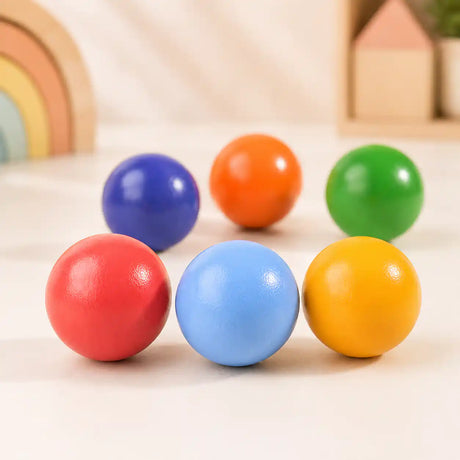
- Large natural materials. Big wooden beads, smooth stones, or wooden rings that are clearly too large to swallow give texture and weight without the small-parts risk. Size is the whole point here.
- Fabric and texture contrast. Muslin, felt, wool, and smooth wood in one basket offer real sensory variety with essentially no hazard.
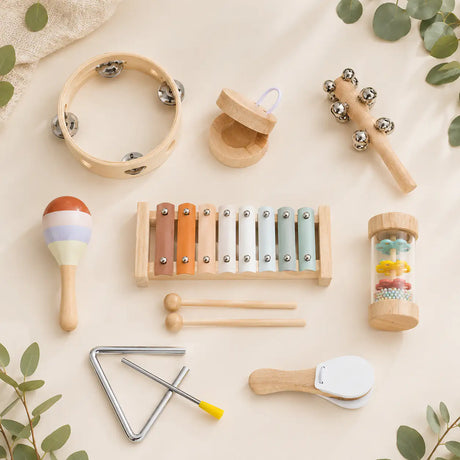
- Sound and vibration. Simple percussion — a wooden shaker, a small drum, tapping sticks — is regulating for many children and often overlooked as sensory input.
If you are building out this kind of play, our music and sensory toys are chosen with size and material in mind for exactly this age band, and our guide to what sensory play is and why it calms some children goes deeper on the developmental side. As always, adult supervision is recommended, and it is worth reviewing the age guidance on any toy before it joins the shelf.
For what it is worth, JuniSprouts does not stock water bead products in any form. That is not a claim to virtue — it is simply that a material whose primary hazard is expanding after a child swallows it is a poor fit for a shop built around toddlers and open-ended play.
Frequently asked questions
Are water beads banned in the United States now?
No. Water bead toys are regulated, not banned. Since March 12, 2026, covered toys manufactured on or after that date must meet federal limits on expanded bead size and acrylamide content and carry required warnings. Water beads sold as non-toy products, such as decorative filler or garden products, fall outside this particular rule.
Does the new rule mean the water beads I already own are safe?
Not necessarily. The standard applies to products manufactured after the effective date, so anything bought earlier was made under the previous requirements. Recalls announced in September 2026 involved toys sold as recently as August 2026.
At what age are water beads appropriate?
There is no single answer, and the safest reading of the pediatric guidance is cautious. Researchers at Nationwide Children's Hospital recommend keeping water beads out of homes where children under six — or children with developmental delays — live or visit. CPSC advises that children should not play with water beads unsupervised.
What should I do if my child swallows one?
Seek medical guidance promptly rather than waiting. Because the bead continues absorbing fluid and expanding inside the body, an object that seemed small when swallowed can cause an obstruction later. Contact your pediatrician or emergency services.
How do I find out whether a specific toy has been recalled?
CPSC publishes recalls and warnings at CPSC.gov and offers free email alerts. You can also report an unsafe product at SaferProducts.gov, which is how many of these enforcement actions begin.
References
- Water Bead Toys Business Guidance (16 C.F.R. § 1250.4) — U.S. Consumer Product Safety Commission
- Safety Standard for Toys: Requirements for Water Beads — Federal Register (2025)
- CPSC Approves New Federal Safety Standard for Water Beads — U.S. CPSC (August 21, 2025)
- Consumer Safety Alert: Fake and Counterfeit Squishy Toys — U.S. CPSC (August 5, 2026)
- OKK Trading Recalls Rainbow Mystery Squishy Bun Toys — U.S. CPSC (September 3, 2026)
- Study Finds Emergency Department Visits by Children Associated with Water Beads More Than Doubled — Nationwide Children's Hospital (2024)
- Water Beads: Sensory Fun or Ticket to the Emergency Department? — Pediatrics Nationwide (2024)
- Water bead injuries by children presenting to emergency departments 2013–2023: An expanding issue — J Pediatr Gastroenterol Nutr (2024)
Rules like this one are a floor, not a guarantee. The more useful habit is the one that costs nothing: pick up the toy, look at it properly, and ask whether it would still be safe in the hands of the youngest child who might reach it. Smart play for little growing minds.