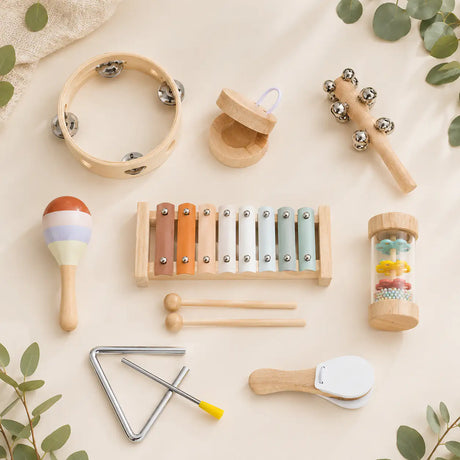
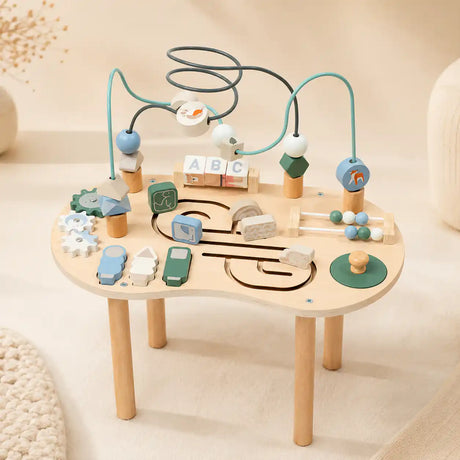
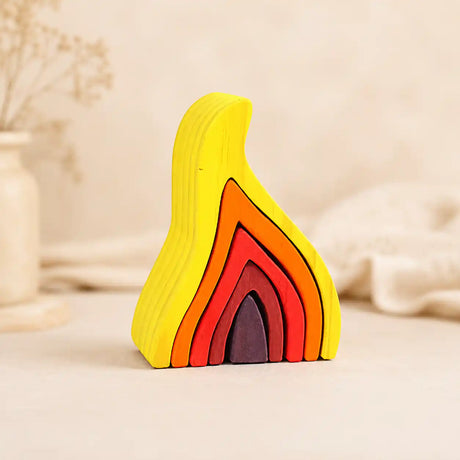
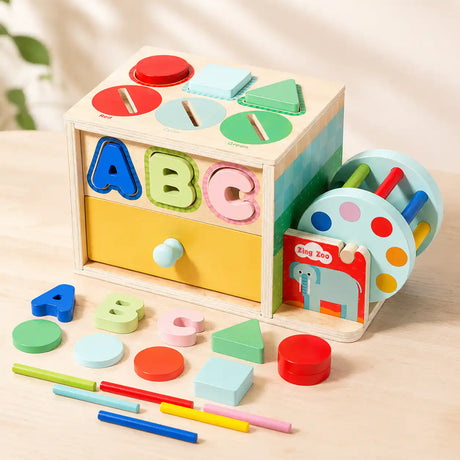
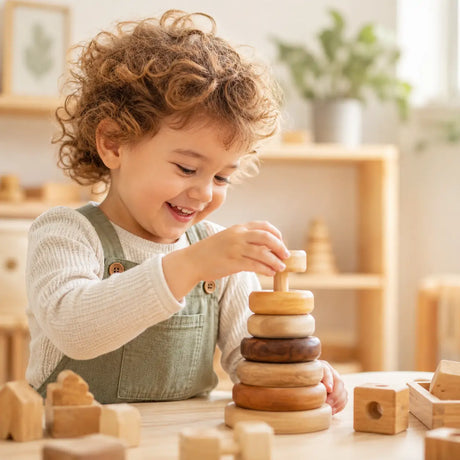
The best big sibling gift is a calm, hands-on toy your toddler can use independently — something that gives them a job of their own while the baby is being fed, changed, or held. Practical favorites include a wooden doll cradle or care set, a chunky stacking or threading toy, a simple puzzle, and a small basket of blocks. What matters is not the price tag but the message: you still have a place here, and you still have work that is yours.
If you are shopping for big sibling gift ideas right now, you are probably juggling two things at once — a toddler who is about to lose the spotlight, and a newborn who will take up most of the room. A well-chosen gift can genuinely soften that first month. A poorly chosen one becomes another noisy plastic thing on the floor by week two.
Here is how to choose one that earns its keep.
What makes a good big sibling gift?
A new baby rearranges a toddler's whole world. Clinginess, regression, and attention-seeking are all common in the weeks after a sibling arrives — not because anything is wrong, but because a two-year-old has no other vocabulary for a change that size.
A good gift works with that, rather than trying to distract from it. In practice, the ones that land tend to share four traits:
- It can be used alone. The gift should not require an adult to set it up, referee it, or hold a piece. Your hands will be full.
- It is quiet. A newborn sleeping in a carrier changes the math on anything that beeps, sings, or flashes.
- It gives them a role. Toys that let a toddler nurture, carry, sort, or build something give them a sense of competence at exactly the moment they feel displaced.
- It has a long runway. The postpartum months are not the time to introduce something they will outgrow in six weeks.
Notice what is missing from that list: novelty. A big sibling gift does not have to be exciting. It has to be absorbing. Those are different things, and the second one is far more useful at 2 p.m. on a day when nobody has napped.
When should you give it?
There are three common approaches, and none of them is wrong.
Before the baby comes. Giving the gift in the last few weeks of pregnancy lets your toddler get familiar with it while you are still available to play alongside them. By the time the baby arrives, it is already theirs — a known, comforting thing rather than a consolation prize.
At the first meeting. Many families hand over a "gift from the baby" during that first introduction at the hospital or at home. It is a sweet ritual, and it gives a nervous toddler something concrete to do with their hands in a strange, emotional moment.
A week or two later. This is the underrated option. The initial excitement usually fades around day seven to ten, right when the visitors stop coming and the reality of a permanent roommate sets in. A gift held back for that week can do more good than one given on day one.
If you are choosing between them, our honest suggestion is: give something small before, and keep something quiet in reserve for the second week.
Big sibling gift ideas by age: 1 to 4 years
A "big sibling" can be anywhere from twelve months to five years old, and the right gift shifts a lot across that range. Here is a quick orientation before the detail.
| Age of the big sibling | What they are working on | Gift ideas that fit |
|---|---|---|
| 12–18 months | Grasping, in-and-out, cause and effect | Wooden nesting cups, a chunky stacking toy, a simple posting box, a push toy |
| 18 months–2 years | Carrying, filling, dumping, imitating adults | A small basket with a handle, wooden blocks, a shape sorter, a soft doll to carry |
| 2–3 years | Pretend play, sequencing, fine motor control | Doll cradle and care set, threading beads, 4–8 piece puzzles, play food |
| 3–4 years | Storytelling, sorting by rule, early building | Open-ended block sets, animal figures, matching and memory games, a play kitchen |
| 4 years and up | Rules, patterns, longer projects | Larger construction sets, pattern blocks, counting and early number toys |
One caveat worth saying plainly: a brand-new big sibling often plays below their age band for a few weeks. A three-year-old who was building elaborate towers in July may want the simple stacking toy in September. That is not a step backward. It is a child reaching for something reliable while everything else is in flux, and it is worth letting them.
Why care play works so well right now
If there is one category of gift that consistently earns its place in the first months, it is care play — a doll, a cradle, a small blanket, a wooden bottle, a soft carrier. It looks sentimental. It is actually very practical.

Care play gives a toddler somewhere to put feelings they cannot yet name. A two-year-old who is not allowed to pick up the real baby can pick up theirs. A child who feels shushed all day can shush someone else. The American Academy of Pediatrics, in its guidance on selecting toys, highlights exactly this kind of symbolic, pretend play as a strong support for early language and social-emotional development — children narrate what they are doing, borrow adult phrases, and rehearse the routines they are watching all day long.
It also quietly does something for you: a toddler who is "feeding their baby" next to you while you feed yours is a toddler who is included rather than sidelined. That parallel play, side by side, tends to reduce the number of times you get interrupted mid-feed.
Practical picks: a simple wooden cradle, a soft-bodied doll with no small removable parts, a little basket of cloths and blankets, or a set of wooden pretend play toys that mirror the caregiving they see every day.
Gifts that buy you twenty quiet minutes
Let's be direct about the other job a big sibling gift is doing. You need stretches of time when your toddler is genuinely occupied and you are not.

The toys that reliably produce those stretches tend to be repetitive, self-correcting, and open-ended — the child can tell whether it worked without asking you. Threading beads. Nesting cups. A shape sorter. A wooden puzzle with a satisfying fit. Blocks with no instructions.
What almost never produces those stretches: anything with batteries. The American Academy of Pediatrics has cautioned that electronic toys tend to do the talking and problem-solving for the child, which shortens engagement rather than deepening it. When a toy performs, the child watches. When a toy waits, the child works.
Two setup notes that matter as much as the gift itself:
- Put fewer things out. A shelf with five toys visible gets used more than a bin with thirty. Rotate the rest out of sight and swap weekly.
- Start together, then step back. Sit down for two or three minutes, get them started, then move to the couch with the baby. Leaving mid-play works far better than never sitting down at all.

If independent play is the real goal here — and for most new-baby households it is — our guide to encouraging independent play in toddlers covers realistic expectations by age and how to set the space up so it actually happens.
What not to give a brand-new big sibling
A few things are worth avoiding, either because they backfire or because they are genuinely unsafe in a house that now contains an infant.
- Anything with small parts, if your toddler is under three. U.S. toy safety rules restrict small parts in toys intended for children under three because of the choking risk, and a house with a newborn is a house where floor supervision is thinner than usual. Check age grading and follow it.
- Toys with magnets. High-powered magnets are a serious ingestion hazard — swallowed magnets can attract through intestinal tissue and cause life-threatening injury. This is not the season to introduce them. Adult supervision is essential with any magnetic toy.
- Long cords, strings, or ribbons. Pull-along toys and anything with a cord longer than about 12 inches should stay out of reach of the baby entirely.
- Loud or light-up toys. Practical, not precious: they wake newborns.
- A huge, exciting gift. An oversized present can accidentally raise the emotional stakes of the whole event. Smaller and quieter usually lands better.
- Anything that needs you. If it requires an adult to referee, it will sit unused for six months.
When in doubt, choose the simpler toy in the older age bracket and keep it for supervised play, rather than the complicated toy marketed to a younger one.
Big sibling gift questions, answered
Should the gift be "from the baby"?
It is a lovely ritual and many families swear by it. It is also completely optional. Some toddlers find it confusing that a newborn who cannot lift their head chose a present. If yours is on the older, more literal end, "we got you this because you're a big brother now" works just as well.
How much should I spend on a big sibling gift?
Less than you think. The gift is doing emotional work, not impressing anyone. A thoughtful $20 wooden toy that gets used daily for a year is a better gift than a $90 set that stays in the box. If you want to spend more, consider splitting it — something small before the birth, something else a few weeks later.
What if the big sibling is only 15 or 18 months old?
Then skip the symbolism entirely and choose for the stage: nesting cups, a chunky stacking toy, a posting box, a basket they can fill and carry. A toddler that age will not understand "big sibling gift," but they will absolutely understand a toy that is theirs and works every time.
Do I need to buy something for each sibling if there are already two?
Something small for each, yes — but it does not have to be equal or matched. Older siblings often do better with a gift that acknowledges their new role practically, like a task or a set they are trusted with, rather than another toy.
What if my toddler ignores the gift completely?
Very common, and usually temporary. Put it away for two weeks and bring it back out. Novelty fatigue is real, and a toy reintroduced after a break often gets a much warmer reception than it did on day one.
A last thought
The gift is not really the point, and every parent reading this already knows it. What actually helps a toddler through a new sibling is time, predictability, and being given something real to do. A good toy is simply a tool for delivering the third one on a day when the first two are in short supply.
Choose something quiet, something they can manage alone, and something that will still be on the shelf next spring. If you would like a starting point, our toddler gift collection is curated with exactly this kind of shopping in mind.
Smart play for little growing minds.
References
- Toy Buying Tips for Babies & Young Children — HealthyChildren.org, American Academy of Pediatrics
- Healey A, Mendelsohn A. Selecting Appropriate Toys for Young Children in the Digital Era — Pediatrics, American Academy of Pediatrics (2019)
- Yogman M, et al. The Power of Play: A Pediatric Role in Enhancing Development in Young Children — Pediatrics, American Academy of Pediatrics (2018)
- Small Parts and Choking Hazard Labeling FAQs — U.S. Consumer Product Safety Commission