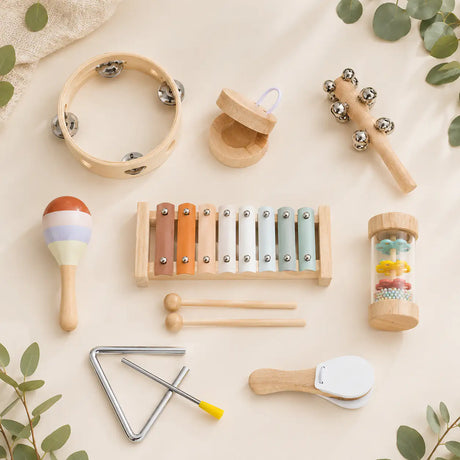
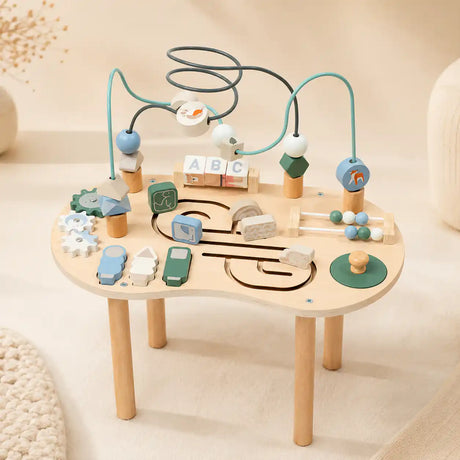
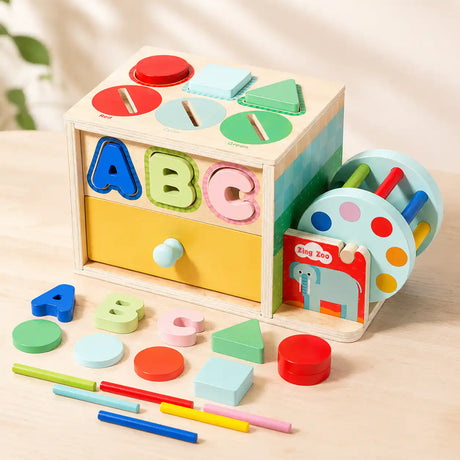
The travel toys that actually work for toddlers are small, quiet, self-contained, and new to your child. That combination matters far more than the toy itself. A single unfamiliar object with no loose pieces will usually hold a one, two, or three year old longer than a whole bag of familiar favourites — and it won't end the trip by rolling under someone else's seat.
Travel is also one of the few moments where a screen can feel non-negotiable. It doesn't have to be. The American Academy of Pediatrics suggests packing a bag of toys and snacks to keep a child occupied on a flight, and deciding on screen-free activities before you leave rather than in the middle of a meltdown at 30,000 feet.
Below: what makes a travel toy work, what to pack by age, what changes between a plane and a car seat, the safety checks worth two minutes of your time, and the packing trick that stretches five small toys across a whole day.
What makes a travel toy actually work?
A travel toy has a harder job than a toy at home. It has to be interesting without a floor to spread out on, quiet enough for strangers nearby, and forgiving when your toddler drops it into a footwell you cannot reach.
Four qualities do most of the heavy lifting:
- Novelty. A toy your child has never seen buys attention that a beloved favourite won't. This is the single biggest lever you have.
- Containment. The pieces stay attached to the toy, or there are no separate pieces at all. Anything that scatters is a one-time toy.
- Lap-scale. It works on a tray table, a lap, or a car seat chest — not on a flat surface you don't have.
- Repeatability. There is something to do again: thread it, stack it, open and close it, match it. Toys with a single "solve" are finished in ninety seconds.
It's worth saying plainly: a wooden toy is not automatically a good travel toy. Plenty of parents pack a beautiful wooden set and watch it get three minutes of attention before it's abandoned — usually because it's bulky, it rolls, or it needs a table. The wooden toys that travel well are the ones that hold themselves together: threading sets on a fixed cord, chunky single-piece figures, small stackers on a base peg, and simple lacing cards.
The five checks before a toy goes in the bag
Before anything earns a spot, run it through five quick questions. If it fails two or more, leave it home.
- Can my child hold and use it with one hand?
- Does it work on a lap, without a flat surface?
- If one piece is lost on the trip, is the toy ruined?
- Is it quiet — no rattling, clacking, or batteries?
- Has my child seen it in the last two weeks?
A simple way to sort your shelf at home:
| Travels well | Better left at home |
|---|---|
| Threading and lacing sets on a fixed cord | Loose bead sets in an open tray |
| Chunky single-piece animal or vehicle figures | Multi-piece play scenes |
| Board books and cloth books | Anything with small magnetic parts |
| Small stackers with a fixed base peg | Free-standing balance and toppling games |
| Two-piece matching or puzzle cards | Full puzzle sets with a frame |
Most of what survives falls into the same family: quiet, hand-sized, fine-motor work. If you want a starting point, our fine motor toys collection is where most of the genuinely travel-friendly pieces live.
Travel toys by age: 1, 2, 3 and 4 year olds
What holds attention shifts quickly across the toddler years. Packing for the wrong stage is the most common reason a carefully chosen bag goes untouched.
Travel toys for a 1 year old
At this age the play is mostly in and out, on and off, open and shut. One-year-olds are not building anything yet — they are testing what objects do. Good picks: a chunky wooden ring on a fixed post, a cloth or board book with flaps, one smooth wooden animal figure to hold and mouth, and a small fabric pouch to fill and empty. Expect short bursts and a lot of repetition, and expect to hand the same thing back many times. Close supervision matters here, particularly with anything small enough to reach the back of the mouth.
Travel toys for a 2 year old
Two-year-olds want to do something with their hands and see a result. Threading a large bead onto a cord, posting shapes into a slot, and simple matching all land well. This is also the age where dropping things is a game in itself, so a short ribbon tether between the toy and the bag strap is genuinely worth the ninety seconds it takes to tie. Board books with textures and simple lift-the-flap pages still hold real attention.
Travel toys for a 3 year old
Pretend play takes over around three. A single wooden animal or small vehicle becomes a character with a whole storyline, which makes it one of the highest-value-per-cubic-inch things you can pack. Three-year-olds also start enjoying rules: simple memory or matching cards, "find the one that's different", and I-spy out the window. Reusable sticker scenes and chunky crayons with a small pad work well if you have a tray table.
Travel toys for a 4 year old
Four-year-olds can hold a task for longer and enjoy a small challenge with a right answer. Lacing cards, simple pattern-copying, counting games, and short sequencing puzzles all suit the age. They can also help pack their own travel pouch, which turns the toys into something they're invested in before the trip even begins.
Airplane toys for toddlers: play in a very small space

A plane gives you roughly the area of a laptop and no way to retrieve anything that falls. That single constraint should drive every choice you make.
- Nothing round, nothing free-rolling. A wheeled car or loose ball is gone the moment it leaves the tray.
- Tether what you can. A short cord from the toy to the seat-back pocket or your bag saves a dozen retrievals.
- Lay a cloth first. A muslin over the tray table gives grip, quiets the surface, and keeps things from sliding at the first bump.
- Keep it silent. Rattles, clackers, and anything with a speaker will make a long flight longer for everyone.
- Snacks are half the plan. Almost every experienced parent says the same thing: toys stretch further when hunger isn't competing with them.
One practical note for the airport itself: all carry-on property is screened, so your child's toys and bag will go through the X-ray machine. The AAP suggests talking this through with your child beforehand — that their backpack or doll goes in and comes out the other end — which heads off a surprising number of security-line tears.
On the screen question, the AAP's guidance is not "never". It's to decide in advance what the plan is, and to have real alternatives ready so a screen isn't the only tool in the bag. A pouch of unfamiliar small toys is exactly that alternative.
Road trip toys for toddlers: what works from a car seat

A car is a different problem. There is more room than a plane but far less access — once you're moving, you can't hand anything back safely, and your toddler can't see much of what they've dropped.
The most important difference is a safety one. The AAP specifically recommends soft, lightweight toys for car travel. In a sudden stop, a hard or heavy object loose in the cabin can become dangerous, so heavier wooden pieces are better saved for rest stops than handed over at speed.
What works well in the car:
- Soft cloth books, fabric flip books, and stuffed companions for the drive itself
- A window-facing looking game — spot the red car, count the bridges, find something yellow
- Music and sing-alongs, which the AAP also suggests for keeping children from getting restless
- Chunkier wooden toys saved for the breaks, on a picnic blanket at a rest stop
That last point matters more than any toy: the AAP advises stopping to give yourself and your child a break roughly every two hours. A ten-minute stretch with a real toy on the ground resets a toddler far more effectively than anything you can hand backwards while driving.
Small parts and magnets: a quick safety check
Travel changes the risk picture. Play is less supervised, lighting is poorer, and a dropped piece can sit unnoticed in a car seat or seat pocket for hours.
Two things are worth checking before packing:
Small parts. Under U.S. rules, children's products intended for children under three cannot present a small-parts choking hazard. The CPSC defines a small part as anything that fits entirely, uncompressed and in any orientation, into a small parts cylinder that approximates the fully expanded throat of a child under three. Toys that contain small parts and are intended for older children must carry a choking hazard warning label. Read the age grading on the box rather than judging by how sturdy a toy looks, and keep older siblings' pieces separate from a younger child's pouch. Our guide to small parts and choking hazards walks through how to check a toy at home.
Magnets. Toys with small, loose magnetic pieces deserve extra caution on a trip. Swallowed magnets are a serious medical emergency, and a small magnet lost in a car or a hotel room is easy to miss. If a magnetic set is going in the bag, count the pieces in and count them out, and keep it to supervised play only. For most toddler trips, leaving magnetic toys at home is the simpler call.
Adult supervision is recommended for all of the play described in this guide, and every toy should be used within its stated age range.
How to pack and pace the toys

How you release the toys matters as much as which ones you bring. A bag handed over all at once is spent within the first hour.
- Wrap each one. Plain kraft paper and a bit of twine. Unwrapping is a fine-motor activity in its own right and adds several minutes per toy.
- One at a time. Release a new item roughly every 30 to 45 minutes, and put the previous one away before the next appears.
- Hold two in reserve. Keep your two best options for the hardest stretch — descent, the last hour of a drive, or a delay.
- Use one small pouch. A single drawstring bag within arm's reach beats a well-organised suitcase in the trunk.
- Shelve them afterwards. Put the travel toys away when you get home and they'll be novel again for the return journey.
Five small, well-chosen items handled this way will comfortably outperform fifteen thrown in a tote. If you're building a travel pouch from scratch, our gifts under $25 are a sensible place to look — small enough to pack, inexpensive enough that losing one on a plane isn't a disaster.
Frequently asked questions
What are the best travel toys for a 2 year old?
Threading sets on a fixed cord, simple shape-posting toys, chunky single-piece wooden animals, and lift-the-flap board books. At two, the toy needs a visible result from a hand action, and it needs to survive being dropped repeatedly without losing pieces.
How many toys should I pack for a flight?
Four to six small items for a typical flight, with at least two your child has never seen. Quantity is less useful than novelty and pacing — releasing one item at a time will stretch a small set much further than a full bag handed over at takeoff.
Are wooden toys good for travelling?
Some are. Wooden toys that stay in one piece — threading sets, single figures, small fixed-base stackers — travel very well and hold up to being packed and unpacked. Bulky multi-piece wooden sets and heavier items are better left at home, and the AAP recommends soft, lightweight toys specifically for car travel.
How do I keep a toddler off a screen on a long journey?
Plan the alternatives before you leave rather than in the moment. The AAP suggests defining tech expectations for different spaces — the car, the plane, the hotel room — and preparing a list of screen-free activities ahead of time. Novelty, snacks, and a slow release of small toys do most of the work.
What should I avoid packing?
Anything that rolls, anything noisy, anything with many separate pieces, anything battery-powered, and small loose magnets. Also skip toys that need a flat surface — a tray table is not a play mat, and a car seat gives you even less.
A calmer way to travel
Travelling with a toddler is rarely quiet, but it doesn't have to be a scramble. A handful of small, quiet, unfamiliar things — released slowly, chosen for the space you'll actually be in, and checked for safety before they go in the bag — will carry you further than almost anything else you can pack.
Smart play for little growing minds, even at 30,000 feet.
References
- Tips for Safe & Stress-Free Family Travel — HealthyChildren.org, American Academy of Pediatrics (updated 2025)
- Setting Healthy Screen Time Boundaries on Family Vacations — HealthyChildren.org, American Academy of Pediatrics (2025)
- Small Parts Ban and Choking Hazard Labeling — U.S. Consumer Product Safety Commission
- Traveling with Children — U.S. Transportation Security Administration