If you are wondering how to get your toddler to play independently, the short answer is this: independent play is a skill you build gradually, not a switch you flip. Most toddlers can only focus on solo play for a few minutes at first, so the goal is to prepare a safe, inviting space, offer a few open-ended toys, and slowly stretch the time as your child's confidence grows. With a little setup and patience, even a clingy toddler can learn to happily entertain themselves.
Independent play — sometimes called solo or self-directed play — simply means your child engages with toys or activities on their own, without constant direction. It is one of the most valuable things a young child can practice, and it is completely normal for it to feel hard at the start. This guide walks through what is realistic at each age, why your toddler may resist, and a gentle, Montessori-inspired way to encourage it at home.
What is independent play, and why does it matter?
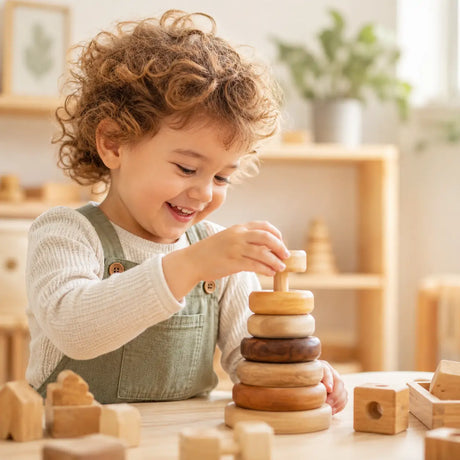
Independent play is any time your child directs their own play — stacking blocks, lining up figures, flipping through a board book, or turning a cardboard box into a boat — while you stay nearby but let them lead. It is different from parallel play with a sibling or a caregiver-led activity. The child chooses what to do and how to do it.
Why it matters comes down to development. The American Academy of Pediatrics, in its clinical report The Power of Play, puts it plainly: "Play is not frivolous: it enhances brain structure and function and promotes executive function." Executive function is the set of skills behind attention, impulse control, and flexible thinking — the quiet groundwork for later learning. Self-directed play is where toddlers practice those skills on their own terms.
There are everyday benefits, too. Independent play encourages focus, problem-solving, and creativity. Lovevery's child-development team notes that solo play may be linked to divergent thinking — the ability to look at a problem and see several paths forward. It also gives children a genuine sense of "I can do this," which supports confidence and emotional resilience. And, practically speaking, it gives you a few minutes to start dinner or answer an email without guilt.

How long should a toddler play independently?
Far shorter than most parents expect — and that is completely normal. A young toddler's attention span is measured in minutes, not half-hours, so early independent play sessions are brief by design.
According to guidance from PBS KIDS for Parents, a rough attention-span rule of thumb looks like this:
- 2-year-olds: about 5 to 6 minutes of focused play
- 3-year-olds: up to about 8 minutes
- 4-year-olds: up to about 10 minutes
Lovevery offers similar estimates, noting that independent play can begin as early as six months, with babies managing a couple of minutes, one- to two-year-olds around four minutes, and three- to four-year-olds up to roughly eight minutes at a stretch. These numbers naturally lengthen between ages one and three-and-a-half as focus matures.
Treat these as starting points, not targets. A toddler who is tired, hungry, teething, or coming down with something will focus for less time, and that is fine. If your child plays alone for three minutes today, that is a win to build on — not a problem to fix.
Why won't my toddler play alone?
If your toddler trails you from room to room and melts down the moment you step away, you are in very good company. There are a few common, developmentally normal reasons behind it.
They are wired for connection. Toddlers are learning that they are safe and secure, and staying close to you is how they check. Separation anxiety, especially around 12 to 24 months, is a healthy stage, not a setback.
The environment is working against them. If a play space is full of "no" — cords, breakables, or off-limits drawers — a child cannot relax into play, and you end up hovering. A space that constantly requires supervision makes independent play nearly impossible.
There are too many toys, or the wrong ones. A jumbled bin of thirty toys can overwhelm rather than invite. Toys that only do one thing, or that entertain with lights and sounds, tend to hold attention for a shorter time than open-ended toys a child can use many different ways.
Screens have reset the baseline. A 2025 University of Michigan C.S. Mott Children's Hospital National Poll on Children's Health found that 78% of parents of 3-to-5-year-olds use phones or tablets for play, often to keep a child occupied. Fast-moving screens can make slower, self-directed play feel less exciting by comparison, which is one reason many experts suggest keeping screens out of the play space.
How do I encourage independent play at home?
The Montessori approach offers a calm, repeatable path: set up the environment, connect first, then step back gradually. Here is how the pieces fit together.
Prepare a "yes space." Create a small, genuinely safe area where almost everything is allowed. As Montessori educator and parent Sarah of Montessori in Real Life puts it, "it's nearly impossible to expect a child to play independently if we have to keep hovering and telling them 'no.'" Lock away hazards, anchor furniture, and let your child roam and explore without a running commentary of corrections.

Fill the cup first. Independent play tends to follow connection. PBS KIDS for Parents suggests 15 to 20 minutes of engaged, together playtime before inviting your child to play on their own. A short burst of undivided attention often makes a toddler more willing to wander off and explore solo afterward.
Start with five minutes. If solo play is new, begin with about five minutes. Get your child started with an inviting activity, narrate briefly, then say something simple like, "I'm going to fold laundry right here while you build." Stay within sight and earshot, and stretch the time as your child grows comfortable.
Protect concentration. When your toddler is absorbed in something, resist the urge to praise, correct, or jump in with a "better" way. In Montessori, a child's focused play is treated as meaningful work. The less you interrupt, the longer those pockets of concentration tend to grow.
Let a little boredom happen. When your child says "I'm bored," you do not have to solve it instantly. As PBS KIDS for Parents notes, "boredom is the bridge to creativity, imagination, and new ways to play." Giving a toddler space to find their own next idea is part of how independent play develops.
Independent play and attention tend to grow together, so if focus is your real concern, our guide to helping a toddler build focus without forcing it is a natural companion to the setup above.
Which toys are best for independent play?
The best independent-play toys are open-ended: simple, well-made things a child can use in many ways, at just the right level of challenge. A toy that is too easy gets boring; one that is too hard gets abandoned. Aim for the sweet spot in between, and offer only a few options at a time.
Open-ended favorites that tend to sustain solo play include:
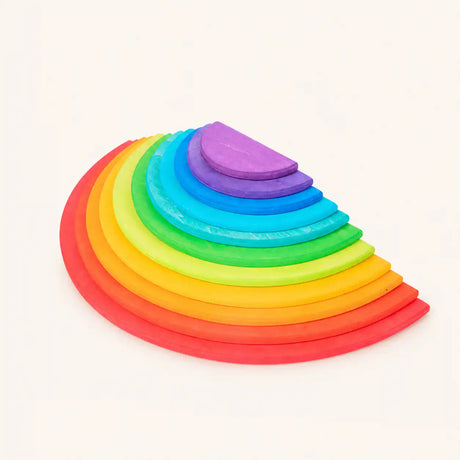
- Wooden blocks for stacking, sorting, knocking down, and building — endlessly reusable as skills grow.
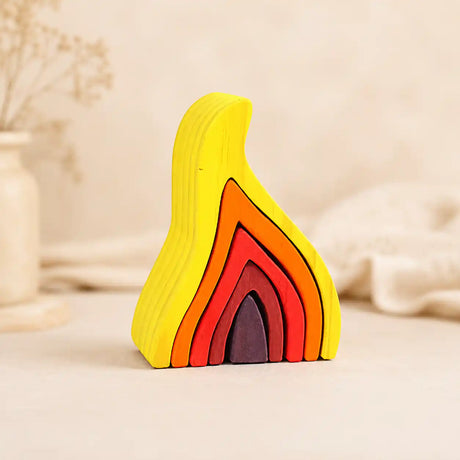
- Stacking and nesting toys that invite trial and error and reward focus.
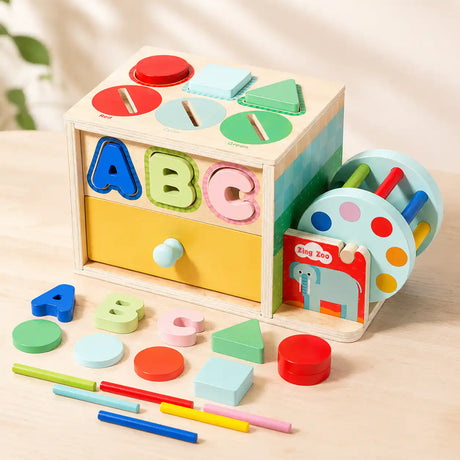
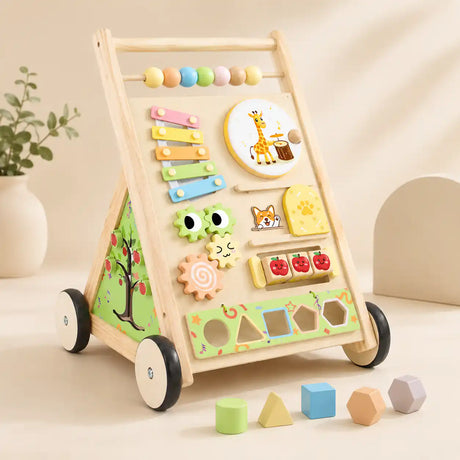
- Simple puzzles and shape sorters a child can attempt, fail, and retry on their own.
- Baskets of natural objects or figures for pretend play and storytelling.
- Everyday "loose parts" like cups, boxes, and scarves for open-ended exploration.

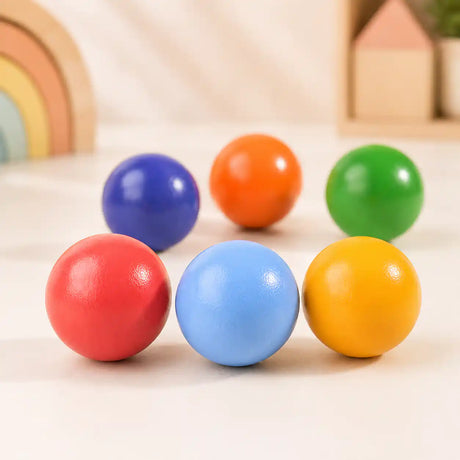
A quick word on quantity: fewer, better toys usually beat a full bin. Rotating toys — keeping most out of sight and swapping a few onto an accessible shelf every week or two — keeps the selection feeling fresh without constant shopping. If you are curating a small, open-ended collection, our wooden building blocks and the broader range of wooden toys are designed for exactly this kind of hands-on, self-directed play. As with any toy, check the age grading and keep small parts away from children who still mouth objects; adult supervision is always recommended.
A gentle two-week starting plan
If you like a concrete starting point, try this low-pressure rhythm. Adjust freely to your child.
- Days 1–3: Tidy and simplify the play space into a small "yes space" with four or five open-ended toys on a low shelf. Play together, and just observe what your child gravitates toward.
- Days 4–7: After 15–20 minutes of together time, help your child start an activity, then step a few feet away for about five minutes while you do a quiet task nearby. Return warmly before frustration sets in.
- Days 8–11: Stretch to 8–10 minutes when it is going well. Rotate one or two toys to renew interest. Keep resisting the urge to interrupt focused play.
- Days 12–14: Aim for one slightly longer stretch a day at a predictable time — often mid-morning, when toddlers are rested and fed. Celebrate quietly, and expect some up-and-down days.
Progress is rarely a straight line. A new tooth, a growth spurt, or a clingy week can shrink independent play for a while, and that is normal. Keep the environment inviting and the pressure low, and the skill tends to return on its own.
Frequently asked questions
At what age can a toddler play independently?
Brief solo play can appear as early as six months and grows steadily through the toddler years. Expect only a few minutes at first, gradually lengthening between ages one and three-and-a-half as attention matures.
How long should independent play last?
Use age-based attention spans as a guide: roughly 5–6 minutes at age two, up to 8 minutes at three, and up to 10 minutes at four. Tiredness, hunger, or teething will shorten it, so treat these as flexible starting points.
Is it bad if my toddler wants me to play with them all the time?
Not at all — wanting connection is healthy and normal, especially during separation-anxiety stages. Building independent play alongside plenty of together time supports your child; it does not replace your role.
What toys are best for encouraging solo play?
Open-ended toys a child can use many ways — wooden blocks, stacking and nesting toys, simple puzzles, and baskets of loose parts — tend to sustain focus far better than single-function or light-and-sound toys. Offer a few at a time and rotate them.
Should I use screens to keep my toddler busy instead?
Screens can occupy a child, but fast-moving media can make slower, self-directed play feel less rewarding by comparison. Many experts suggest keeping screens out of the play space so independent play has room to develop.
References
- Encouraging Independent Play for Toddlers and Preschoolers (Rebecca Parlakian) — PBS KIDS for Parents (2021)
- Independent Play: What it is and why it's important — Lovevery
- The Power of Play: A Pediatric Role in Enhancing Development in Young Children (Yogman et al.) — Pediatrics, American Academy of Pediatrics (2018)
- Parent perspectives on play — C.S. Mott Children's Hospital National Poll on Children's Health, University of Michigan (2025)
- Encouraging Independent Play — Montessori in Real Life (2019)