If your toddler keeps throwing food off the highchair, dumping every basket of toys onto the floor, or doing the same small action again and again, the most likely explanation is a play schema — a normal, healthy pattern of repeated behavior that helps young children learn how the world works. Play schemas are not misbehavior and not a sign that anything is wrong. They are one of the ways a toddler’s brain organizes new information, and once you can name what your child is exploring, a lot of “why does my toddler do that?” moments suddenly make sense.
In this guide we’ll explain what play schemas are, why toddlers throw and dump so enthusiastically, the most common schemas you’ll see between roughly 12 months and 4 years, and gentle, practical ways to support this stage at home without turning your living room into a demolition zone.
Think of it as a translation key. The behavior that looks random or frustrating is usually a toddler running the same little experiment over and over, gathering data with their whole body.
What are play schemas?
A play schema is a repeated pattern of action that a child returns to again and again as they explore an idea. It is not tied to one specific toy or activity — it’s the underlying action the child is drawn to, whether that’s moving things through the air, carrying objects from room to room, or wrapping everything in a blanket.
The idea has deep roots in child development. The term “schema” comes from the work of psychologist Jean Piaget, and in the 1970s the British researcher Chris Athey studied these patterns closely as part of the Froebel Early Education Project, observing children aged two to six to understand how they build knowledge of the world. Athey described a schema as “a pattern of repeatable behaviour into which experiences are assimilated and that are gradually co-ordinated.” In plain language: children repeat an action across lots of different situations until they truly understand it.
That repetition is the point, not a problem to be solved. When a toddler drops a spoon from the highchair for the twentieth time, they aren’t being difficult — they’re confirming that objects fall every time, testing whether the sound changes, and watching what the grown-up does next. Each repetition adds a little more certainty.
Why does my toddler throw, drop, and dump everything?
Throwing and dumping are usually expressions of the trajectory schema — a fascination with how objects (and their own bodies) move through space. It’s one of the earliest and most visible schemas, and it tends to arrive right around the time toddlers gain the coordination to make it happen.
There’s a lot of learning packed into a thrown block. According to early childhood specialists, throwing helps little ones practice both fine and gross motor skills and builds hand-eye coordination, muscle strength, and motor planning. It’s also how toddlers explore cause and effect — gravity, the weight of an object, and what happens when something travels across the room. And because it reliably gets a reaction, throwing can even be an early, pre-verbal form of social play and communication.
Development tends to follow a rough timeline, though every child is different:
- 9–12 months: intentional dropping begins — releasing objects on purpose to watch them fall.
- 12–18 months: true throwing emerges as arm control improves.
- 18–24 months: aim and precision sharpen, including overhand throws.
- 24–30 months: a better grasp of “what can and can’t be thrown,” and throwing usually begins to ease.
Dumping fits the same picture. Emptying a basket, tipping out a bin of blocks, or unpacking a drawer lets a toddler see everything at once, hear the satisfying clatter, and experience the difference between full and empty. It looks like a mess to us; to them it’s a tidy little lesson in quantity, volume, and cause and effect.

The most common toddler play schemas
Most toddlers move through several schemas, sometimes exploring more than one at a time. You don’t need to memorize the list — it’s simply a lens that makes everyday play easier to read. Here are the patterns you’re most likely to notice.
| Schema | What it looks like | What it helps build |
|---|---|---|
| Trajectory | Throwing, dropping, rolling, kicking; moving their own body up and down | Motor coordination, cause and effect, early physics |
| Transporting | Carrying objects from place to place, filling bags, baskets, and pockets | Planning, sequencing, spatial awareness |
| Enveloping | Covering or hiding objects — and themselves — with blankets, cloths, or paint | Object permanence, sensory exploration |
| Enclosing | Building borders and fences, putting toys inside boxes or drawn circles | Boundaries, containment, early geometry |
| Rotation | Spinning wheels, twisting lids, turning in circles, watching things whirl | Understanding of movement and circular motion |
| Connecting | Joining and separating — train tracks, sticky tape, pegs, linking rings | Fine motor control, relationships between parts |
| Positioning | Lining objects up, ordering by size or color, insisting things go “just so” | Order, sorting, early math thinking |
| Transforming | Mixing, mushing, adding water — changing how something looks or feels | Curiosity, states of matter, experimentation |
| Orientation | Hanging upside down, peering between their legs, viewing from new angles | Spatial reasoning, perspective |
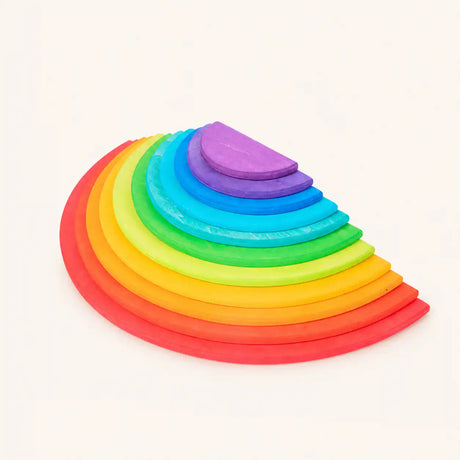
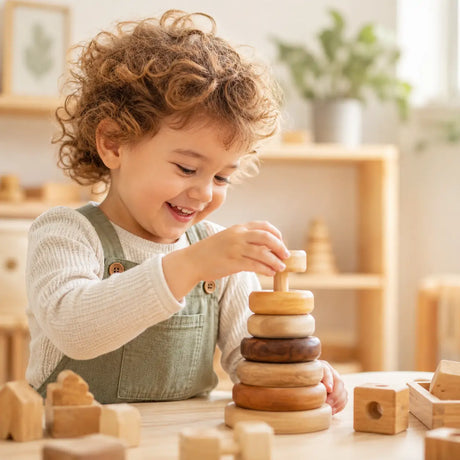
Notice how many of these map onto classic open-ended toys. A set of wooden building blocks can feed the enclosing schema one week and the trajectory schema the next, which is part of what makes simple, versatile toys so useful during these years.
How do I know which schema my toddler is exploring?
The trick is to watch the action, not the object. A toddler in a transporting phase might empty a bookshelf, load up a toy dump truck, and stuff snacks into a handbag — three unrelated toys, one clear pattern of moving things from A to B.

A few things help you tell a genuine schema from a passing interest:
- It repeats across days and settings. A true schema shows up at home, at the park, and at grandma’s — not just once.
- It survives different materials. The same action appears with water, blocks, food, and toys.
- It’s driven from within. Nobody taught it; your child keeps returning to it on their own.
Early years educators recommend simply observing over a week or two before drawing conclusions. Once you spot the pattern, you can gently offer more of what your toddler is already hungry to explore — which is far more effective than trying to redirect the behavior away entirely.
This is also why a “new” toy sometimes gets ignored while an empty box gets loved for a month. If you’re curious about that mismatch, our guide on why toddlers love to sort looks at the positioning schema in more depth.
How can I support schema play safely at home?
Supporting a schema doesn’t mean buying more toys. It usually means offering an acceptable version of the action your child already wants to do, then stepping back and letting them repeat it. Here are gentle setups for the most common schemas:

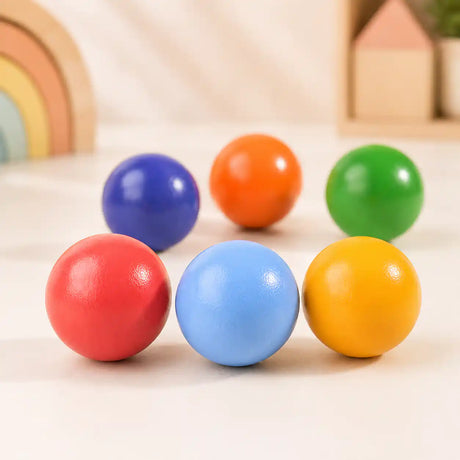
- For throwing (trajectory): keep a basket of soft balls or rolled-up socks and a laundry hamper “target.” When you say “we don’t throw blocks,” you can add “— but you can throw these.”
- For dumping and carrying (transporting): offer a small bag, basket, or cart and a set of items that are meant to be moved. Open-ended wooden sorting sets are a natural fit, because filling and emptying is the whole activity.
- For hiding (enveloping): a few scarves, a cardboard box, and a blanket fort go a long way.
- For spinning (rotation): toys with wheels, spinning tops, or a simple salad spinner in the kitchen.
- For lining up (positioning): let them arrange and re-arrange; resist the urge to “fix” the order.
Two small mindset shifts make a big difference. First, resist demonstrating the “right” way. Schema play is trial-and-error learning, and children get more out of figuring it out than being shown. Second, plan for the mess. A defined mat, tray, or corner gives the repetition somewhere to happen, so you can say yes more often than no.
Because schemas are about actions rather than specific products, you rarely need a lot of toys — you need a few open-ended ones that can be used many ways, plus a little patience for the hundredth repetition. Adult supervision is always recommended, especially with small parts, water play, and anything a younger sibling might reach.
When should I redirect — and when should I check in?
Some schema behavior genuinely needs redirecting — throwing hard toys near faces, dumping something breakable, or climbing to view the world from the top of the bookshelf. The goal isn’t to stamp out the schema but to give it a safer outlet. Staying calm, keeping your response neutral, and consistently offering an allowed alternative works better than a big reaction, which can accidentally make the behavior more fun to repeat. Expect it to take time, repetition, and plenty of support before habits shift.
Play schemas themselves are a typical part of early development, not a cause for worry. That said, you know your child best. If you have questions about your toddler’s development, movement, or behavior, your pediatrician or a qualified early childhood professional is always the right person to ask — not because schema play is concerning, but because personalized guidance beats any general article. Trust your instincts and reach out whenever something doesn’t feel right to you.
Frequently asked questions
At what age do play schemas start?
Many schemas become noticeable in early toddlerhood, roughly from 12 months as movement and coordination develop, and they continue through the preschool years. The trajectory schema (throwing and dropping) often appears first, sometimes as early as 9–12 months with intentional dropping.
Is throwing and dumping normal, or is my toddler misbehaving?
It’s typically normal and developmentally healthy. Throwing and dumping help toddlers explore cause and effect and practice motor skills. The behavior usually needs guiding toward safe outlets rather than stopping altogether, and it tends to ease as children get older.
Should I stop my toddler from repeating the same play over and over?
Repetition is how schema learning works, so it’s best supported rather than interrupted — as long as it’s safe. Offering acceptable versions of the action lets your child get the practice they’re seeking.
What toys are best for schema play?
Open-ended toys that can be used many ways tend to serve schemas best — blocks, stacking and sorting sets, balls, containers, and simple wooden pieces. Because schemas are about actions rather than specific toys, versatile basics usually beat single-purpose gadgets.
Can my toddler have more than one schema at once?
Yes. Children often explore several schemas at the same time, or move between them, which is completely normal. Watching for repeated actions across different toys is the easiest way to spot which patterns are currently in play.
Understanding play schemas won’t make the tenth spoon-drop of the morning less tiring — but it does change what you see. Underneath the mess is a curious little mind running the same experiment until it makes sense, one throw, dump, and repeat at a time. That’s smart play for little growing minds.
References
- Recognizing Play Schemas Can Transform Your Early Learning Practice — Community Playthings, Heather Bernt-Santy (2025)
- Schemas: Repeated Patterns of Behaviour (citing Athey, 2007) — Birth to 5 Matters
- Play Schemas and Why They Matter — Famly (2024)
- What Are Play Schemas and How Do They Help Your Toddler Learn? — Lovevery
- Why Your Toddler Throws Everything — The Bump (2024)