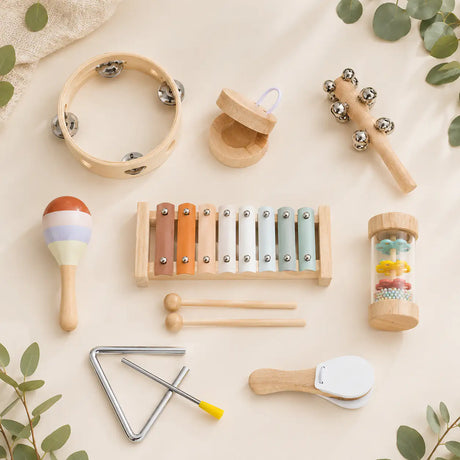
You don't need a dedicated playroom to bring Montessori home. In a small apartment, a Montessori play space is really just three things: a low shelf the child can reach, a small defined area to work in, and a few well-chosen toys displayed with room to breathe. The "prepared environment" is about accessibility and calm, not square footage. This guide is part of our Montessori Basics hub.
Here's how to set up a calm, functional Montessori space in a small home — the essentials, some room-by-room ideas, and a few space-smart toys that pack a lot into a small footprint.

Key takeaways
- A Montessori space needs accessibility and calm, not a whole room — a corner is plenty.
- A low open shelf with just a few toys on display is the single most important element.
- Less on show means more focused play; store the rest and rotate.
- A small rug or mat quietly defines the work area in an open-plan home.
- All-in-one toys and busy boards deliver lots of skills in a small footprint.
What is a "prepared environment" in a small space?
In Montessori, the "prepared environment" is a space arranged so a child can choose, use, and put away activities on their own. In a small home that translates to a few practical ideas: keep things low and reachable, show only a little at a time, give every item a clear home, and leave enough floor for a child to spread out and move. Done well, it actually makes a small space feel calmer, because there's less clutter competing for attention.
The five essentials of a small-space Montessori setup
You can create a complete setup with just these five pieces, in almost any footprint.
1. A low, open shelf
One or two low shelves at your child's height, holding a handful of activities facing outward. Low and open is what lets a toddler serve themselves — the whole point of the setup.
2. A defined work area
A small rug, mat, or sheepskin gives the child a visible boundary for their work. In an open-plan flat, this one item quietly turns "the living room floor" into "my space."
3. A mirror and a little movement space
A low, securely fixed mirror and a clear patch of floor support movement and self-awareness — no gym required. Even a metre of clear floor is enough for a young toddler.
4. A few toys, beautifully displayed
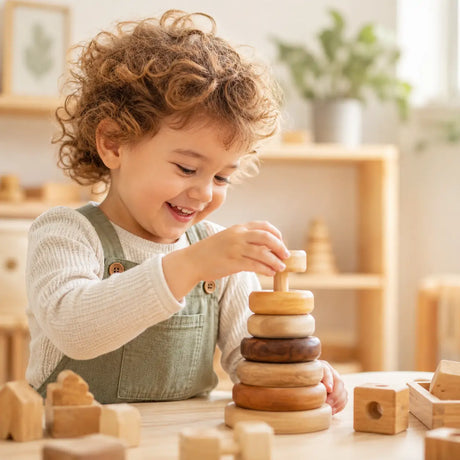
Show four to eight activities at a time, spaced apart so each one is easy to see and choose. Our wooden toys are chosen to display well and hold up to daily use.
5. A small practical-life spot
A low hook for a cloth, a little basket with a dustpan, or a step stool at the sink invites your child into real home life — the heart of Montessori, and free.
Room-by-room ideas for tiny homes
No spare room? A Montessori space fits into corners you already have. A living-room corner with a low shelf and a rug is the most popular choice. The foot of the bed or a bedroom nook works for quieter activities and books. Even a wide hallway can hold a slim shelf and a mirror. The goal is a calm, defined pocket — not a themed room.

Keeping it from taking over: storage and rotation
The secret to a small-space setup is showing less. Keep most toys in a closet or under-bed box, and put out only a few at a time. Swapping them every week or two keeps play feeling fresh without buying more — the toy your child ignored last month often becomes a favourite when it reappears. Our guide to Montessori toy rotation walks through a simple system.
All-in-one toys for small spaces
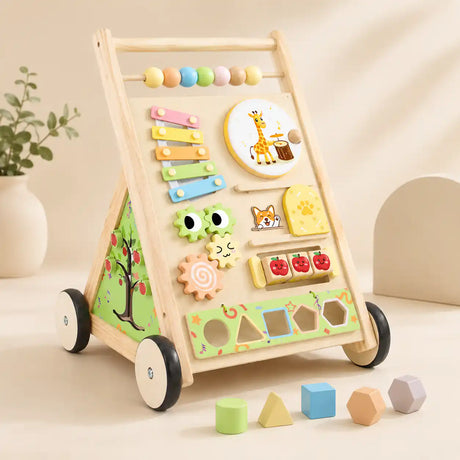
When floor space is tight, a single well-made activity toy can stand in for a whole shelf of separate ones. A wooden Montessori learning board packs sorting, counting, and fine motor practice into one compact piece. Browse more in our activity centers & all-in-one toys collection.

 Wooden 10-in-1 Activity Walker
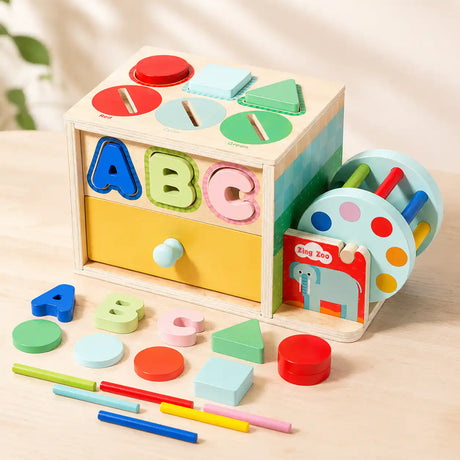
 Wooden 6-in-1 Activity Cube
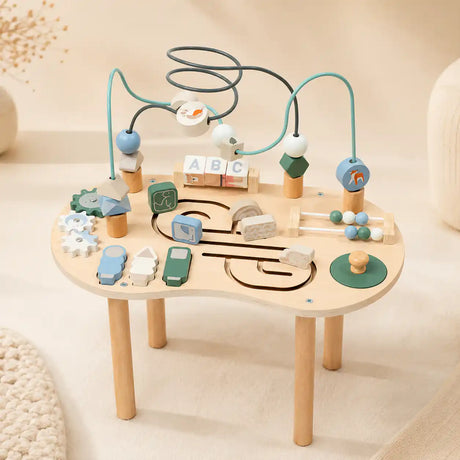
 Wooden Activity Table
 Wooden 8-in-1 Activity Cube
 Montessori Busy Book Set
Busy boards: big play, small footprint
Busy boards are a small-space favourite because they gather latches, laces, gears, and switches onto one flat surface that can lean against a wall or slide behind the sofa. They're ideal for independent, seated play in a tight spot. A wooden Montessori busy board is a sturdy starting point; see more in our busy boards collection.

A small-space Montessori checklist
If you're starting from scratch, this is all you really need.
| Element | Why it matters | Small-space tip |
|---|---|---|
| Low open shelf | Lets the child choose independently | One slim shelf against any wall |
| Defined mat or rug | Marks the work area | A small washable rug rolls away |
| A few displayed toys | Focus over overwhelm | Show 4–8; store the rest |
| Mirror + floor space | Movement and self-awareness | A low, securely fixed mirror |
| Practical-life spot | Real-life participation | A hook, a cloth, a step stool |
Frequently asked questions
-
Do you need a whole room for a Montessori setup?
No. A calm corner with a low shelf, a small defined mat, and a few well-chosen toys is a complete Montessori space. Accessibility and order matter far more than square footage. -
How do I do Montessori in a small apartment?
Use a low shelf the child can reach, display only a few activities at a time, define the area with a small rug, and store and rotate the rest. Choose space-smart toys like all-in-one activity boards. -
How many toys should be out at once?
Usually four to eight, spaced apart so each is easy to see and choose. Fewer toys on display tend to lead to longer, more focused play, which is a bonus in a small home. -
Where do I store the toys that aren't out?
A closet shelf, an under-bed box, or a lidded basket works well. Keeping the off-duty toys out of sight is what makes rotation feel fresh and keeps the space uncluttered. -
What furniture do I actually need?
At minimum, one low open shelf and a small rug or mat. A low mirror and a step stool are helpful additions but not essential to start. -
Is Montessori at home expensive to set up?
It doesn't have to be. A single low shelf, a few natural toys, and everyday practical-life items go a long way. You can add pieces gradually rather than buying a full setup at once.
A note on safety: in a small space, secure shelves and mirrors to the wall, keep the area free of tip and trip hazards, and follow the age guidance and supervision notes on each product listing. Keep small parts away from children who still put things in their mouths. Adult supervision is recommended during play.
Last reviewed: July 2026.
Sources & further reading
- American Montessori Society — What Is Montessori
- University of Toledo — Fewer Toys Lead to Richer Play Experiences, UT Researchers Find