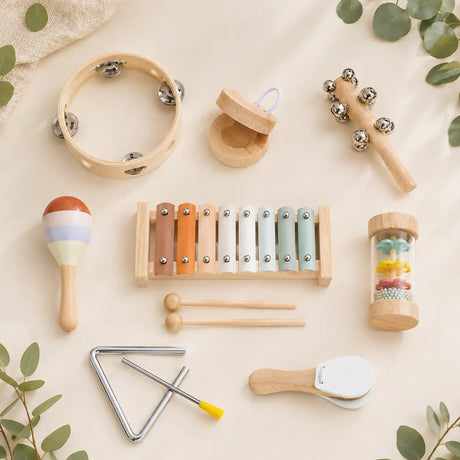
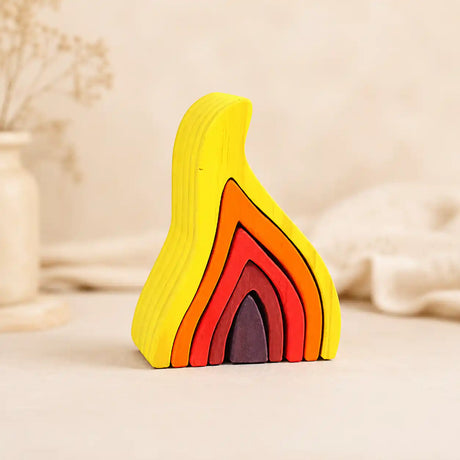
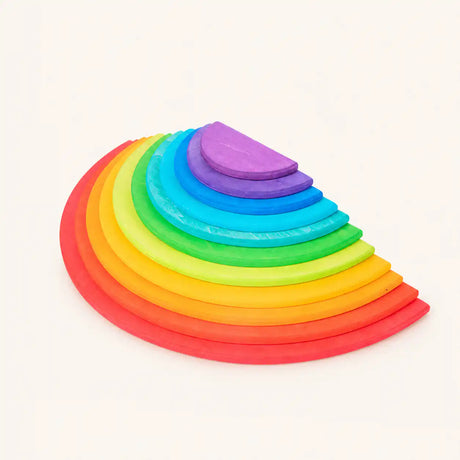
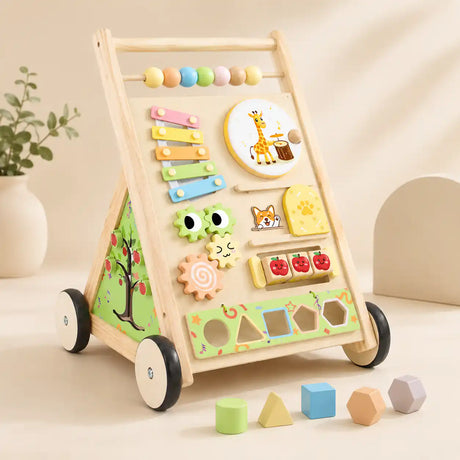
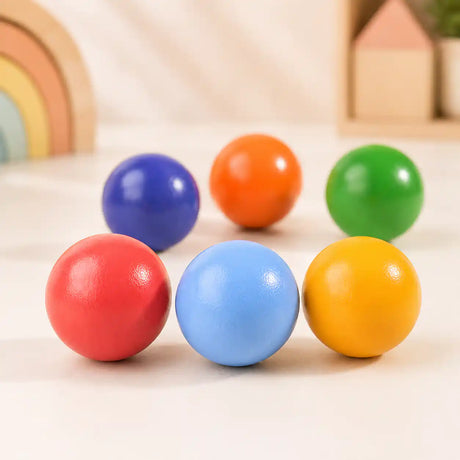
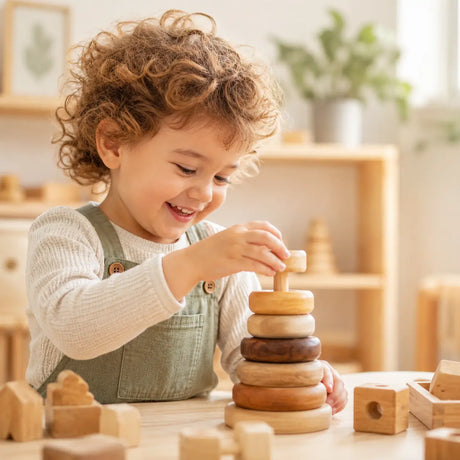
The best Montessori stocking stuffers for toddlers are small, chunky, open-ended, and genuinely useful: think a wooden balancing stacker, a large peg doll, oversized lacing beads, a toddler-sized spoon or apron, or a sturdy board book. The one rule that matters more than any idea list is size. Stockings are where tiny trinkets end up, and for children under three, anything small enough to fit through a toilet-paper tube can be a choking risk.
Stocking stuffers have a reputation for being the "filler" part of the holidays: party-favor toys, plastic novelties, and candy that's forgotten by lunch. For a toddler, though, a stocking can be the most exciting part of the morning. A few thoughtful, well-sized things pulled out one at a time is a real delight at this age, and it doesn't take a big budget.
This guide walks through what makes a good Montessori-inspired stocking stuffer, the safety check every item should pass, age-by-age ideas, and what to quietly leave out.
What makes a good Montessori stocking stuffer?
A Montessori-inspired stocking stuffer follows the same principles as any good toddler toy, just in a smaller package. It should invite your child to do something with their hands, match what they're working on developmentally, and hold up to real use. The Montessori-at-home blog The Kavanaugh Report sums up the stocking-stuffer challenge well: parents want items that won't fall apart, that suit the child's interests, and that will actually get used, while still being small and affordable.
When you're standing in a store aisle or scrolling late at night, a quick filter helps. A good toddler stocking stuffer usually checks most of these boxes:
- Hands-on: it's stacked, threaded, opened, poured, or held, not just watched.
- Simple: one clear purpose or open-ended play, no lights or sound effects doing the work.
- Natural or durable materials: solid wood, thick fabric, sturdy board pages, or food-grade silicone.
- Right-sized: big enough to be safe, small enough to fit in the stocking.
- Matched to the stage: chosen for what your child is practicing now, not what the package says they "should" like.
That last point is the heart of the Montessori approach. Follow the child. A toddler who's obsessed with putting things in and taking them out will get far more from a small posting toy than from something clever but beyond their reach.
Why toddler stockings need a safety check
Stockings are uniquely tricky for families with young children. The format rewards small items, and small is exactly what makes some objects hazardous for toddlers, who still explore the world with their mouths.
The numbers are a useful reminder. According to the U.S. Consumer Product Safety Commission (CPSC), an estimated 154,700 children ages 12 and under were treated in emergency rooms for toy-related injuries in 2023, and 10 children died in toy-related incidents. Among the leading causes of those deaths: choking on small balls or crayons. For children under 5, ingestion was the second most common injury diagnosis. Small bouncy balls and novelty crayons happen to be classic stocking fillers, which is why a quick check before anything goes in the sock is worth the minute it takes.
The small-parts check
Federal rules ban small parts in toys intended for children under three. The CPSC defines a "small part" as anything that fits entirely into a standard test cylinder that approximates the size of a young child's fully expanded throat. That cylinder is about 2.25 inches long and 1.25 inches wide. At home, many parents use a toilet-paper tube as a rough stand-in: if an item (or a piece that could break off) slides inside, keep it out of a toddler's stocking.
The CPSC also recommends keeping small balls and toys with small parts away from children younger than 3, keeping deflated balloons away from children under 8, and throwing away plastic wrap and packaging as soon as gifts are opened. For a deeper explanation of age labels and choking hazards, our plain-language guide to small parts and choking hazards covers it step by step.
Watch for button batteries
Light-up wands, musical cards, and tiny electronic gadgets often run on coin or button batteries. CPSC guidance says toys with these batteries should have a secured compartment that takes a screwdriver, coin, or tool to open. If a stocking item has an easy-open battery door, or if spare batteries are packed in, it's safer to skip it. Adult supervision is recommended with any battery-powered toy.
Montessori stocking stuffer ideas by age
Ages are approximate. Every child develops at their own pace, so use this as a starting point and adjust to what you see your toddler reaching for.

| Age | What they're working on | Stocking stuffer ideas |
|---|---|---|
| 12–18 months | Grasping, releasing, in-and-out play, first words | Large wooden peg doll, chunky board book, simple posting or drop toy, soft fabric ball too big to swallow |
| 18–24 months | Stacking, early balance, two-handed coordination | Small wooden stacker, wooden balancing toy with large pieces, fabric busy book, toddler-sized cup for pouring practice |
| 2–3 years | Threading, sorting, pretend play, language bursts | Oversized lacing beads on a thick cord, a few chunky play-food pieces, matching or memory cards with large tiles, a child-sized apron |
| 3–4 years | Fine-motor precision, early counting, storytelling | Simple wooden puzzle, wooden counting or sorting set (check age grading), chunky crayons for supervised drawing, small wooden vehicle |
A few favorites deserve a closer look.
Balancing and stacking toys
Small wooden balancing toys, like stacking animals or cactus-shaped pieces, fit neatly in a stocking and reward patience and hand-eye coordination. Look for chunky pieces that pass the small-parts check and a stable base so early attempts don't end in instant frustration.
Peg dolls and simple figures
A smooth wooden peg doll is one of the most open-ended toys a toddler can own. It rides in a toy car, goes to bed in a shoebox, and becomes the main character of a dozen made-up stories. Choose larger dolls for younger toddlers and save small sets with tiny accessories for later.
Threading and lacing sets
Around age two, many toddlers become fascinated with pushing a cord through a hole. Lacing sets with oversized wooden pieces and a thick, stiff-tipped string support the pincer grasp and bilateral coordination. Always check the bead size against the age grading, and supervise use.

Board books
Books are an easy, mess-free stocking win. Sturdy board books with real photographs or simple, realistic illustrations fit Montessori principles well, and reading one together is a calm way to slow down a busy morning.
If you'd like to browse small, giftable options in one place, our wooden gifts under $25 include several stocking-sized stackers, balancing toys, and lacing sets. Check the age guidance on each listing before purchase.
Practical-life stocking stuffers toddlers love
Some of the most-loved Montessori stocking stuffers aren't toys at all. In Montessori homes, "practical life" means the real, everyday tasks children are eager to do themselves: pouring, wiping, washing, dressing, and helping in the kitchen. Montessori writers often recommend child-sized tools as gifts because they invite independence and real contribution.

Practical-life ideas that fit in a stocking include:
- A toddler-sized apron for helping in the kitchen
- A small sponge or cloth and a mini spray bottle for "cleaning" a low table
- A child-sized wooden spoon, whisk, or mixing bowl
- A soft-bristled nail brush or toothbrush of their own
- A small pitcher and cup for pouring practice
- Cozy socks or slippers with grips, which many families tuck in every year
For older preschoolers, some families add a child-safe crinkle cutter or banana slicer for supervised food prep. These tools are designed for children but should always be used with an adult nearby. The joy on a toddler's face when they're handed a "real" job is hard to beat, and these gifts keep being used long after the wrapping is gone.
How many stocking stuffers does a toddler need?
Fewer than you might think. Many families keep stockings to a handful of items. The Kavanaugh Report shares that the author's children's stockings typically hold five or six items plus a couple of treats. For a one- or two-year-old, three or four well-chosen things is plenty.
A simple formula keeps stockings balanced without overbuying:
- Something to play with: a stacker, peg doll, or lacing set
- Something to read: one sturdy board book
- Something to use: a practical-life tool or cozy socks
- Something small and festive: a clementine, a simple ornament they can hang, or a sticker sheet for older preschoolers
This pairs naturally with a calmer approach to holiday gifting overall. If you're also planning the bigger presents, our 4-gift rule guide for toddlers follows the same "fewer, better" idea for under the tree.
Why fewer works better
Toddlers tend to engage more deeply with a small number of toys than with a large pile. A stocking with four meaningful items gives each one a moment in the spotlight. It also makes it easier to add the new pieces to your toy rotation in January rather than shelving them in a bin.
What to leave out of a toddler's stocking
Knowing what to skip is just as useful as an idea list. For toddlers under three especially, consider leaving out:
- Small balls and bouncy balls that fit in the small-parts cylinder
- Mini figurine sets and capsule toys with tiny accessories
- Balloons, which the CPSC advises keeping away from children under 8 when deflated or broken
- Coin-battery gadgets without a screw-secured battery door
- Water beads and squishy novelty toys that can be swallowed or broken apart
- Hard candies and small, round treats, which are common choking risks for young children
- Toys labeled 3+ when the stocking belongs to a younger child, especially if siblings share a space
That last point catches a lot of families. A 3+ toy in a big sibling's stocking can easily end up in a baby's hands by mid-morning. A quick sweep of wrapping paper, packaging, and loose pieces after the stockings are opened goes a long way.
Frequently asked questions
What are good stocking stuffers for a 1 year old?
Good stocking stuffers for a one-year-old are large, simple, and mouth-safe: a chunky board book, a big wooden peg doll, a soft fabric ball that's too large to swallow, or a simple drop-and-retrieve toy. Skip anything with small or detachable parts.
What are Montessori stocking stuffers for a 2 year old?
For two-year-olds, Montessori-friendly picks include small wooden stackers, balancing toys with large pieces, oversized lacing beads, a fabric busy book, a toddler apron, or a child-sized cup and pitcher for pouring practice.
How do I know if a stocking stuffer is safe for a toddler?
Check the age label first, then do a size check. If an item or any piece that could break off fits inside a toilet-paper tube, treat it as too small for a child under three. Avoid easy-open button-battery compartments, and supervise play with any new toy.
Are practical items good stocking stuffers?
Yes. Child-sized tools, aprons, cozy socks, and toothbrushes are classic Montessori stocking stuffers because they support independence and get used every day.
How much should I spend on a toddler's stocking?
There's no right number. Many thoughtful stockings come in under $25 to $40 total by mixing one or two small wooden toys with a book, a practical item, and a seasonal treat like a clementine.
A toddler's stocking doesn't need to be overflowing to feel magical. A few sturdy, well-sized treasures, chosen for the child in front of you and checked for safety, can turn into favorites that last well past the holidays. That's smart play, one small gift at a time.
References
- Happy Holidays Start with Safety: CPSC Urges Families to Cook, Decorate and Select Toys with Care This Season — U.S. Consumer Product Safety Commission (2024)
- Small Parts Ban and Choking Hazard Labeling — U.S. Consumer Product Safety Commission
- Small Parts Regulations and Warnings in the United States: An Overview — ComplianceGate
- Making Families Safer from Button Cell or Coin Battery Dangers; Reese's Law Leads to New Federal Mandatory Safety Standard — U.S. Consumer Product Safety Commission (2023)
- More Montessori Friendly Practical Stocking Stuffers — The Kavanaugh Report (2024)
- Inexpensive Montessori Toys: Gifts for Less than $10 — Carrots Are Orange