STEM-inspired toys that bring science, engineering, and early math thinking into hands-on toddler play. From marble runs and balance scales to wooden tool sets, each toy invites little ones to test, build, and observe.

![Wooden activity cube with yellow storage drawer open showing ABC letters and shape pieces neatly stored inside]()
![Smiling toddler in cream cardigan playing with the wooden 6-in-1 activity cube on a soft rug in a Montessori playroom]()
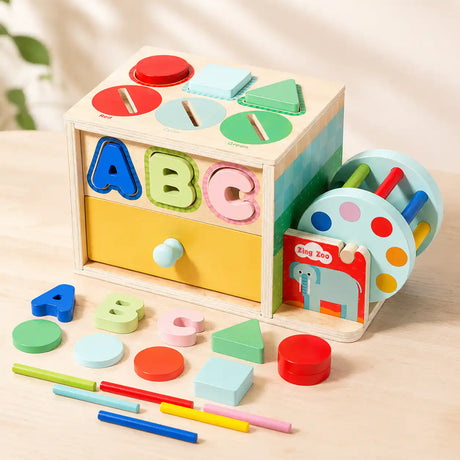
![Side view of wooden 6-in-1 activity cube showing shape sorter top with Red, Cyan, Green color slots and ABC letter puzzle front]()
![Back panel of wooden activity cube showing six rainbow pull-through sticks and a friendly lion illustration]()
![Side of wooden activity cube showing hippo illustration, peek-through hole, and shape slots for toddler play]()
![Wooden 6-in-1 activity cube with detachable rainbow drum and slide-out Zing Zoo elephant puzzle card]()
![Close-up detail of wooden rainbow drum with colored sticks and Zing Zoo elephant puzzle card attached to the activity cube]()
![Top-down view of yellow storage drawer holding all wooden activity cube pieces including ABC letters, shapes, color coins, and rainbow sticks]()
![Wooden 6-in-1 activity cube dimensions diagram showing 24.5 by 13.3 by 12.5 centimeters cube and individual piece sizes]() 1 Year+
1 Year+-
![Wooden rainbow semicircles shown alongside a JuniSprouts rainbow arch stacker, sold separately — Waldorf-inspired open-ended toy for preschoolers]()
![Preschool-age child placing the purple wooden semicircle on top of a fully nested rainbow stacker at a wooden table]()
![Close-up of wooden rainbow semicircles showing soft color wash and visible wood grain in classic Waldorf style]()
![Toddler hand reaching for the smallest purple semicircle of a wooden rainbow nesting set on a soft mat]()
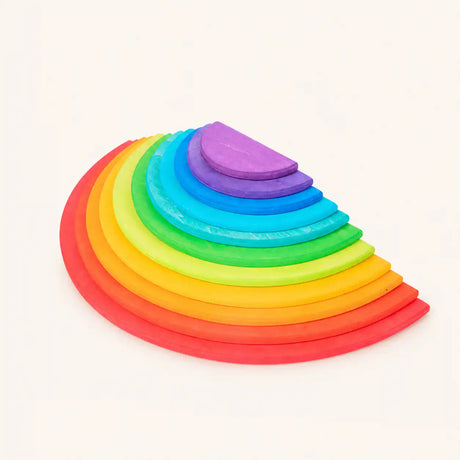
![11-piece wooden Waldorf rainbow semicircles nested from largest red to smallest purple in graduated sizes]()
![Wooden rainbow semicircles in an open-ended building scene with soft natural light, Waldorf-inspired loose parts play for preschoolers ages 4+]() 4 Year+
4 Year+ -
![Close-up of wooden activity table top showing bead maze loops, spinning gears, and rotating alphabet blocks]()
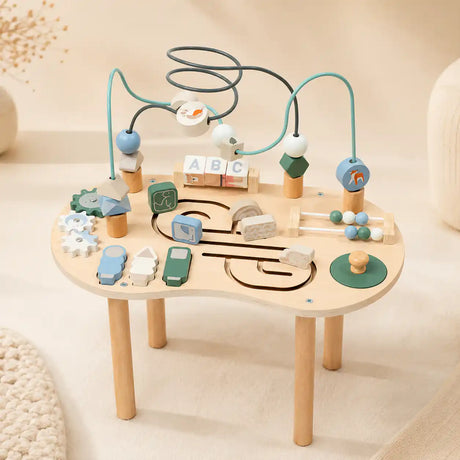
![Wooden Montessori activity table from above showing bead maze, sliding bear, spinning fox disc, and shape sorter for toddlers ages 1+]()
![Wooden Montessori activity table styled in a neutral nursery with soft natural light, ready for toddler play]()
![Side view of wooden activity table with carved sliding mazes, spinning fox disc, and pop-up spinner button]()
![Wooden Montessori table close-up of rotating ABC blocks for early alphabet recognition and fine motor play]()
![Detail of wooden activity table bead maze with colorful sliding beads on curved wire tracks]()
![Wooden activity table side panel featuring sliding bear and spinning fox disc for animal-themed pretend play]()
![Toddler exploring the wooden 10-in-1 activity table on a soft playroom rug, manipulating bead maze and turning gears]()
![Wooden activity table dimensions diagram, approximately 36 by 24 by 37 centimeters, designed for toddlers ages 1+]() 1 Year+
1 Year+ -
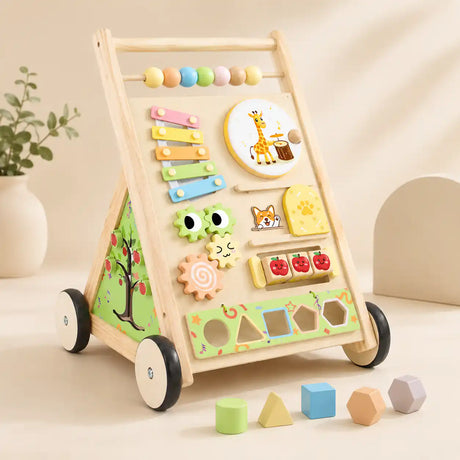
![Side view of wooden Montessori push walker showing magnifying viewer, rainbow slider, apple rollers, and sturdy wooden wheels for ages 1+]()
![Close-up of wooden activity walker top panel with colorful xylophone bars and turning wooden gears for toddler fine motor play]()
![Wooden activity walker side panel with peek-a-boo corgi door, giraffe drum, and apple tree busy board for toddler sensory exploration]()
![Toddler hands engaging the wooden walker's busy board panel — turning gears, opening doors, and exploring shape sorting]()
![Toddler standing and pushing the wooden Montessori activity walker across a soft playroom rug, building first walking confidence]()
![Wooden 10-in-1 activity walker feature breakdown showing xylophone, gears, drum, shape sorter, magnifying viewer, and apple rollers]()
![Wooden Montessori activity walker dimensions diagram, approximately 49.5 by 36.5 by 37 centimeters, designed for toddlers ages 1+]() 1 Year+
1 Year+ -
![Toddler hands placing a small teal disc on top of a rainbow wooden stacking tower]()
![Close-up of stacked rainbow wooden discs showing smooth matte finish and graduated sizes]()
![Wooden rainbow stacking discs tower beside a ruler and tape measure showing scale and size]()
![Young child smiling and stacking wooden rainbow discs into a tall tower on a soft nursery rug]()
![Wooden rainbow stacking discs arranged in several small balancing piles showing open-ended play options]()
![Wooden rainbow stacking discs balanced into a tall tower on a soft cream surface]()
![Wooden rainbow stacking discs tower with extra graduated discs resting beside it]() 3 Year+
3 Year+ -
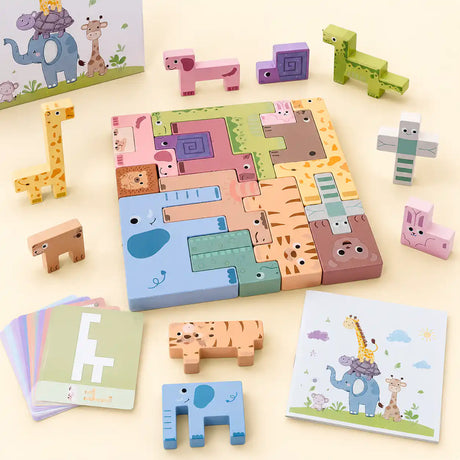
![Side angle of wooden animal puzzle stacker showing layered animal silhouettes and painted finish]()
![Small hands assembling the wooden animal puzzle stacker piece by piece on a warm neutral surface]()
![Flat lay of all wooden animal puzzle stacker pieces arranged in order showing each animal]()
![Close-up of a single wooden animal piece showing smooth painted finish and detail]()
![Wooden animal puzzle stacker beside a ruler and tape measure showing size and scale]()
![Wooden animal puzzle stacker styled in a warm nursery play scene]() 4 Year+
4 Year+ -
![Small hands placing felt pieces on a Montessori busy book activity page]()
![Close-up of Montessori busy book pieces with hook-and-loop attachments on a colorful page]()
![All activity pages of the Montessori busy book set laid out flat showing each themed scene]()
![Toddler engaged with the Montessori busy book set, exploring an interactive activity page]()
![Detail of the Montessori busy book cover and bound spine showing fabric and stitching]()
![Montessori busy book set beside a ruler showing size and scale]()
![Montessori busy book set styled in a warm nursery play scene]()
![Montessori busy book set closed on a soft cream surface, hero shot]()
![Montessori busy book set open showing multiple themed activity pages side by side]() 3 Year+
3 Year+ -
![Side angle of wooden rainbow arch stacker showing graduated arch sizes and rainbow color order]()
![Top-down view of wooden rainbow arch stacker showing nested arch shapes]()
![Close-up of a single wooden rainbow arch showing smooth painted finish]()
![Wooden rainbow arch stacker beside a ruler and tape measure showing size and scale]()
![Small hands placing a wooden rainbow arch onto the stacker on a warm neutral surface]()
![Wooden rainbow arch stacker styled in a warm nursery play scene]()
![Wooden rainbow arches arranged separately on a cream surface showing each color in the set]() 3 Year+
3 Year+ -
![Close-up of a single wooden rainbow stacking tablet showing smooth painted finish]()
![Side view of stacked wooden rainbow tablets showing color order and varied thickness]()
![Wooden rainbow stacking tablets styled in a warm nursery play scene]()
![Wooden rainbow stacking tablets beside a ruler and tape measure showing size and scale]()
![Wooden rainbow stacking tablets laid out in a line showing graduated sizes and rainbow color order]()
![Small hands stacking a wooden rainbow tablet on top of the tower on a warm neutral surface]()
![Wooden rainbow stacking tablets arranged into a pattern showing open-ended play options]() 3 Year+
3 Year+ -
![Top-down view of the wooden Montessori 10-in-1 learning board with stacked pattern cards, sorting bowls, all numbers, shapes, beads, fishing rod, and wooden tools]()
![Toddler in a white blouse using wooden chopsticks to play with the wooden Montessori 10-in-1 learning board in a softly lit nursery with sorting bowls and stacking pegs]()
![Side angle of the wooden Montessori 10-in-1 learning board showing counting tower pegs, numbers 1 to 10, shape pieces, math symbols, and a pyramid of colored wooden beads]()
![Close-up of the wooden Montessori learning board showing rainbow numbers 1 to 10, math operation symbols, shape pieces, and counting tower pegs with stacked rings]()
![Hands holding a colorful pattern card next to the wooden Montessori 10-in-1 learning board with bead grid, numbers, and sorting bowls]()
![Hand using a wooden spoon to place a colored bead on the wooden Montessori 10-in-1 learning board with sorting bowls and shape pieces]()
![Hand using the magnetic wooden fishing rod to lift a character peg above the wooden Montessori 10-in-1 learning board with beads, numbers, and sorting bowls]()
![Close-up of the wooden Montessori learning board showing chunky rainbow numbers 1 through 5, addition and subtraction symbols, and counting tower pegs in red, orange, and yellow]()
![Clean top-down view of the complete wooden Montessori 10-in-1 learning board set with pegs, numbers, shapes, beads, sorting bowls, fishing rod, tweezers, spoon, and wooden ruler]() 3 Year+
3 Year+ -
![Child's hand using a wooden punch tool on a colored peg in the hammer and peg pounding bench, with a soft-headed hammer in the foreground]()
![Side angle view of the wooden hammer and peg pounding bench showing teal painted legs, colorful pegs, hammer, and wooden punch tool on a warm cream background]()
![Wooden hammer and peg pounding bench styled in a Montessori-inspired playroom with pastel cloud, rainbow, and house-shaped wooden toys]()
![Wooden hammer and peg pounding bench size guide showing dimensions of the bench, 14 colored pegs, hammer, and punch tool in centimeters]() 3 Year+
3 Year+ -
![Young boy stacking a wooden 8 onto a number block tower with other natural wood numbers and dice spread across the table]()
![Preschool girl sitting at a white table playing with natural wood stacking number blocks, including a tall stack of 7 and 8]()
![Tall sculptural tower of natural wood stacking number blocks 0 to 10 with math operator pieces and wooden dice arranged below]()
![Natural wood stacking number blocks 0 to 10 arranged with math operator pieces and dice on a soft blue Montessori display]()
![Dimensions diagram for wooden stacking number blocks showing the 1, 5, 6, and 10 pieces with proportional heights and the 2 cm dice]()
![Wooden stacking number blocks arranged to spell the equation 3 plus 2 equals 5, showing how heights physically match the math]()
![Toddler girl smiling as she places a small wooden number block onto a tall stack of natural beech wood Montessori number blocks]() 2 Year+
2 Year+ -
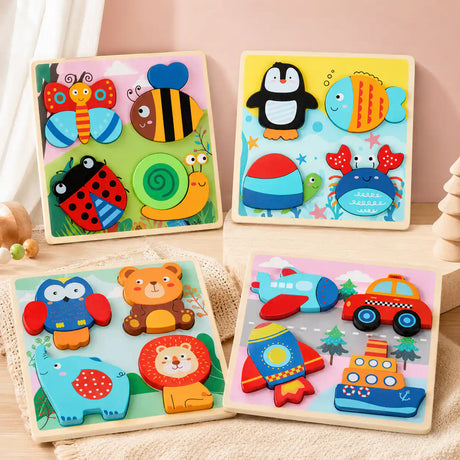
![Smiling toddler boy holding a wooden bee piece above the chunky puzzle set, with all 4 toddler puzzle boards spread across the table]()
![Flat-lay of the 4-pack wooden chunky puzzle set with garden bugs, ocean animals, forest friends, and vehicles puzzles for toddlers]()
![Wooden vehicles chunky puzzle board for toddlers with airplane, taxi, rocket, and ship pieces Montessori first puzzle]()
![Wooden forest animals chunky puzzle for toddlers with owl, bear, elephant, and lion pieces Montessori first puzzle]()
![Wooden ocean animals chunky puzzle for toddlers with penguin, fish, turtle, and crab pieces Montessori first puzzle]()
![Wooden garden bugs chunky puzzle for toddlers with butterfly, bee, ladybug, and snail pieces Montessori first puzzle]()
![Multi-panel collage showing children playing with the wooden chunky puzzle set, placing animal and vehicle pieces onto their boards]()
![Close-up details of the wooden chunky puzzle set with rocket, snail, elephant, and lion pieces with smooth rounded edges]()
![Wooden chunky puzzle gift set with sturdy printed box, dimensions 30 by 30 by 3 centimeters, showing all four toddler puzzle boards]() 2 Year+
2 Year+ -
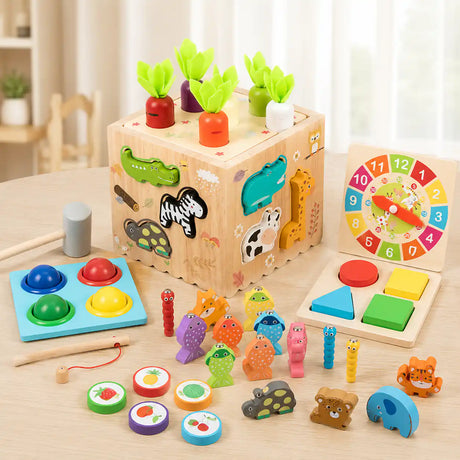
![Wooden activity cube with the whack-a-mole top showing four colored half-domes, wooden mallet, and chunky animal shape-sorter pieces on the sides]()
![Four interchangeable activity tops on the wooden cube including learning clock, geometric shape sorter, fruit memory discs, and colored whack-a-mole domes]()
![Wooden Montessori activity cube shown with four play modes including clock face, geometric shape sorter, fruit memory discs, and whack-a-mole domes]()
![Smiling toddler boy holding a magnetic fishing rod above the wooden activity cube, with carrots on top and animal sorter pieces and accessories on the table]()
![Close-up details of the wooden activity cube including pull-up felt-leafed carrots, chunky animal sorter pieces, and colored whack-a-mole domes]()
![Wooden Montessori activity cube with carrot top in place and six chunky wooden animal shape-sorter pieces including turtle, zebra, hippo, cow, and giraffe lined up beside it]()
![Wooden activity cube with magnetic fishing top showing colorful wooden fish and worms, with a child's hand holding the wooden fishing rod above]()
![Wooden Montessori activity cube with carrot harvest top, animal shape sorter sides, and dimensions of 13.5 by 13.5 by 16 centimeters]() 2 Year+
2 Year+ -
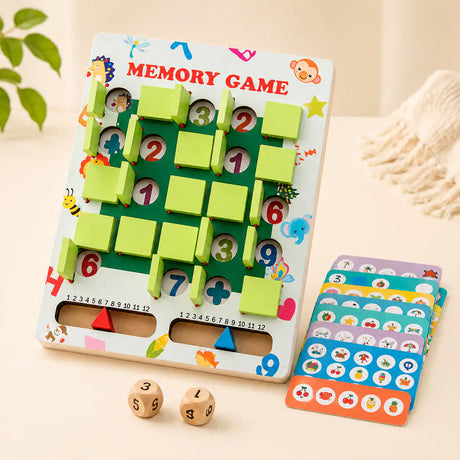
![Wooden memory game board with sliding tiles, red and blue triangle scoring markers, picture cards, and two number dice]()
![Toddler boy lifting a green sliding tile on the wooden memory game board, with a wooden number die on the table]()
![Child holding a purple picture card above the wooden memory game board, with additional picture cards spread out to the side]()
![Wooden Memory Game board with all green tiles in place, showing the printed title and picture cards alongside]()
![Wooden memory game play instructions panels 1 through 3 with picking a picture card, comparing it to the board, and matching hidden pictures]()
![Wooden memory game play instructions panels 4 through 6 with sliding tiles, finding matches, and completing the game]()
![Close-up details of the wooden memory game showing the sliding green tile construction, red cord attachment, and rounded board edges]()
![Dimensions diagram showing wooden memory game board at 26.2 cm by 21.8 cm by 1.9 cm, dice 1.5 cm, triangle markers 1.6 to 1.8 cm]() 3 Year+
3 Year+ -
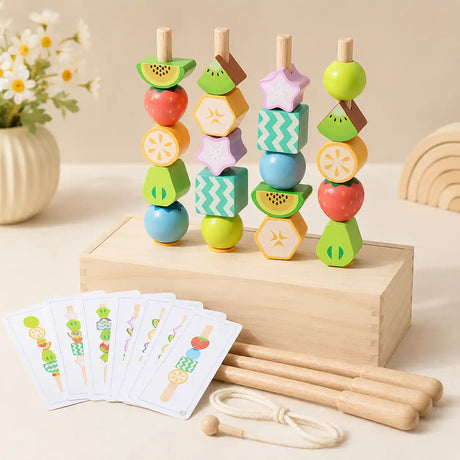
![Young child threading a wooden fruit bead onto a lacing stick, with a wooden tray of fruit beads and pattern cards on the table]()
![Smiling toddler placing a wooden kiwi bead onto one of four standing dowels in the wooden fruit bead stacking set]()
![Four wooden dowels with stacked fruit beads on a wooden box base, with three pattern cards leaning in front showing bead sequences]()
![Toddler hands threading colorful wooden fruit beads onto two wooden lacing sticks, pattern card visible in the background]()
![Close-up of wooden fruit beads in assorted shapes including kiwi, strawberry, star fruit, lemon hexagon, watermelon, pear, and patterned cube]()
![Wooden fruit bead set components laid flat with wooden box, dowels, lacing sticks, string, 25 fruit beads, and pattern cards]()
![Wooden box dimensions diagram showing 246 mm by 172 mm by 71 mm, with wooden dowels, lacing string, and 25 fruit beads laid out below]() 3 Year+
3 Year+ -
![Toddler sliding wooden beads across the golden arches of the Montessori counting abacus during supervised play]()
![Wooden 4-in-1 learning bundle styled on a wooden table with counting abacus, hexagon stacker, rainbow puzzle, and pull-along xylophone]()
![Wooden rainbow puzzle with 7 nested colorful arches in red, orange, yellow, light green, green, and dark green on a wooden tabletop]()
![Wooden hexagon shape stacker with 5 nested rings in orange, pink, light pink, cream, and teal on a dark wood base with center peg]()
![Wooden pull-along xylophone with 7 colorful metal bars, wooden mallet, yellow pull string, and dark wood base on wheels]()
![Close-up of the wooden 4-in-1 learning bundle showing the rainbow puzzle, abacus, xylophone, and hexagon stacker]()
![Size diagram for the wooden 4-in-1 learning bundle showing the dimensions of the abacus, xylophone, rainbow puzzle, and hexagon stacker in centimeters]()
![Child seated at a wooden table stacking a hexagon ring on the wooden Montessori stacker next to the rainbow puzzle]()
![Toddler tapping the colorful metal bars of the wooden pull-along xylophone with all 4 bundle toys nearby]() 3 Year+
3 Year+ -
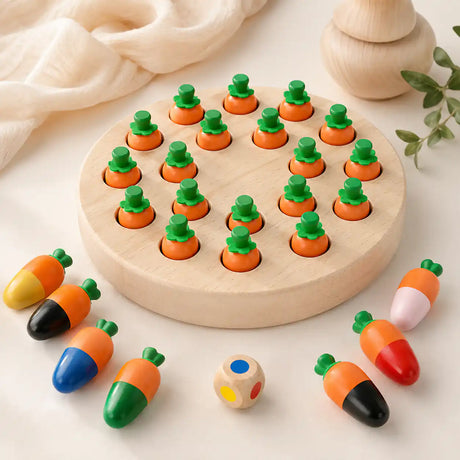
![Wooden carrot memory game showing six carrot colors, color die, and three-step game play diagram]()
![Wooden carrot memory game material details with smooth rounded edges, natural beech wood, and water-based paint]()
![Child playing wooden carrot memory game at a table, lifting a colored carrot from the wooden board]()
![Wooden carrot memory game Win Rule 1 illustration showing that the player with the most carrots wins]()
![Wooden carrot memory game Win Rule 2 illustration showing four red carrots collected to win]()
![Wooden carrot memory game Win Rule 3 illustration showing all six carrot colors lined up to win]()
![Wooden carrot memory game size diagram showing 19 cm board diameter, 4.2 cm carrot length, and 1.5 cm color die dimensions]() 3 Year+
3 Year+ -
![Toddler hands slotting a pastel wooden stick into the rectangular slot disc of the wooden Montessori sorting cylinder]()
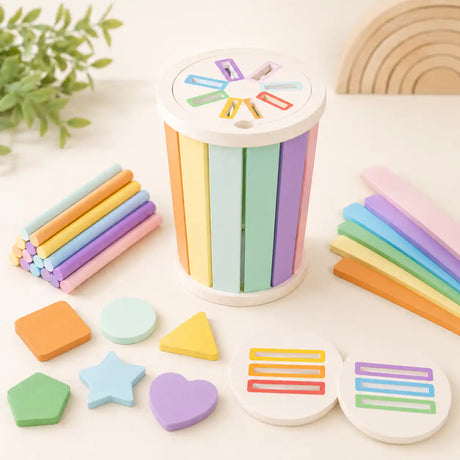
![Wooden rainbow sorting cylinder with pastel sticks, geometric shapes, sorting discs, and natural cotton storage bag on cream background]()
![Wooden rainbow sorting cylinder tipped on its side with pastel dowels visible inside, beside a natural cotton drawstring storage bag and shape pieces]()
![Toddler hands placing a green wooden shape piece into the cutout lid of the pastel wooden sorting cylinder during supervised play]()
![Size and dimensions diagram showing the wooden cylinder, sorting discs, geometric shape pieces, dowels, and cotton drawstring bag in centimeters]()
![Pastel wooden multi-sorter cylinder with shapes, dowels, and sticks displayed in a flat lay on warm neutral background]()
![Pastel wooden Montessori sorting cylinder set with shape pieces and colored sticks styled on a soft neutral surface]()
![Close-up details of the wooden sorting cylinder showing the lid cutouts, vertical pastel bars, round dowels, and rectangular slot disc]()
![Four-panel image showing each interchangeable sorting disc of the wooden cylinder being used with dowels, sticks, and shape pieces]() 1 Year+
1 Year+ -
![Wooden shape sorter top view showing how each piece matches its hole]()
![Toddler dropping a wooden ball into the Montessori shape sorter box]()
![Toddler engaged with the wooden shape sorter at a calm play table]()
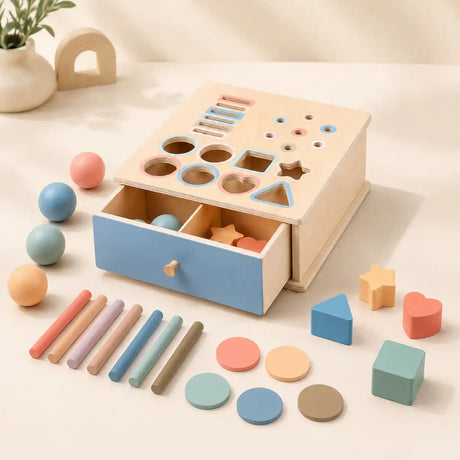
![Top-down view of the wooden shape sorter box with all sorting pieces laid out]()
![Wooden shape sorter drawer open showing balls, shapes, and storage compartments]()
![Side angle of the wooden shape sorter with open peek-a-boo drawer]()
![Wooden shape sorter box dimensions and size reference chart]() 1 Year+
1 Year+ -
![Both magnetic fishing rod and wand in use on the wooden alphabet fishing game]()
![Wooden alphabet fish spelling CAT, FISH, and FROG on the magnetic fishing board]()
![Wooden magnetic alphabet fishing game features and play modes overview]()
![Toddler boy fishing for wooden alphabet letters with a magnetic fishing rod]()
![Toddler using the magnetic wand on the wooden alphabet fishing game]()
![Wooden magnetic numbers fishing board with math symbols and 1 to 20 fish]()
![Close-up of colorful wooden alphabet fish with letters A, T, X, and Ñ]()
![Wooden magnetic alphabet fishing game with full A to Z fish set on the cat board]()
![Wooden magnetic alphabet fishing game dimensions and size reference chart]() 4 Year+
4 Year+ -
![Top view of the Montessori wooden sensory window blocks set]()
![Toddler exploring the wooden sensory blocks in a calm Montessori playroom]()
![Family lifestyle scene with the Montessori wooden sensory blocks set]()
![Close-up of colored sand window inside a wooden sensory block]()
![Mirror panel detail on a Montessori wooden sensory block]()
![Wooden bead-filled sensory blocks for tactile toddler exploration]()
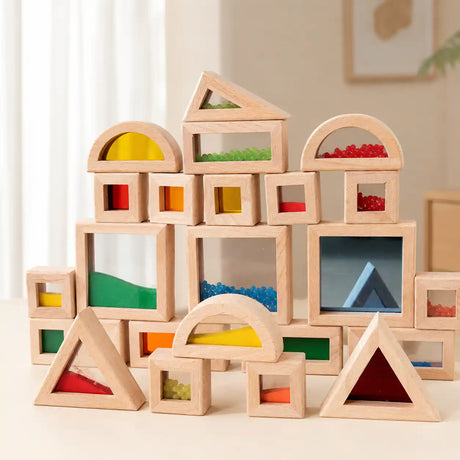
![Wooden sensory blocks set with natural beech wood frames]()
![Wooden sensory blocks stacked into a Montessori tower on cream background]()
![Wooden sensory blocks set dimensions and size reference chart]() 2 Year+
2 Year+ -
![Top-down view of Montessori wooden gem building blocks with storage tray]()
![Wooden gem building blocks arranged for toddler stacking and sorting play]()
![Toddler engaging with the Montessori wooden gem building blocks set]()
![Close-up of faceted gems embedded in wooden building block frames]()
![Wooden gem block frames showing sensory texture and natural finish]()
![Natural wood finish of the Montessori-inspired gem building blocks set]()
![Wooden gem building blocks tidied in their storage tray for shelf display]()
![Wooden gem building blocks set dimensions and size reference chart]()
![Wooden gem building blocks set styled as a Montessori-inspired gift]() 2 Year+
2 Year+ -
![Rainbow wooden marble run music tree styled in a calm Montessori-inspired nursery corner]()
![Toddler hands placing a marble at the top of the wooden marble run music tree]()
![Close-up of the smooth sanded wood and rainbow leaf chimes on the marble run music tree]()
![Marbles cascading through the rainbow leaf chimes of the wooden marble run music tree]()
![Color-sorted marbles racing down the rainbow tiers of the wooden marble run music tree]()
![Wooden marble run music tree at 71 cm tall with size dimensions shown]() 3 Year+
3 Year+










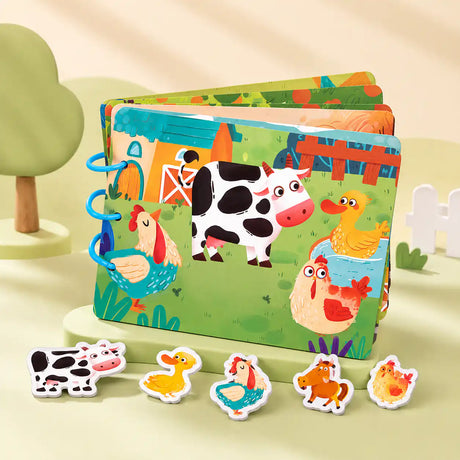


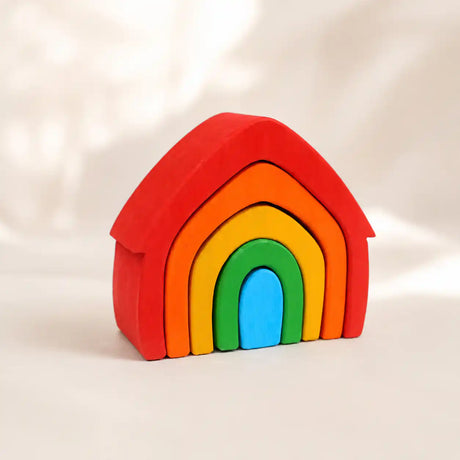


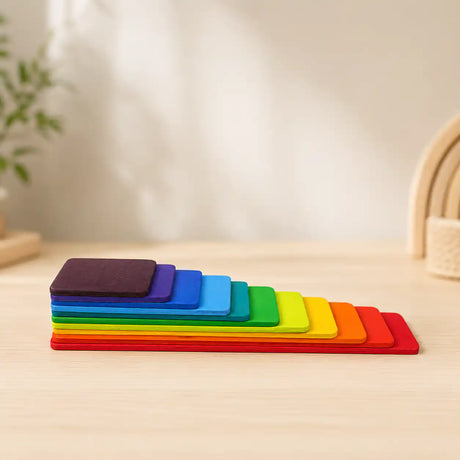


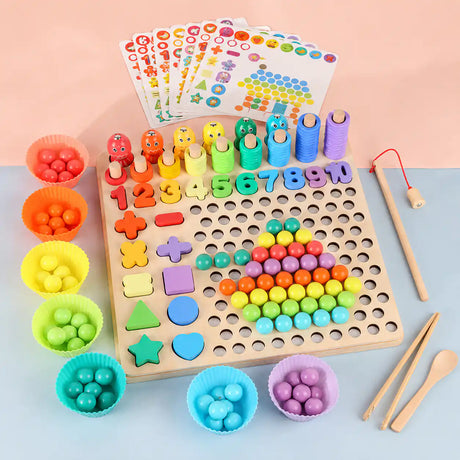


















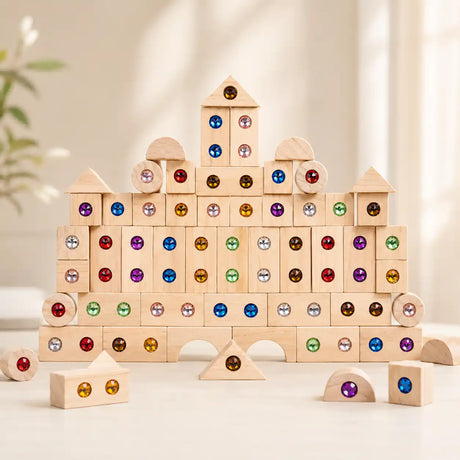


What STEM Means at This Age
For toddlers and preschoolers, STEM isn't coding or robotics. It's the habit of noticing what happens, wondering why, and trying again differently. A child rolling a marble down a track and adjusting the slope is running an experiment, whether or not anyone calls it one.
- Cause and effect — the foundation of all scientific reasoning
- Prediction and testing — guessing what will happen, then finding out
- Structural thinking — discovering what makes a build stand or fall
- Measurement and comparison — heavier, faster, taller, further
What's in This Collection
Marble runs, balance scales, tool sets, gear boards, construction sets, and building blocks — Montessori STEM toys with no screens and no batteries, where the interesting behavior comes from physics rather than programming.
STEM Toy Questions
What age should STEM toys start?
Meaningfully, from about two — the age at which a child starts predicting rather than just observing. Simple cause-and-effect toys work earlier. Multi-step building and marble run construction generally suit three or four and up.
Do STEM toys actually help?
The useful ones build reasoning habits rather than knowledge. A child who has learned to test an idea, watch what happens, and adjust has something more durable than a memorized fact. Be skeptical of toys promising to teach engineering to two-year-olds — what they can genuinely offer is curiosity and persistence.
What do marble runs teach?
Gravity, momentum, slope, and sequencing. Building the track is a design problem; running the marble tests it. When it fails, the child has to work out which section is wrong — which is debugging, in physical form.
Are wooden STEM toys as good as electronic ones?
For young children, often better. Electronic toys tend to do the interesting part themselves, leaving the child to press a button. With a wooden marble run, everything that happens is a consequence of something the child built.
How do I encourage scientific thinking at home?
Ask what they think will happen before they try, and ask what they noticed afterward. Resist supplying answers. "I don't know, how could we find out?" is a more useful sentence than any explanation you could give.
Adult supervision is recommended. Many sets contain small parts; see each product page for age guidance.
Read more about STEM-Inspired Toys Show less
You May Also Like
View all-
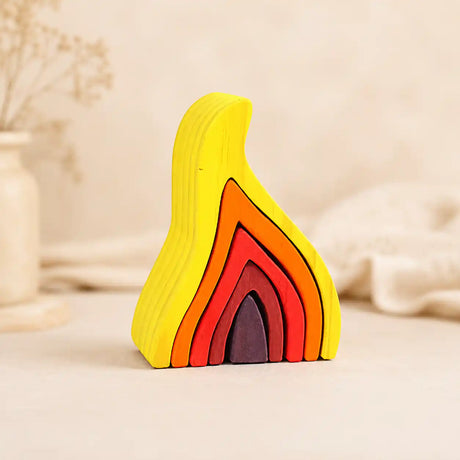
![Five wooden flame puzzle pieces lined up as separate arches showing graduated sizes from yellow to dark ember]()
![Curly-haired toddler in cream clothing sitting on a soft rug and playing with the wooden flame nesting puzzle]()
![Child's hands fitting the outer yellow flame piece into the wooden Waldorf nesting puzzle on a soft surface]()
![Wooden flame nesting puzzle fully assembled on a textured linen surface with soft natural light]()
![Wooden flame puzzle styled on a neutral table with a ceramic vase, wooden beads, and dried eucalyptus]()
![Wooden flame puzzle pieces arranged in an open layered configuration showing creative play possibilities]()
![Wooden flame stacking puzzle shown next to a wooden ruler for size reference, approximately 16 to 17 centimeters tall]() 4 Year+
4 Year+ -
![Wooden activity cube with yellow storage drawer open showing ABC letters and shape pieces neatly stored inside]()
![Smiling toddler in cream cardigan playing with the wooden 6-in-1 activity cube on a soft rug in a Montessori playroom]()
![Side view of wooden 6-in-1 activity cube showing shape sorter top with Red, Cyan, Green color slots and ABC letter puzzle front]()
![Back panel of wooden activity cube showing six rainbow pull-through sticks and a friendly lion illustration]()
![Side of wooden activity cube showing hippo illustration, peek-through hole, and shape slots for toddler play]()
![Wooden 6-in-1 activity cube with detachable rainbow drum and slide-out Zing Zoo elephant puzzle card]()
![Close-up detail of wooden rainbow drum with colored sticks and Zing Zoo elephant puzzle card attached to the activity cube]()
![Top-down view of yellow storage drawer holding all wooden activity cube pieces including ABC letters, shapes, color coins, and rainbow sticks]()
![Wooden 6-in-1 activity cube dimensions diagram showing 24.5 by 13.3 by 12.5 centimeters cube and individual piece sizes]() 1 Year+
1 Year+ -
![Wooden rainbow semicircles shown alongside a JuniSprouts rainbow arch stacker, sold separately — Waldorf-inspired open-ended toy for preschoolers]()
![Preschool-age child placing the purple wooden semicircle on top of a fully nested rainbow stacker at a wooden table]()
![Close-up of wooden rainbow semicircles showing soft color wash and visible wood grain in classic Waldorf style]()
![Toddler hand reaching for the smallest purple semicircle of a wooden rainbow nesting set on a soft mat]()
![11-piece wooden Waldorf rainbow semicircles nested from largest red to smallest purple in graduated sizes]()
![Wooden rainbow semicircles in an open-ended building scene with soft natural light, Waldorf-inspired loose parts play for preschoolers ages 4+]() 4 Year+
4 Year+ -
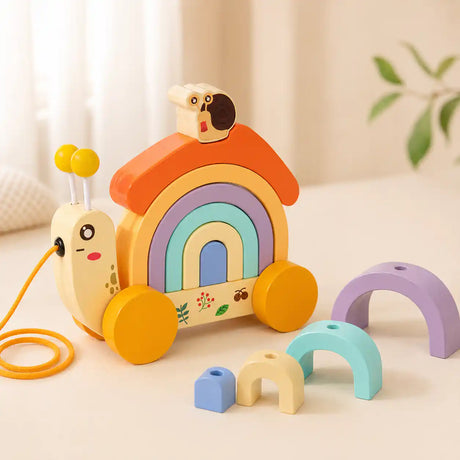
![Hand demonstrating how the orange roof lifts off the wooden snail rainbow stacker to reveal the nesting arches]()
![Wooden snail stacker with pastel arches restacked into a tall balance tower beside it for open-ended play]()
![Toddler crawling on a soft rug while pulling the wooden snail pull-along toy by its string]()
![Wooden snail pull-along stacker styled in a soft nursery setting with a plush bunny and linen pillow]()
![Close-up details of wooden snail pull toy — antennae, snail topper, pastel rainbow arches, and wooden wheels]()
![Wooden snail pull-along toy rolling on its yellow wheels with the pull string trailing behind, first walker for toddlers]()
![Toddler hands placing the small wooden snail figure on top of the rainbow stacker arches]()
![Wooden snail rainbow stacker shown next to a wooden ruler for size reference, approximately 20 centimeters tall]()
![Wooden snail pull-along toy with pastel rainbow arches and small blue block laid out alongside on cream background]() 1 Year+
1 Year+ -
![Close-up of wooden activity table top showing bead maze loops, spinning gears, and rotating alphabet blocks]()
![Wooden Montessori activity table from above showing bead maze, sliding bear, spinning fox disc, and shape sorter for toddlers ages 1+]()
![Wooden Montessori activity table styled in a neutral nursery with soft natural light, ready for toddler play]()
![Side view of wooden activity table with carved sliding mazes, spinning fox disc, and pop-up spinner button]()
![Wooden Montessori table close-up of rotating ABC blocks for early alphabet recognition and fine motor play]()
![Detail of wooden activity table bead maze with colorful sliding beads on curved wire tracks]()
![Wooden activity table side panel featuring sliding bear and spinning fox disc for animal-themed pretend play]()
![Toddler exploring the wooden 10-in-1 activity table on a soft playroom rug, manipulating bead maze and turning gears]()
![Wooden activity table dimensions diagram, approximately 36 by 24 by 37 centimeters, designed for toddlers ages 1+]() 1 Year+
1 Year+ -
![Side view of wooden Montessori push walker showing magnifying viewer, rainbow slider, apple rollers, and sturdy wooden wheels for ages 1+]()
![Close-up of wooden activity walker top panel with colorful xylophone bars and turning wooden gears for toddler fine motor play]()
![Wooden activity walker side panel with peek-a-boo corgi door, giraffe drum, and apple tree busy board for toddler sensory exploration]()
![Toddler hands engaging the wooden walker's busy board panel — turning gears, opening doors, and exploring shape sorting]()
![Toddler standing and pushing the wooden Montessori activity walker across a soft playroom rug, building first walking confidence]()
![Wooden 10-in-1 activity walker feature breakdown showing xylophone, gears, drum, shape sorter, magnifying viewer, and apple rollers]()
![Wooden Montessori activity walker dimensions diagram, approximately 49.5 by 36.5 by 37 centimeters, designed for toddlers ages 1+]() 1 Year+
1 Year+ -
![Close-up of a wooden cake slice topped with a bear and yellow candle, beside the decorated cake]()
![Wooden birthday cake with a slice being lifted on a wooden knife and two plated slices nearby]()
![Child's hands placing colorful candles into a wooden pretend play birthday cake on a pink table]()
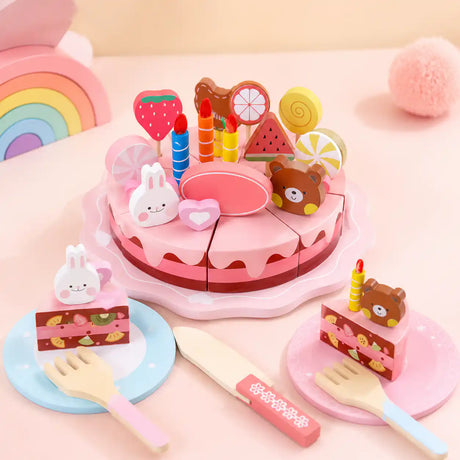
![Full set of wooden birthday cake pretend play pieces laid out, including cake, plates, candles, fruit, and toppers]()
![Wooden pretend play birthday cake styled with two decorated slices, fruit lollipops, and a wooden rainbow in the background]()
![Young child smiling and decorating a wooden pretend play birthday cake on a nursery table]()
![Wooden birthday cake pretend play set with arrows indicating the size and scale of each piece]() 3 Year+
3 Year+ -
![Toddler hands placing a small teal disc on top of a rainbow wooden stacking tower]()
![Close-up of stacked rainbow wooden discs showing smooth matte finish and graduated sizes]()
![Wooden rainbow stacking discs tower beside a ruler and tape measure showing scale and size]()
![Young child smiling and stacking wooden rainbow discs into a tall tower on a soft nursery rug]()
![Wooden rainbow stacking discs arranged in several small balancing piles showing open-ended play options]()
![Wooden rainbow stacking discs balanced into a tall tower on a soft cream surface]()
![Wooden rainbow stacking discs tower with extra graduated discs resting beside it]() 3 Year+
3 Year+ -
![Side angle of wooden animal puzzle stacker showing layered animal silhouettes and painted finish]()
![Small hands assembling the wooden animal puzzle stacker piece by piece on a warm neutral surface]()
![Flat lay of all wooden animal puzzle stacker pieces arranged in order showing each animal]()
![Close-up of a single wooden animal piece showing smooth painted finish and detail]()
![Wooden animal puzzle stacker beside a ruler and tape measure showing size and scale]()
![Wooden animal puzzle stacker styled in a warm nursery play scene]() 4 Year+
4 Year+ -
![Side angle of wooden rainbow arch stacker showing graduated arch sizes and rainbow color order]()
![Top-down view of wooden rainbow arch stacker showing nested arch shapes]()
![Close-up of a single wooden rainbow arch showing smooth painted finish]()
![Wooden rainbow arch stacker beside a ruler and tape measure showing size and scale]()
![Small hands placing a wooden rainbow arch onto the stacker on a warm neutral surface]()
![Wooden rainbow arch stacker styled in a warm nursery play scene]()
![Wooden rainbow arches arranged separately on a cream surface showing each color in the set]() 3 Year+
3 Year+