Gifts Siblings Can Share: Joint Gift Ideas for a Toddler and Preschooler
Shopping for two? The best gifts siblings can share are open-ended toys with no age ceiling, graded for the youngest child. Here are joint gift ideas by age gap, how to handle small parts with a toddler at home, and simple ways to keep it fair.

By Chloe M.Early Learning Writer
12 min read
In this article10 sections
- What makes a good gift for siblings to share?
- Is it safe to give a 3+ toy when there’s a toddler at home?
- Shared gift ideas by sibling age gap
- 7 joint gifts that grow with both kids
- What research says about siblings playing together
- One shared gift or one each? How to keep it fair
- How to set up shared play so it actually works
- Frequently Asked Questions
- The bottom line
- References
The best gifts siblings can share are open-ended toys with no age ceiling, such as a large wooden rainbow stacker, chunky blocks, a pretend-play set or a family band of instruments, chosen so they’re safe for the youngest child who will play with them. If one sibling is under 3, every piece of a shared gift needs to be big enough to meet the federal small-parts rule. Anything labeled 3+ works better as the older child’s own gift that comes out at nap time or with an adult right there.
Shopping for two at once is one of the trickiest parts of holiday gifting. A 2-year-old and a 4-year-old play in very different ways, and what delights one can frustrate the other. This guide covers what makes a good joint gift for siblings, how to handle small parts when there’s a toddler at home, gift ideas by age gap, what research says about siblings playing together, and simple ways to keep a shared gift feeling fair on the big day.
What makes a good gift for siblings to share?
A good gift for two meets each child where they are. The younger one might stack, knock down and carry pieces around the room, while the older one builds, sorts, invents stories and makes up rules. The toy stays the same; the play grows up around it.
When you’re choosing a joint gift for siblings, look for these five things:
- No age ceiling. Open-ended toys like stackers, blocks and pretend-play sets have no single “right” way to play, so a toddler and a preschooler can both use them well.
- Enough pieces for two. A set with plenty of parts lets each child hold something at the same time, which heads off a lot of grabbing.
- Room for roles. Gifts that suggest roles, like shopkeeper and customer or band leader and drummer, give the older child a job and the younger child a partner.
- Safe for the youngest player. The age grade of a joint gift should fit the youngest child who will touch it, not the oldest.
- Easy to put away. A shared toy needs a shared home. One basket or shelf spot turns tidying into a joint job instead of an argument.
Is it safe to give a 3+ toy when there’s a toddler at home?
Usually yes, with a plan. It’s one of the most common questions gift-givers ask. Many wonderful preschool toys, including sorting sets, threading kits, play food and memory games, have pieces small enough to be a choking hazard for babies and toddlers. That’s why they carry a 3+ label.
U.S. law bans small parts in toys intended for children under 3. A “small part” is anything that fits completely inside a test cylinder sized to approximate a young child’s throat, about 1¼ inches wide and 2¼ inches long. Nemours KidsHealth points out that the age levels on toys are set by safety factors, “not intelligence or maturity,” so a toddler who seems advanced still shouldn’t play with toys meant for older kids.
The U.S. Consumer Product Safety Commission’s long-standing advice for families with more than one child is simple: keep toys designed for older children out of the hands of little ones, and teach older children to help keep their toys away from younger brothers and sisters. In practice, that looks like this:
- Make the shared gift an under-3 gift whenever a baby or toddler will be part of the play. Save small-piece sets for the older child’s own gift.
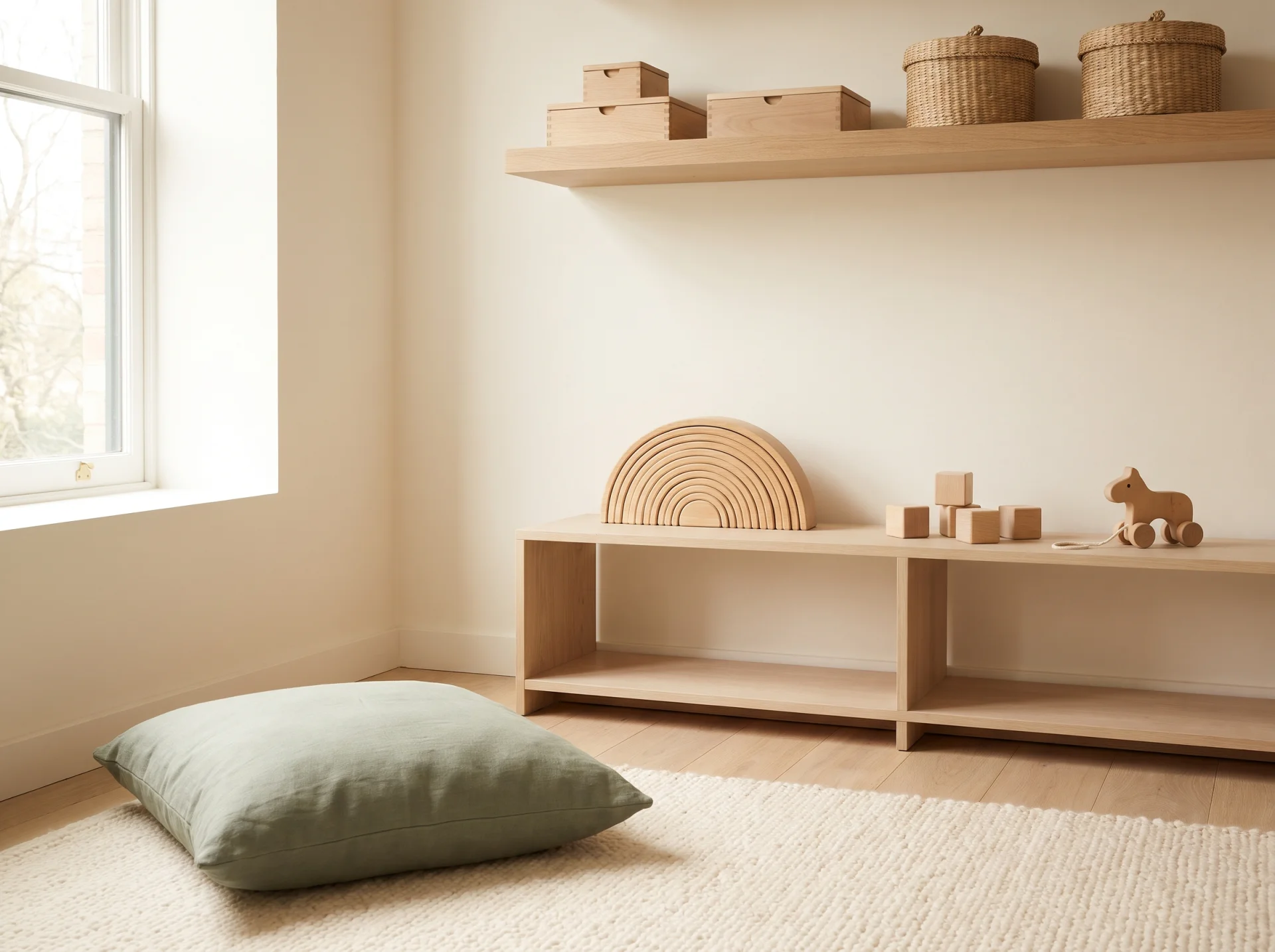
- Give 3+ toys a high home. Store small-piece sets in a lidded box on a higher shelf, not in the floor-level toy bin.
- Make “big-kid time” a treat. Bring 3+ toys out during the younger child’s nap or at the table with an adult close by, then pack them away together.
- Count pieces at clean-up. A quick count before the lid goes on helps make sure nothing small has wandered off under the sofa.
- Give the older child a job. Many preschoolers love being trusted as the “keeper” of their special set.
Toys with loose magnets or button batteries deserve extra caution at any age, because these parts can cause serious injuries if swallowed. Read the product details and age grade before you buy, and adult supervision is always recommended for young children’s play.
Shared gift ideas by sibling age gap
Here’s a quick way to match a gift to the two children you’re shopping for. Ages are a guide, not a rule; always check the age grade on the specific toy.
| Siblings | Shared gift that works | How the younger one plays | How the older one plays | Age-grade tip |
|---|---|---|---|---|
| Baby (9–12 months) + toddler (2–3) | Large wooden stacker, big soft balls, sturdy board books | Grasps, explores, knocks towers down | Builds towers “for the baby,” reads and points | Every piece must be graded for under 3 |
| 1-year-old + 3-year-old | Rainbow stacker, pull-along toy, chunky blocks | Nests, carries, pulls along | Builds tunnels, bridges and roads | Choose under-3 toys; keep the 3-year-old’s small-piece sets separate |
| 2-year-old + 4-year-old | Pretend café or kitchen with large pieces, big blocks | Fills, pours, “feeds” stuffed animals | Runs the café, takes orders, sets the table | Look for large pieces, or keep 3+ sets for play at the table |
| 3-year-old + 5-year-old | Memory game, musical instruments, ramp racer, play food | Matches pairs, shakes and taps | Follows rules, keeps score, leads the band | Both are 3+, so most preschool sets work |
| Twins or siblings close in age | Two of the same toy, or one big set split into two baskets | Plays alongside, often the same way | Plays alongside, often the same way | Fairness matters more than range; match the grade to the younger child |
One pattern stands out: the closer the youngest child is to 3, the wider your choices get. Under 3, stick with big, sturdy pieces. Once both children are past their third birthday, almost any well-made preschool toy can become a shared gift.
7 joint gifts that grow with both kids
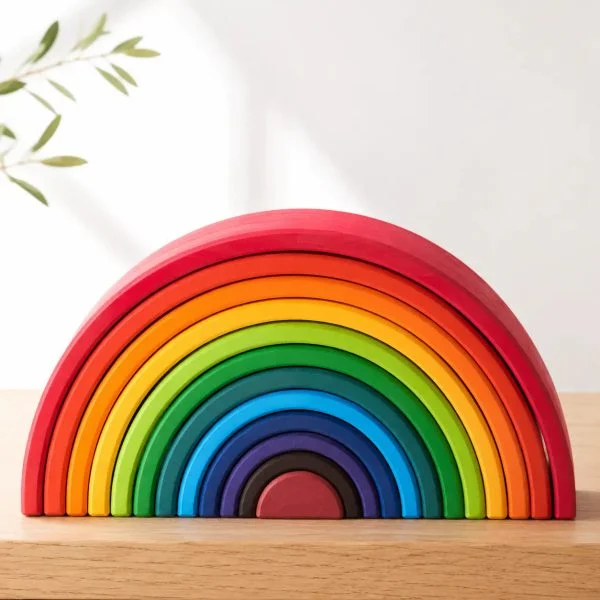
1. A large wooden rainbow stacker
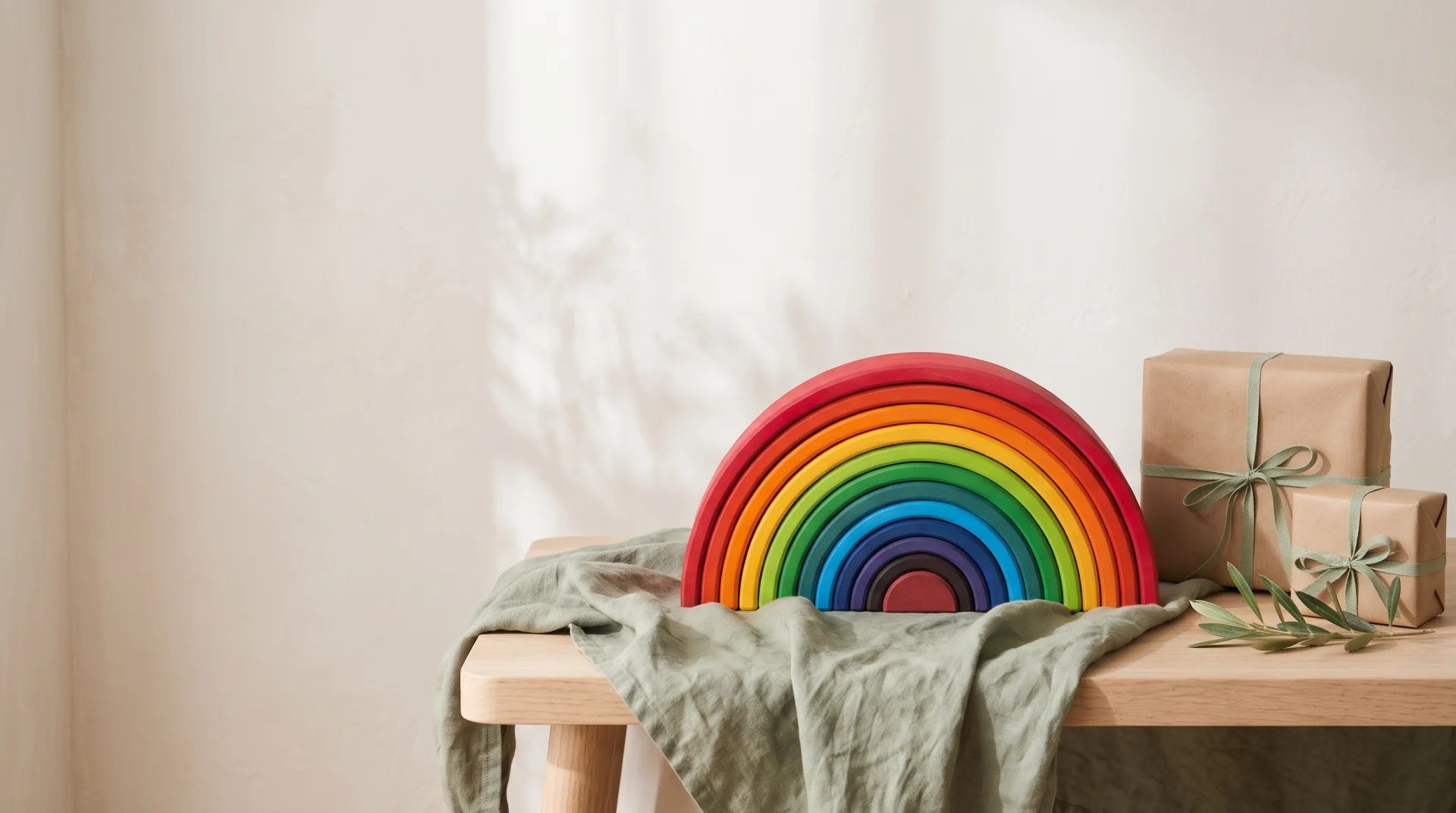
A big rainbow stacker is one of the few toys a 1-year-old and a 5-year-old will happily play with side by side. Toddlers nest and un-nest the arches and knock them over; preschoolers stand them up as tunnels, bridges, cradles and rolling hills for their animals. Our 12-piece wooden rainbow stacker is graded for ages 1+, which makes it a natural pick when one sibling is still under 3.

2. Chunky wooden blocks
Blocks are the classic mixed-age toy. The younger child stacks two or three and topples them with glee; the older child builds a garage, a zoo or a tower taller than their sibling. For under-3s, choose blocks too big to fit inside a small-parts tester, and skip sets with tiny accessory pieces.
3. A pretend kitchen, café or shop
Pretend play is where siblings tend to play together best, because it has natural roles for different ages. A 4-year-old can be the chef while a 2-year-old is the very enthusiastic customer. Many wooden play food sets are graded 3+ because of the size of their pieces, so if the younger child is under 3, look for larger pieces or keep this gift for supervised play at the table.
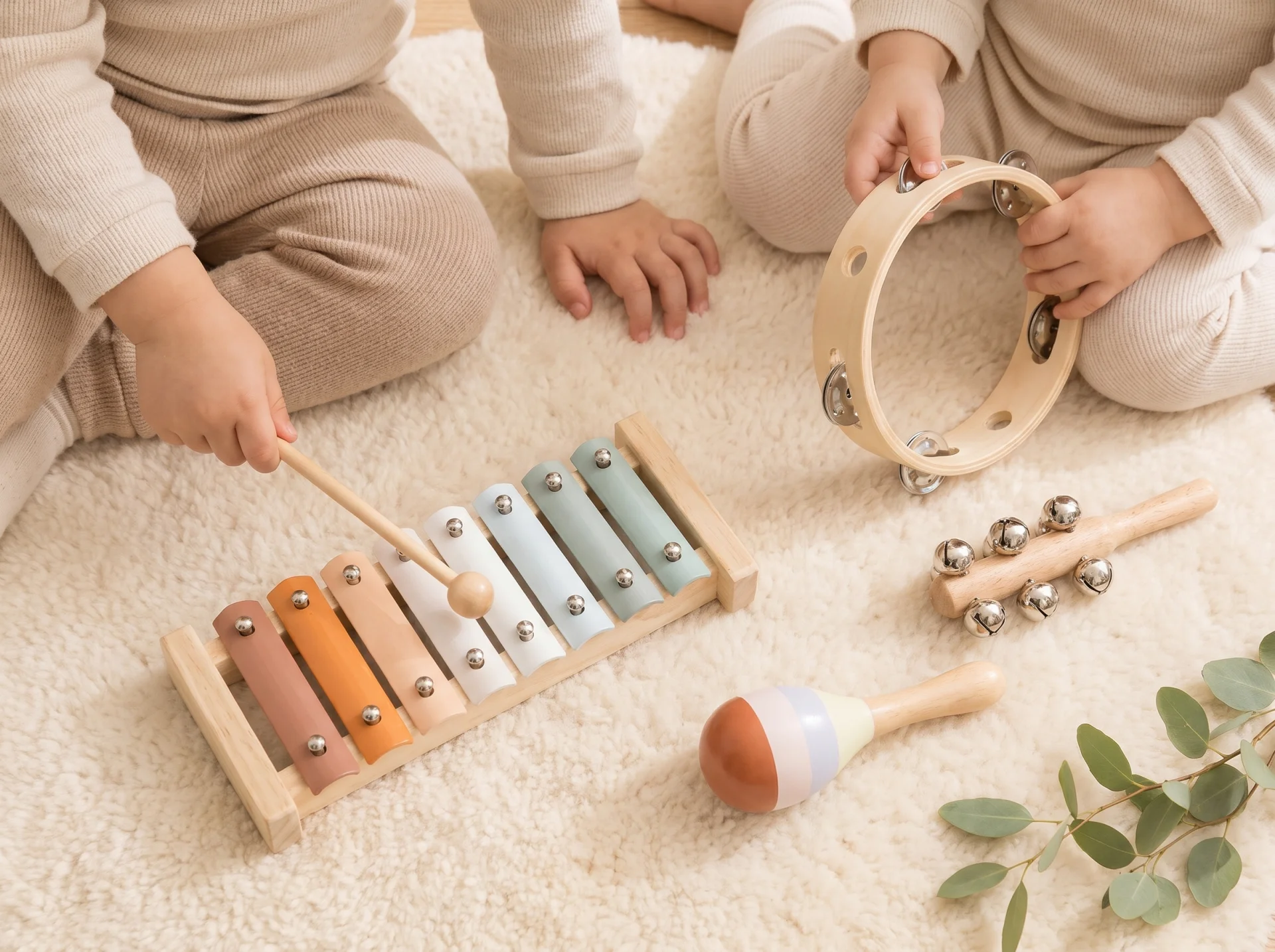
4. A family band of musical instruments
Music is one of the easiest ways for different ages to play together, because there’s no wrong answer. One child keeps the beat on a tambourine, the other plays the xylophone, and everyone marches around the living room. Check the age grade first: many instrument sets include small parts such as bells or mallet tips and are labeled 3+.
5. A simple memory or matching game
Matching games grow with children in a lovely way. A 3-year-old can turn tiles over and hunt for pairs with a little help, and by age 5 most children can follow rules and take turns in a game, according to the CDC’s developmental milestones. Pairing the younger child with a grown-up as a “team” keeps the game fun for everyone.
6. A pull-along toy
Pull-along toys are a sweet pick when the younger sibling is a brand-new walker. The toddler tows the toy around the house while the older child leads the parade or builds a road for it. Keep play with pull strings supervised, and check the age grade for any removable pieces.
7. Something for the whole family
Not every family gift needs to be a toy. A cozy reading nook, a basket of new board books, a family pass to a local zoo or children’s museum, or a simple easel for drawing side by side can all be shared by children of very different ages, and they don’t compete with the individual gifts under the tree.
What research says about siblings playing together
Gifts for two aren’t just practical. Play between siblings is one of the places young children practice understanding other people’s thoughts and feelings.
In the University of Cambridge’s Toddlers Up study, which followed 140 children from age 2, researcher Claire Hughes described siblings as natural allies who are often on the same wavelength and dive into pretend play together. Those games involve a lot of talk about thoughts and feelings. Younger siblings used less of that kind of talk at age 3, but by age 6 they were discussing emotions almost on equal footing with their older brothers and sisters.
Earlier work by Nina Howe and colleagues points the same way. In a 1998 study of 40 kindergarten-age children and their siblings, pairs who pretended together often used more advanced negotiation and more talk about thoughts and feelings than pairs who rarely pretended.
The toys themselves matter, too. A 2022 study from the same research group watched 44 seven-year-olds play with an open-ended village set and a more closed-ended train set, once with a sibling and once with a friend. The village set prompted more describing and questioning, while the train set led to more helping. The researchers concluded that not all pretend-play materials encourage play in the same way. For gift-givers, that’s a nice argument for pairing one open-ended gift with one more structured one.
It also helps to know what to expect at each age. According to the CDC, most children play next to other children, and sometimes with them, by 30 months. By 3, most notice other children and join them to play. By 5, most can follow rules and take turns. So a 2-year-old and a 4-year-old will play “together” in a loose, side-by-side way at first, and that’s completely normal.
One shared gift or one each? How to keep it fair
For many families, the sweet spot is one small gift of their own for each child plus one bigger shared gift. Toddlers are still learning that something can belong to more than one person, and sharing on request usually takes until the preschool years, as we explain in our guide to what’s normal when a toddler won’t share. A gift that is clearly theirs can make the shared one much easier to enjoy.
A few ideas that help on the big day:
- Wrap it to both of them. One tag with both names makes the “ours” message clear from the start.
- Open it together. Let the children unwrap it side by side, so neither one is “first.”
- Split the pieces. For larger sets, two matching baskets with half the pieces each can prevent a lot of grabbing.
- Use a timer for the favorite piece. A short sand timer turns “mine!” into “your turn next.”
- Let the older child host. Preschoolers often enjoy showing a younger sibling how a toy works.
If you’re buying a gift for each child plus a shared one, it can be worth putting them together. Our wooden toy bundles let you mix ages and toy types, with 10% off two toys and 15% off three or more, applied automatically.
How to set up shared play so it actually works
A thoughtful setup can do as much as the gift itself. These small changes help a toddler and a preschooler play near each other, and eventually with each other, more calmly:
- Give shared toys a low, open home. A low shelf with a few under-3-friendly shared toys invites both children in.
- Keep big-kid sets up high. Small-piece sets live in lidded boxes on a higher shelf and come down with an adult.
- Offer fewer toys at a time. A short, simple selection is easier for two children to navigate, and it makes rotating toys back in feel fresh.
- Join in at first. A grown-up who plays for the first few minutes can help set up roles and model turn-taking, then step back.
- Protect the older child’s projects. A spot where a preschooler’s tower or track can stay up, out of toddler reach, saves a lot of tears.
Frequently Asked Questions
What is a good gift for siblings to share?
Open-ended toys without an age ceiling make the best shared gifts: a large wooden rainbow stacker, chunky blocks, a pretend kitchen or shop, a set of musical instruments, or a simple matching game. Choose a toy that is age-graded for the youngest child who will play with it.
What toy can a 2-year-old and a 4-year-old play with together?
Large stackers, big wooden blocks, pull-along toys and pretend-play sets with large pieces work well for this age gap. The 2-year-old fills, stacks and pours, while the 4-year-old leads the story or builds something bigger. Because the younger child is under 3, check that every piece is graded for under-3s.
Can I give a preschooler a toy with small parts if there’s a toddler at home?
Yes, as long as it’s the older child’s own gift rather than a shared one, and it can be stored out of the toddler’s reach. The CPSC advises keeping toys for older children away from younger siblings and teaching older children to help. Bringing small-piece sets out at nap time or at the table with an adult works well.
Should siblings get one joint gift or separate gifts?
Many families do both: a small gift of their own for each child plus one shared gift. Toddlers are still learning to share, so having something that is clearly theirs can make the joint one easier to enjoy.
Are wooden toys good shared gifts?
Well-made wooden toys are a natural fit for sharing because they are sturdy, simple and open-ended, so they hold up to two children and years of play. As with any toy, check the age grade, look for smooth edges, and make sure every piece is a safe size for the youngest child.
The bottom line
The best gift for two is a toy both children can bring their own ideas to: open-ended, sturdy and safe for the youngest player. Pair it with a small gift of their own for each child, give it a shared home on a low shelf, and let the older one show the younger one how it works.
The real magic of a shared gift isn’t in the unwrapping. It’s in the hundreds of small games two siblings invent together in the months that follow.
References
- For Kids’ Sake: Think Toy Safety (Publication 281) — U.S. Consumer Product Safety Commission
- Small Parts Ban and Choking Hazard Labeling — U.S. Consumer Product Safety Commission
- Choosing Safe Toys for Toddlers and Preschoolers — Nemours KidsHealth (2024)
- Milestones in Action: By 30 Months — Centers for Disease Control and Prevention
- Milestones in Action: By 3 Years — Centers for Disease Control and Prevention
- Milestones in Action: By 5 Years — Centers for Disease Control and Prevention
- Sibling Rivalry and Brotherly Love (Toddlers Up study) — University of Cambridge (2011)
- Howe, Petrakos & Rinaldi, “All the sheeps are dead. He murdered them”: Sibling Pretense, Negotiation, Internal State Language, and Relationship Quality — Child Development (1998)
- Howe, Leach & DeHart, “This is a mailbox, right?”: Associations of Play Materials with Siblings’ and Friends’ Shared Meanings During Pretend Play — Journal of Early Childhood Research (2022)
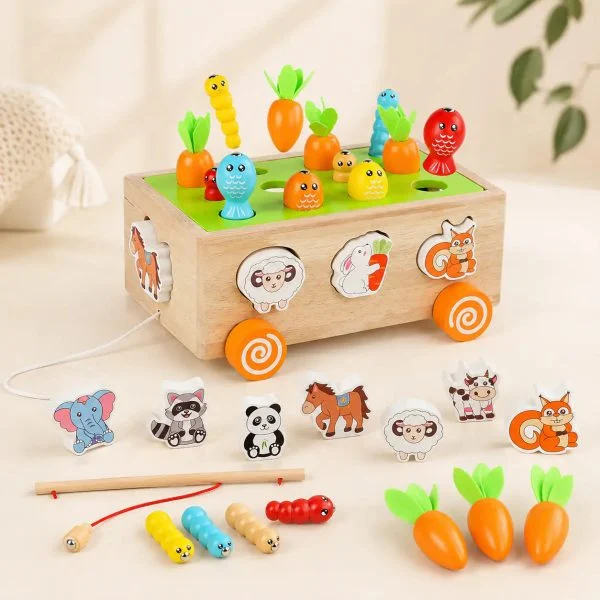
Popular with parents right now
Our best-selling wooden toys, each age-graded and gift-ready.
Keep reading
More Gift Guides
Toddler Birthday Party Gifts: What to Bring When You’re the Guest
Invited to a toddler's birthday party and not sure what to bring? Here's how much to spend, gift ideas by age that…
Montessori Stocking Stuffers for Toddlers: Small, Safe, and Actually Played With
The best Montessori stocking stuffers for toddlers are small, chunky, and genuinely useful. Here are age-by-age ideas, practical-life picks, and the quick…
The 4-Gift Rule for Toddlers: A Calmer Holiday Gift Guide
The 4-gift rule — something to want, need, wear, and read — is a simple way to give toddlers a calmer, more…