
Wooden Rainbow Stacker: What It Teaches, What Age, and 12 Ways to Play
A wooden rainbow stacker grows with your child, from first nesting at 12 months to tunnels, towers and pattern play at 4 and 5. Here’s what it teaches, what the research says, and 12 ways to play by age.

By Chloe M.Early Learning Writer
13 min read
In this article10 sections
- What Is a Wooden Rainbow Stacker?
- What Age Is a Rainbow Stacker For?
- What Does a Rainbow Stacker Teach?
- Is a Wooden Rainbow Stacker Worth It? What the Research Says
- 12 Ways to Play With a Rainbow Stacker, by Age
- How to Choose a Wooden Rainbow Stacker
- How to Set It Out So It Actually Gets Played With
- Safety and Care Tips
- Frequently Asked Questions
- References
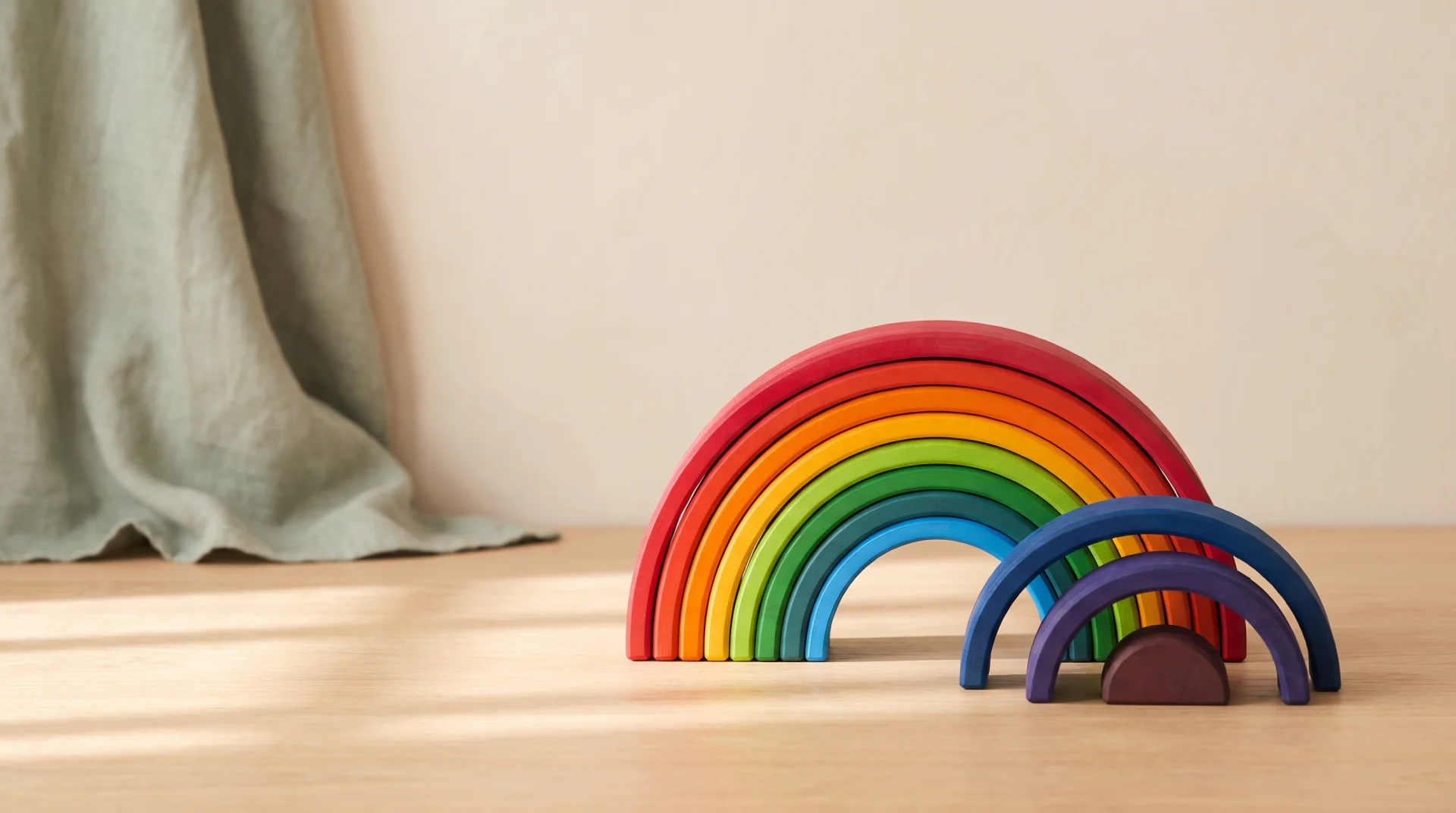
A wooden rainbow stacker is a set of curved wooden arches that nest together into a rainbow, then come apart for building, tunnels, patterns and pretend play. Most children start by lifting, rocking and nesting the big arches from around 12 months (when the toy is graded for that age), build towers and tunnels at 2 and 3, and turn the pieces into fences, bridges and beds for small-world stories at 4 and 5. Along the way, it supports fine motor control, spatial reasoning, early math words like bigger and smaller, and imaginative play.
It’s also one of the most photographed toys in Montessori-style playrooms, so it’s fair to ask whether it’s substance or just style. This Toy Spotlight gives you the honest version: what a rainbow stacker is, what research says about this kind of play, which activities suit which age, and twelve simple ways to play that keep it in use for years.
What Is a Wooden Rainbow Stacker?
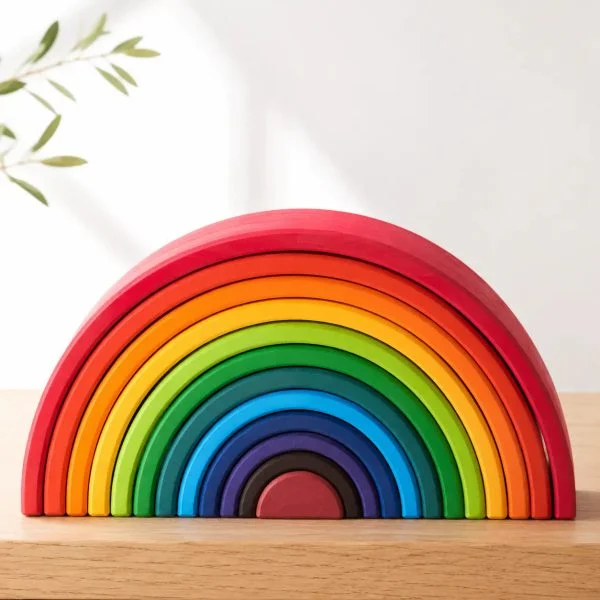
A rainbow stacker, also called a stacking rainbow, rainbow tunnel or Waldorf rainbow, is a set of graduated wooden arches, usually 6, 7 or 12 pieces, that fit inside one another from largest to smallest. Nested, it stands as a rainbow. Taken apart, each arch becomes whatever a child decides: a tunnel, a cradle, a bridge, a fence or a rocking boat.
The design comes from the Waldorf tradition, the approach to education Rudolf Steiner founded in 1919, which favors simple, natural materials that leave room for imagination. It is most closely associated with the German toymaker Grimm’s, whose designs draw on Waldorf and Montessori ideas and are built around open-ended play, where the same pieces can become a farm one day and a hospital the next.
Is it a Montessori toy? Not strictly. Classic Montessori materials are designed around one clear purpose, like a cylinder block where each piece fits only one hole. A rainbow is deliberately open-ended. Still, it sits comfortably in a Montessori-inspired home: it’s real wood, calm to look at, easy for small hands to manage and simple enough to live on a low shelf where children can reach it on their own.
What Age Is a Rainbow Stacker For?
The short answer: from about 12 months for large, chunky rainbows graded for that age, and well into the early school years for building and small-world play. The toy stays the same; the way your child uses it changes.
| Age | What play usually looks like | Skills in focus |
|---|---|---|
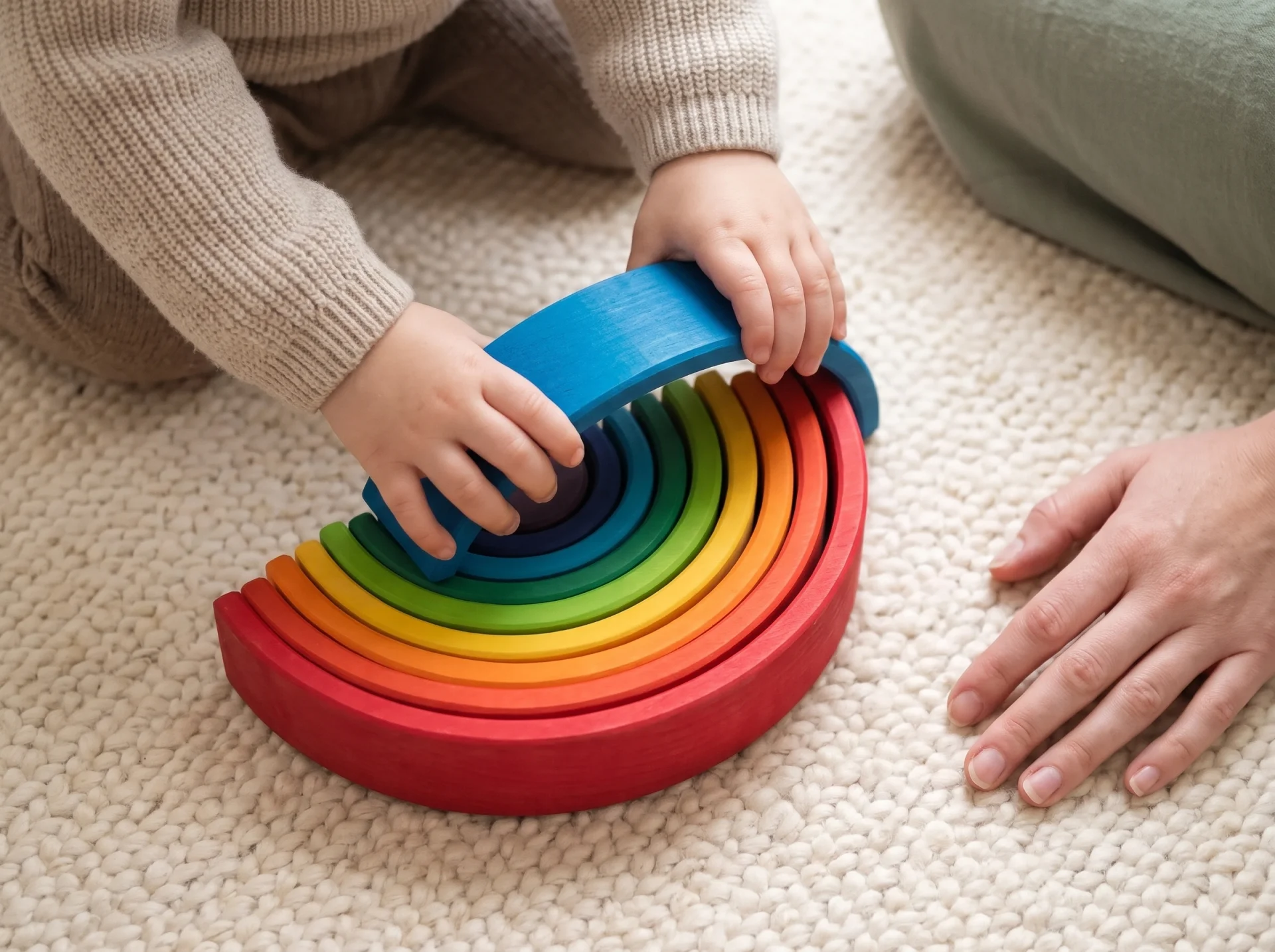
| 12–18 months | Holding and carrying arches, rocking a single arch, pulling pieces out and trying to fit them back | Grasp, two-handed coordination, cause and effect |
| 18 months–2 years | Nesting by size with lots of trial and error, peeking through arches, first two- or three-piece towers | Size order, balance, persistence |
| 2–3 years | Tunnels for toy cars, taller towers, lining arches up biggest to smallest, naming a few colors | Spatial words, early sorting, color vocabulary |
| 3–4 years | Small-world scenes with figures or animals, bridges, fences, simple flat patterns | Pretend play, storytelling, symmetry |
| 4–5+ years | Copying a build from a model, complex structures, combining the rainbow with blocks | Planning, spatial reasoning, problem-solving |
Two practical notes. First, always follow the age grade on the specific toy. U.S. rules ban small parts in toys intended for children under 3, measured with a test cylinder that approximates a young child’s throat, so smaller rainbows and add-ons such as peg dolls, balls or loose figures are often graded 3+. Second, larger rainbows tend to suit younger toddlers best, because big arches are easier to grip and harder to lose. Our 12-piece wooden rainbow stacker is graded 12 months and up, and like any toy at this age, it’s best enjoyed with an adult close by.
What Does a Rainbow Stacker Teach?
A rainbow doesn’t teach the way a flashcard does. It hands children a problem worth solving, and the learning happens in the solving. Here’s what that looks like in everyday play.
Fine motor control and two-handed coordination
Fitting a curved arch inside a slightly bigger one takes a steady grip, a turn of the wrist and two hands working together: one holds the rainbow still while the other lowers the piece in. It’s the same coordination children later use to pour, button and cut.
Spatial reasoning
Every tunnel, tower and bridge asks a spatial question. Will it fit? Will it balance? What happens if I turn it over? Research on this kind of play is encouraging. In a nationally representative U.S. sample of 847 children aged 4 to 7, those who played with puzzles, blocks and board games more than six times a week scored higher on a block-design test of spatial skill than children who played with them less often. A separate study of more than 100 three-year-olds found that children who were better at copying block structures were also better at early math.
Both studies show links, not proof that the toys caused the skills, and the researchers say so. But they point in the same direction: hands-on building is time well spent.
Early math language: size, order and position
A rainbow is a seriation puzzle in disguise. Putting things in order from biggest to smallest is one of the earliest math ideas children meet. It’s also a natural prompt for spatial words such as above, under, inside, between, taller and curved.
That language matters. In a University of Chicago study, the number of spatial words parents used with their children varied enormously, from 5 to 525. Children who heard and used more of these words did better on spatial tasks at about four and a half, and for every 45 additional spatial words children produced, their scores on a spatial analogies test rose by 23 percent.
Colors, in their own time
Plenty of rainbows are bought “to teach colors,” and they’re a lovely prompt. Just keep expectations realistic. In the U.S., children typically begin using color words between about 2 and 3, and it takes longer still for them to use each word the way adults do. Calling the blue arch “green” for a few months is a normal part of the process, not a sign anything is wrong.
Imagination and storytelling
Because the arches don’t look like anything in particular, they can become anything. A ten-year toy study at Eastern Connecticut State University observed three- and four-year-olds playing with nearly 100 toys in preschool classrooms and kept reaching the same conclusion: the simplest toys support the most complex play. Construction toys and small replica toys, like cars and figures, consistently produced high-quality play, while toys that “do the talking” tended to reduce children’s own language.
Is a Wooden Rainbow Stacker Worth It? What the Research Says
Here’s the honest answer. We aren’t aware of any study that has tested rainbow stackers specifically, and you can raise a bright, curious child without one. The evidence is about categories of play: spatial play with blocks and puzzles, simple open-ended toys and, above all, adults playing alongside children.
The American Academy of Pediatrics puts it plainly in its guidance on choosing toys: the best toys are the ones that get parents and children playing, pretending and interacting together. It also encourages families to choose toys that aren’t overstimulating and that invite children to use their imaginations. A rainbow fits that description well, but so does a good set of blocks.
A rainbow is likely to earn its shelf space if:
- Your child is between about 1 and 6, and you’d like one toy that keeps changing roles as they grow.
- You already have, or plan to add, a few companions such as toy cars, animals, figures or blocks. A rainbow is at its best as building material, not as a toy on its own.
- You value something calm to look at and durable enough to hand down to a younger sibling.
It may not be the right buy yet if your child strongly prefers toys with a clear goal and a satisfying “done” moment (a shape sorter or puzzle may suit them better for now), or if you’d rather start with a simple set of wooden blocks, which cover much of the same spatial ground. If you’re weighing the two kinds of toy, our guide to open-ended vs. single-purpose toys walks through how to balance a toy shelf.
12 Ways to Play With a Rainbow Stacker, by Age
There’s no right way to use a rainbow, but a few starter ideas help when it’s been sitting untouched. Begin at your child’s stage, show an idea once, then step back and let them take the lead.
From about 12 months (with a rainbow graded for this age)
- Take apart and put back. Pull the arches out together, then hand them back one at a time, biggest first. At this stage, any fit counts as a win.
- Rock-a-bye arch. Turn one large arch upside down on the floor and show how it rocks. It’s gentle cause and effect, and later it often becomes a cradle for a soft toy.
- Peekaboo window. Look at each other through an upright arch and take turns hiding. Simple, social and a favorite with young toddlers.
From about 2 years
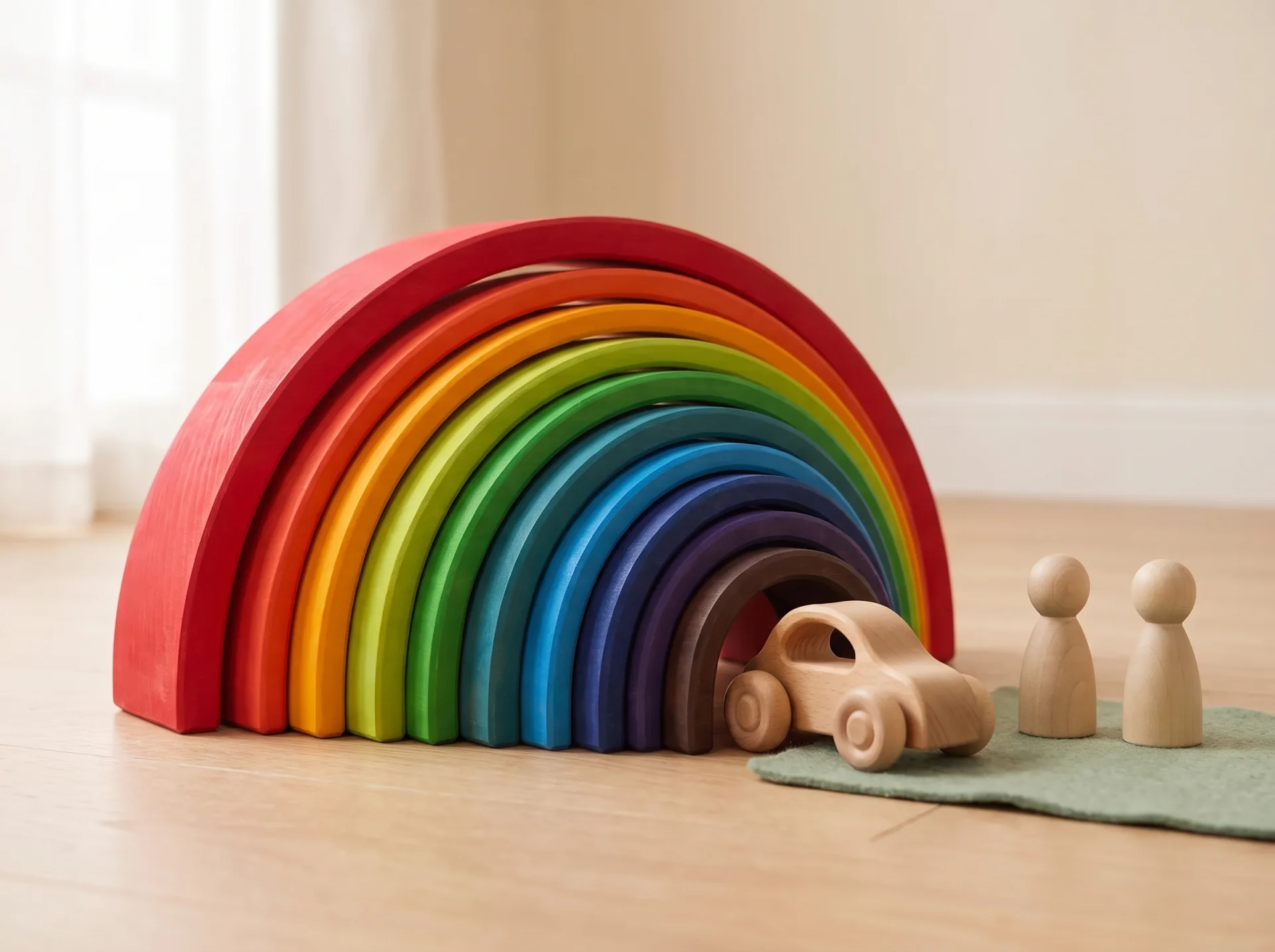
- Tunnel run. Stand the arches in a row and push a toy car through. Ask, “Will the big truck fit under the small arch?” and let your child test the answer.
- Tallest tower. Stack arches flat side down, then try them standing up. Wobbles and tumbles are part of the lesson in balance.
- Biggest-to-smallest line-up. Lay the arches side by side in size order. Then mix them up and try smallest to biggest.
- Color hunt. Hold up an arch and ask, “Can you find something in the room that’s this color?” Name colors as you go, without turning it into a quiz.
From about 3 years
- Small-world scenes. Arches become fences for a farm, bridges over a felt river, beds for peg dolls or a garage for cars. Add one or two companions at a time so the scene stays easy to play in.
- Pattern and symmetry. Lay the arches flat to make a sun, a flower, waves or a smiling face. Then try mirroring a pattern on both sides of a ribbon or a line of tape.
- Weather stories. Retell a rainy day: cotton-ball clouds, a sun made from the yellow and orange arches, and a rainbow that “comes out” when the rain stops. It’s a gentle way to build storytelling and sequencing language.
From about 4 to 5 years
- Copy my build. Make a small structure and invite your child to copy it, then swap roles. Copying a model is the very skill linked to early math in the three-year-old study above, and it’s great practice in careful looking.
- Plan, then build. Combine the rainbow with wooden blocks to make a castle, a zoo or a whole town. Invite your child to draw a quick plan first, then build it and compare the two.
How to Choose a Wooden Rainbow Stacker
Rainbows range from compact six-piece sets to large twelve-piece showpieces. A few details make a real difference in daily play.
| Smaller rainbow (about 6–7 arches) | Larger rainbow (about 12 arches) | |
|---|---|---|
| Best for | Nesting, pattern play, small spaces and travel | Tunnels, bridges, enclosures and bigger building projects |
| Little hands | Small inner arches can be fiddly for young toddlers | Big outer arches are easy to grip and carry |
| Trade-offs | Less building material as children grow | Takes more shelf space and usually costs more |
- Age grade and certification. Check the age grade on the listing and packaging. For toys sold in the U.S., look for a Children’s Product Certificate (CPC), which documents that the toy was tested to the children’s product safety rules that apply to it.
- Weight and stability. Solid, weighty arches stand steadier in towers and tunnels. Very light arches tend to slip, which can make building frustrating.
- Finish and edges. Look for smooth, well-sanded edges and an even finish, and ask what finish is used rather than relying on vague “safe” labels.
- Colorway. Classic rainbow colors are the most useful for color naming. Pastel or natural wood versions are calmer in a shared living space. Children play happily with all of them.
You can compare sizes, colorways and age grades side by side in our wooden rainbow toys collection, where each toy lists the stage it suits and the skills it supports.
How to Set It Out So It Actually Gets Played With
A rainbow that lives fully assembled on a high shelf becomes decor. A few small habits turn it back into a toy.
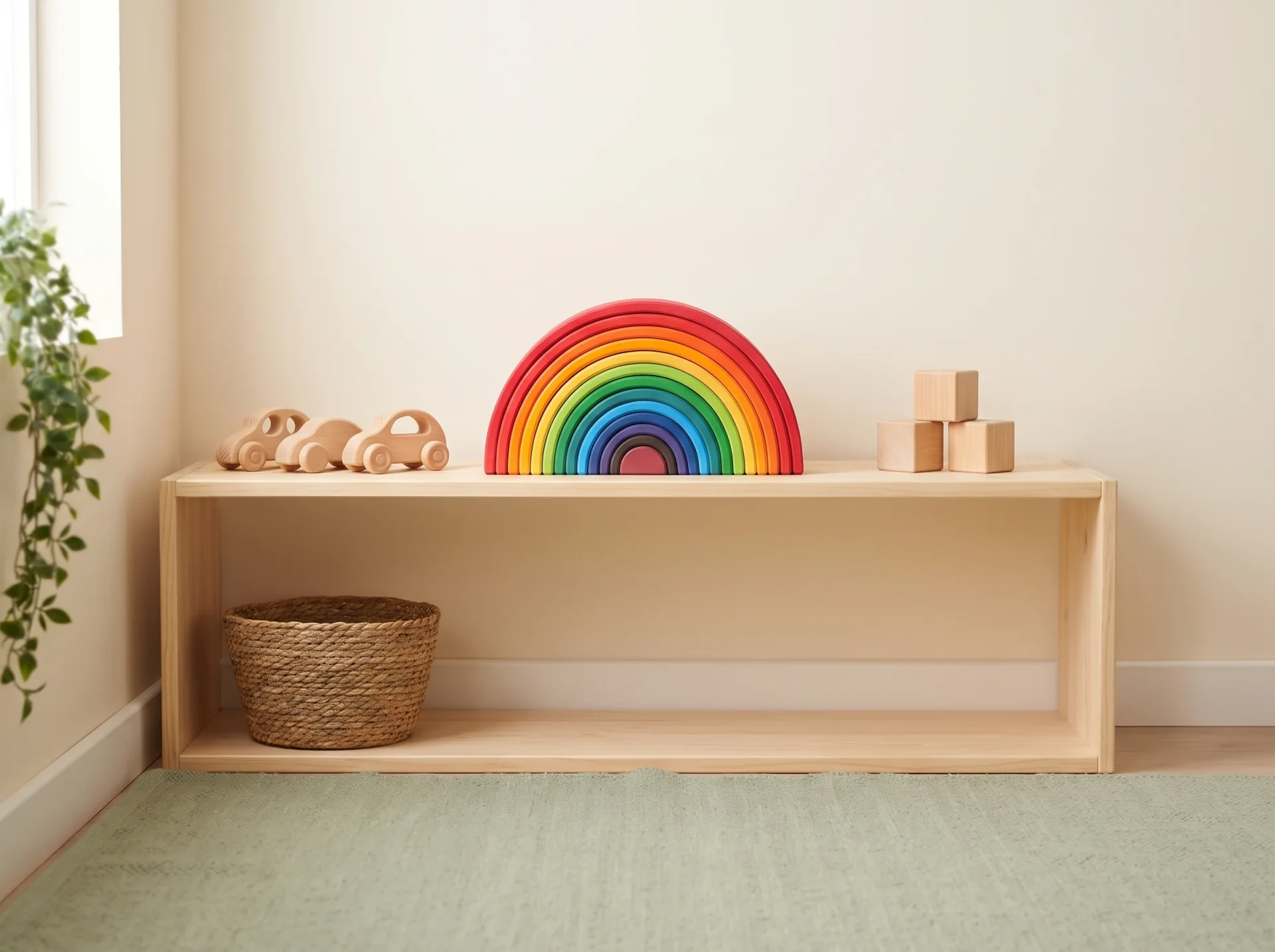
- Keep it low and reachable, on a shelf or tray your child can get to without help.
- Leave a simple invitation. Set two arches beside the rainbow with a car nearby, or line up three arches as a tunnel. A half-finished idea is more inviting than a perfect display.
- Pair, don’t pile. Offer one companion at a time, cars this week and animals next week, instead of a basket of extras.
- Sit nearby and narrate. Describe what you see: “You put the small arch inside the big one.” “The car went under, then through.” That’s the spatial language from the research above, delivered naturally.
Safety and Care Tips
- Stay close while toddlers play, and discourage standing or sitting on the arches, since curved pieces can rock and tip.
- Keep 3+ add-ons such as peg dolls, small balls and figures away from children under 3.
- Check the pieces now and then for chips, cracks or rough spots, and set aside any damaged arch.
- Clean by wiping each arch with a soft, slightly damp cloth and drying it right away. Don’t soak wooden arches or put them in the dishwasher.
One well-made rainbow, a few companions and a grown-up who’s happy to sit on the floor for a while: that’s a play setup that can carry a child from first birthday to kindergarten. Smart play for little growing minds.
Frequently Asked Questions
What age is a wooden rainbow stacker for?
Large rainbows graded for younger children can be enjoyed from about 12 months for simple nesting, rocking and carrying. Most children use rainbows most creatively between 2 and 6, for towers, tunnels, patterns and small-world play. Always follow the age grade on the specific toy, since smaller rainbows and add-ons are often graded 3+.
Is a rainbow stacker a Montessori toy or a Waldorf toy?
It comes from the Waldorf tradition, which favors open-ended natural materials. Montessori materials usually have one specific purpose, so a rainbow isn’t a classic Montessori material, but it fits well in a Montessori-inspired home because it’s simple, made of real wood and easy for children to use independently.
What is the difference between a 6-piece and a 12-piece rainbow stacker?
A 12-piece rainbow has more arches, so it offers more building material and larger outer pieces that are easy for toddlers to grip. A 6- or 7-piece rainbow is smaller and more portable, and it works well for nesting and pattern play.
How do you clean a wooden rainbow stacker?
Wipe each arch with a soft cloth dampened with water, adding a drop of mild soap if needed, then dry it straight away. Avoid soaking, dishwashers and harsh cleaners, which can damage wood and painted finishes.
Is a rainbow stacker a good first birthday gift?
Yes, as long as the rainbow is graded for 12 months and up. It’s one of the few toys a one-year-old can enjoy right away and a five-year-old will still build with, which makes it a thoughtful, long-lasting gift.
References
- Jirout, J. J., & Newcombe, N. S. Building Blocks for Developing Spatial Skills: Evidence From a Large, Representative U.S. Sample — Psychological Science (2015)
- Playing with puzzles, blocks may build children’s spatial skills — Association for Psychological Science via ScienceDaily (2015)
- Playing With Blocks May Help Children’s Spatial and Math Thinking (Verdine et al., Child Development) — Society for Research in Child Development (2013)
- Pruden, S. M., Levine, S. C., & Huttenlocher, J. Children’s Spatial Thinking: Does Talk About the Spatial World Matter? — Developmental Science (2011)
- News release on spatial language and children’s spatial skills (Pruden, Levine & Huttenlocher) — National Science Foundation via EurekAlert! (2011)
- Slow Mapping in Color Word Acquisition Across Languages: A Replication of Wagner et al. (2013) — Frontiers in Developmental Psychology (2025)
- TIMPANI: Ten Years of Studying Toys and Play — Eastern Connecticut State University Magazine (2020)
- The Best Toys Go Back to Basics — American Academy of Pediatrics (2018)
- Best Toys Go Back to the Basics — HealthyChildren.org, American Academy of Pediatrics (2018)
- Small Parts for Toys and Children’s Products — U.S. Consumer Product Safety Commission
- Open-Ended Play — Grimm’s Spiel & Holz Design
Popular with parents right now
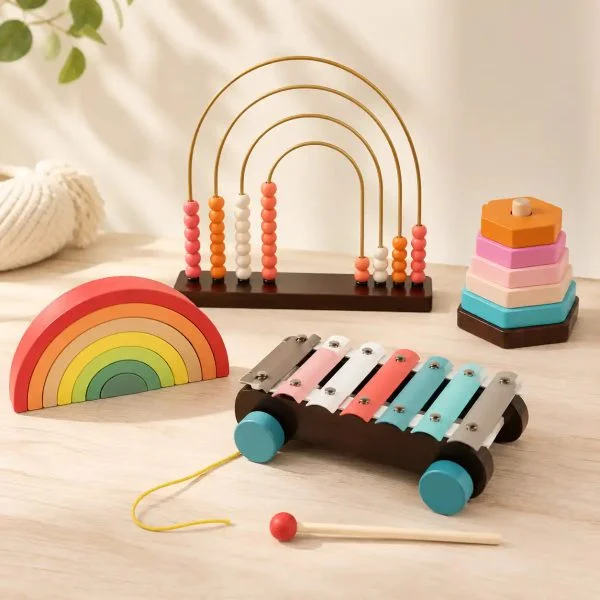
Our best-selling wooden toys, each age-graded and gift-ready.


Keep reading
More Toy Spotlight
Musical Instruments for Toddlers: What They Teach and When to Start
What wooden musical instruments actually teach a toddler, when each type suits their stage, and the volume issue most gift guides skip…
Shape Sorters for Toddlers: What They Teach & When to Start
Shape sorters build fine motor skills, spatial reasoning, and patience. Here's what to expect by age, and how to introduce one without…
Threading and Lacing Toys: The Fine-Motor Skills They Quietly Build
Threading and lacing toys are a quiet fine-motor powerhouse. Here's what they teach, when toddlers are ready, and how to set up…